Mean Reversion vs Trend Following: Which Strategy Fits Your Trading Style?
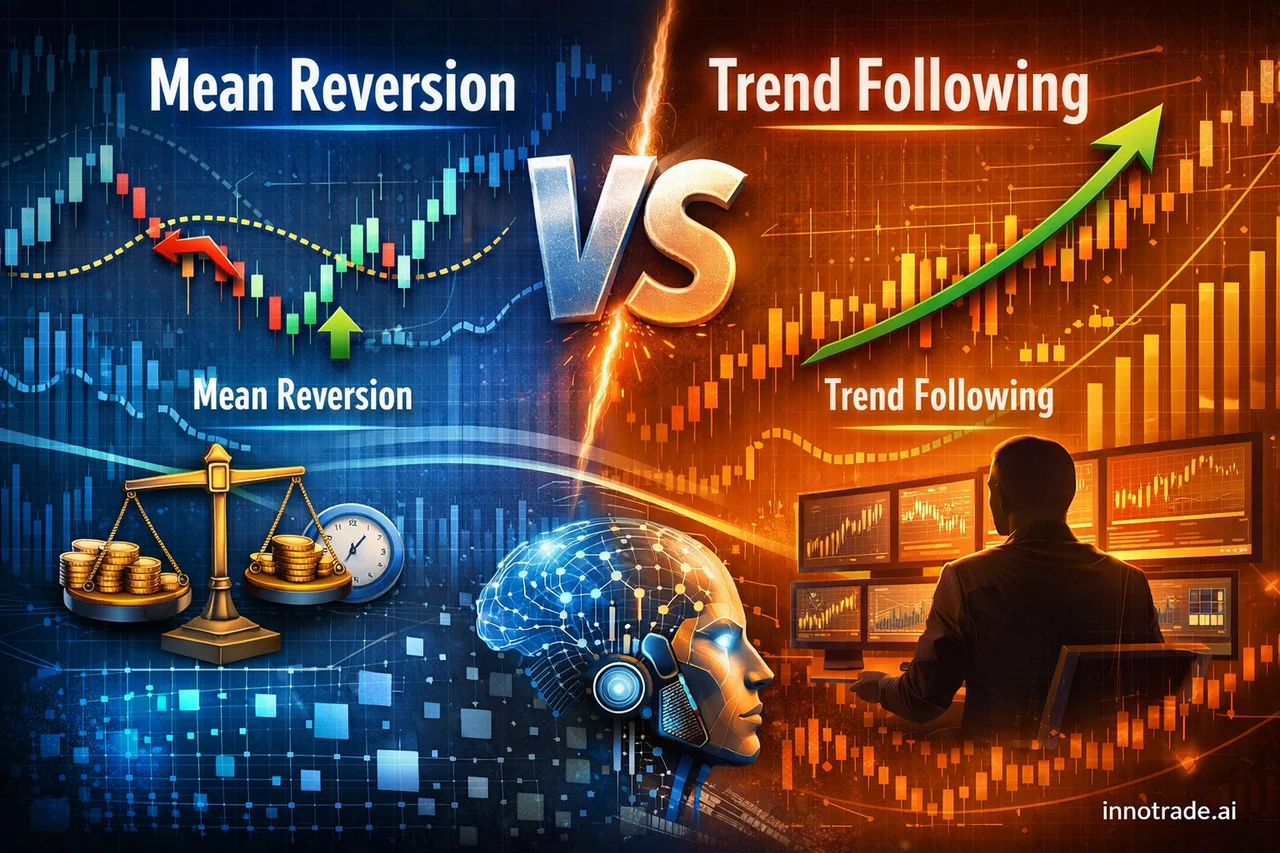
Two philosophies dominate the way retail traders approach the market: mean reversion and trend following. They are not just different strategies — they represent fundamentally opposite beliefs about how price behaves. One says price always snaps back to an average. The other says price, once in motion, tends to stay in motion.
Understanding the real differences between them — not just in theory, but in execution, risk profile, and day-to-day psychological demands — can save you months of frustration. And increasingly, AI-powered platforms like innotrade.ai are generating data that shows exactly when each approach tends to perform best across different instruments and market conditions.
The Core Idea Behind Each Strategy
What Is Mean Reversion?
Mean reversion is the idea that price tends to return to a historical average after extended moves in either direction. When a currency pair or asset has moved significantly away from its typical range, a mean reversion trader expects it to "snap back." The trade is essentially a bet on overextension being corrected.
In practical terms, this often looks like:
- Buying after a sharp, exhaustive sell-off when price is far below a key moving average
- Selling into a parabolic rally when price is stretched well above recent structure
- Fading price into premium and discount zones — a concept from order block and smart money theory where price at the upper range of a value area is considered "expensive" (premium) and price at the lower range is "cheap" (discount)
- Using RSI or Bollinger Bands to identify overextended conditions before entering
Mean reversion strategies tend to produce higher win rates with smaller individual gains. You're right more often, but each win doesn't move the needle dramatically. The danger: when markets trend strongly, mean reversion traders get run over repeatedly — and the losses on those occasions can dwarf the accumulated small wins.
What Is Trend Following?
Trend following works on the opposite assumption: when price establishes directional momentum, it tends to continue. Rather than fading moves, you're joining them — often after a pullback or confirmation signal — and riding the wave until clear evidence of exhaustion or reversal appears.
In practice, this looks like:
- Entering after a displacement candle — a strong, impulsive move that breaks prior structure and signals genuine directional intent rather than noise
- Buying pullbacks to support in an uptrend, rather than selling into strength
- Holding through volatility as long as the higher-level structure remains intact
- Using session bias to align with institutional order flow (e.g., trading GBPUSD long during London if the prior day left bullish structure)
Trend following strategies typically produce lower win rates with larger individual gains. You'll be wrong more often in terms of raw trade count, but the winners stretch far enough to more than compensate. The psychological challenge: sitting through trades that temporarily move against you, and accepting a string of small losses when markets chop sideways.
The Risk-Reward Relationship Is Different for Each
This is where the two approaches diverge most practically, and it's the part most retail traders underestimate before they've traded both for real.
Mean reversion setups often target tighter take-profit levels and use tighter stop-losses placed just beyond the "snap-back" zone. The risk-reward ratio on individual trades tends to be lower — sometimes near 1:1. The strategy's profitability depends heavily on maintaining a high win rate, because you need the edge in frequency to offset the compressed payout per trade.
Trend following setups, by contrast, are designed with multi-stage profit targets and wider stop-losses that give price room to breathe. The risk-reward ratio on individual trades is typically higher — often 2:1 or more. Innotrade.ai's AI analysis is structured precisely around this model, generating three tiered take-profit levels (TP1, TP2, TP3) that allow traders to scale out of positions progressively as a trend extends, rather than forcing a binary outcome.
Across all tracked analyses on the platform, the all-time average risk-reward ratio has held at 1.99, with an overall win rate of 53.9% — a profile that reflects the asymmetric, trend-biased construction of most AI-generated setups. That ratio isn't accidental: it's what makes positive expected value possible even when roughly half of all setups don't reach their full target.
If you want to understand how TP1, TP2, and TP3 levels work structurally — and when it makes sense to bank partial profits versus letting a trade run — the Trading Academy breaks this down step by step.
What Recent Market Data Tells Us
Looking at the past week of AI-tracked analyses on innotrade.ai, the performance picture is instructive. The week opened with a notably difficult session on Monday, June 22 — the weakest day of the period by expected value score, with a win rate of 38.5% and an average RR of 1.78. This kind of session is typical when markets chop without directional conviction — trend-following setups get clipped at stop-loss repeatedly as price fails to follow through after entry.
By contrast, Saturday, June 28 stood out as the strongest session of the period with a win rate of 83.3% and an average RR of 1.76 — a day where the EV score climbed sharply, indicating setups were well-aligned with clean directional movement. Sessions like that reward trend-following entries decisively.
Wednesday, June 24 offered an interesting middle case: a solid win rate of 75.0%, but a lower average RR of 1.24. That combination suggests setups resolved quickly at TP1 and TP2 without many extending to full TP3 — a pattern more consistent with mean-reversion-style compression trades closing fast, rather than extended trend runs. It's a reminder that neither strategy dominates every single session.
Across the full seven-day window, the average win rate hovered in the mid-to-upper 60s percentage range — demonstrating that consistent positive EV is achievable even through choppy and trending sessions alike, provided the risk-reward construction is sound from the outset.
Choosing Based on Your Psychological Profile
Most traders choose a strategy based on what sounds logical — then abandon it based on how it feels during a drawdown. That gap is where most retail accounts are damaged.
Ask yourself honestly:
- Can you tolerate being right less than half the time if your winners are significantly larger than your losers? If yes, trend following suits you. If frequent small losses erode your confidence even when the math is in your favour, it will not.
- Do you feel compelled to "do something" during slow markets? Mean reversion traders often find entries in ranging conditions where trend followers sit on their hands. If you struggle with inactivity, mean reversion gives you more setups — but it also increases exposure to trending-market wipeouts.
- Are you trading a funded account or prop firm challenge? Many prop firm structures penalise drawdowns more harshly than they reward consistent small gains. A trend-following model with structured, tiered exits is often better aligned with those rules than a high-frequency mean-reversion approach where one bad trending week can breach daily loss limits.
How AI Analysis Navigates Both Environments
One of the practical advantages of AI-generated analysis is its ability to identify which regime the market is currently in before committing to a direction. A displacement candle followed by a clean structural shift signals a trending environment. Tight range compression with repeated tests of the same level signals a mean-reversion opportunity.
Rather than forcing a single strategy onto every session, innotrade.ai's AI analysis adapts its entry logic and target placement to match the detected setup type. Scalping setups on volatile instruments like BTCUSD or XAUUSD reflect different parameters than swing setups on a slowly trending forex pair like USDCAD — and both can be tracked transparently through the Trade Tracking dashboard, where users can monitor their own win rates, RR ratios, and performance curves broken down by strategy type.
Over the past two weeks, XAUUSD generated the highest volume of tracked setups across the platform, with strong TP1 follow-through rates that suggest the AI's entry logic was well-calibrated to gold's directional tendencies during that period. XRPUSD also showed consistent TP1 conversions with selective progression to deeper targets — a profile consistent with shorter mean-reversion-style moves within a broader range. AUDJPY, by contrast, showed a high SL hit rate relative to TP hits, suggesting the pair was in a particularly choppy regime where both strategies struggled to find clean follow-through.
For traders who want real-time signals specifically built for quick mean-reversion or momentum-burst setups, the ScalpHunter tool generates confidence-rated scalping opportunities designed for exactly those short-duration, defined-exit trades.
The Practical Takeaway
Mean reversion and trend following are not competing religions — they are tools with different operating conditions. The most resilient retail traders understand both well enough to recognise which one the current market is rewarding, rather than stubbornly applying one approach regardless of context.
If you're still building that framework, start with the FAQ to understand how the platform's analysis is constructed, then use your trade history in the Trade Tracking dashboard to diagnose which setup types your own executions perform best in. The data you accumulate over weeks of tracked trades will tell you far more about your optimal strategy than any theory ever will.
Analytical software only. We do not handle funds, make investments, or provide financial advice. Trading involves substantial risk and past performance does not guarantee future results. Always conduct your own research and consider your risk tolerance before making trading decisions.