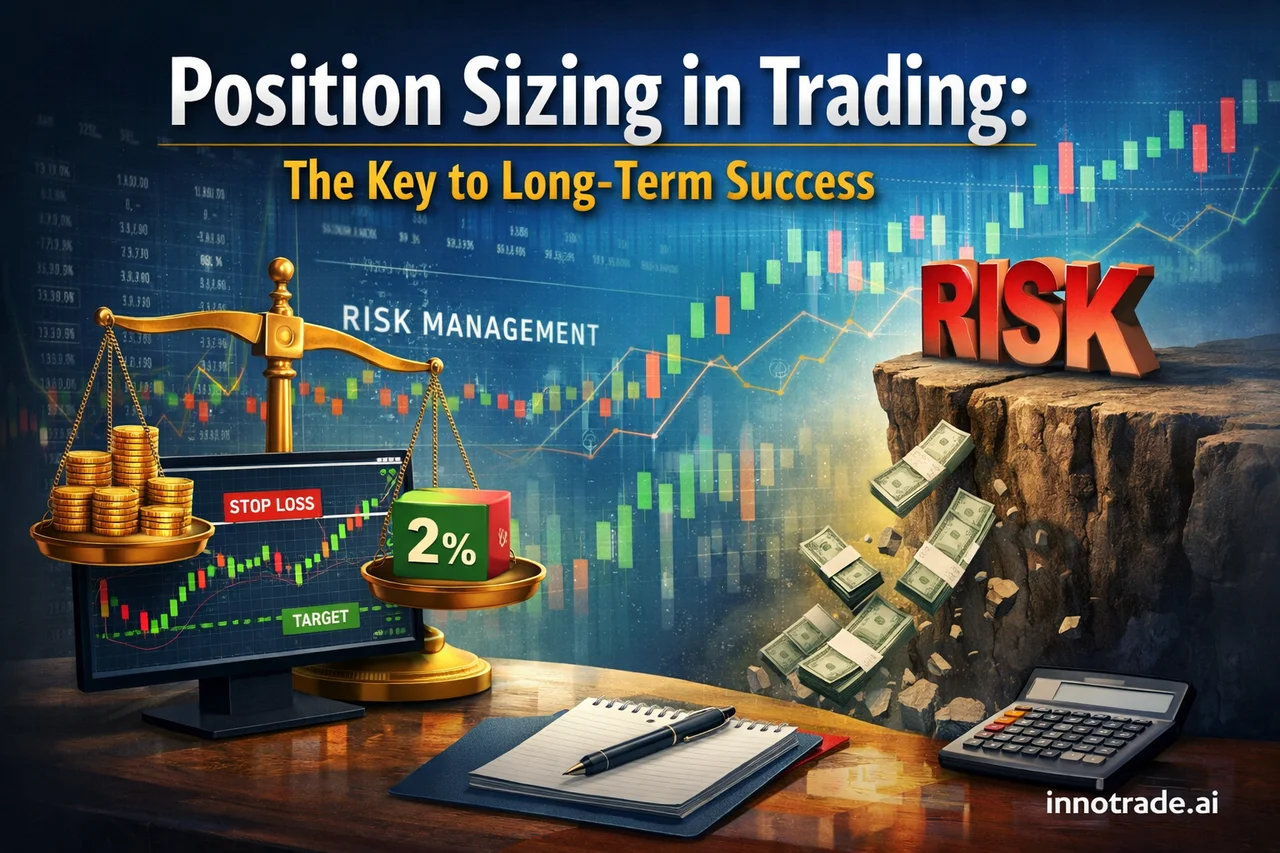
Position sizing is the single most important skill that separates successful traders from those who blow their accounts. It's not about picking winning trades—it's about sizing your trades correctly so that even when you're wrong, you live to trade another day. Yet most retail traders completely ignore this fundamental principle, focusing instead on entry signals while risking far too much capital per trade.
The harsh reality is that you can have the best trading signals in the world, but without proper position sizing, you'll eventually face catastrophic losses. Let's explore how to calculate optimal position sizes and why this skill is essential for anyone using AI-generated trading analysis.
The 2% Rule: Your Capital Protection Foundation
The most widely accepted position sizing rule is to never risk more than 2% of your trading capital on a single trade. This means if you have $10,000 in your account, you should never lose more than $200 on any individual position, regardless of how confident you feel about the trade.
Here's the basic calculation:
Position Size = (Account Balance × Risk Percentage) ÷ Stop Loss Distance
Let's say you're trading EUR/USD with a $10,000 account:
- Account Balance: $10,000
- Risk per trade: 2% = $200
- Stop loss distance: 50 pips (0.0050)
- Position Size = $200 ÷ 0.0050 = 40,000 units (0.4 lots)
This calculation ensures that if your stop loss is hit, you lose exactly $200—no more, no less. The position size adjusts automatically based on how far your stop loss is from your entry point.
Why Most Traders Get Position Sizing Wrong
The biggest mistake traders make is thinking in terms of lot sizes rather than dollar risk. They might say "I always trade 1 standard lot" or "I use 0.5 lots on EUR/USD." This approach completely ignores the actual risk of each trade.
Consider two EUR/USD trades:
- Trade 1: Entry 1.0500, Stop loss 1.0450 (50 pip risk)
- Trade 2: Entry 1.0500, Stop loss 1.0350 (150 pip risk)
If you use the same lot size for both trades, Trade 2 risks three times more capital than Trade 1. This inconsistent risk exposure will destroy your account over time, even if you have more winning trades than losing ones.
Advanced Position Sizing: The Kelly Criterion
For more experienced traders who track their performance statistics, the Kelly Criterion offers a mathematical approach to optimize position sizing based on your historical win rate and average risk-reward ratio.
Kelly Percentage = (Win Rate × Average Win) - (Loss Rate × Average Loss) ÷ Average Win
Using recent platform data where we've observed win rates averaging around 52.3% across the past week with an average risk-reward ratio of 1.64, the Kelly formula would suggest risking approximately 1.8% per trade for optimal growth.
However, the Kelly Criterion can be aggressive. Most professionals use a "fractional Kelly" approach, risking only 25-50% of the full Kelly recommendation to reduce volatility while still optimizing growth.
Position Sizing with Multiple Take-Profit Levels
When using AI analysis with multiple take-profit targets (TP1, TP2, TP3), position sizing becomes more nuanced. The most effective approach is to divide your total position across the profit levels while maintaining your overall risk limit.
For example, with a $200 risk budget:
- 40% of position closed at TP1 (quick profit securing)
- 35% of position closed at TP2 (balanced approach)
- 25% of position held for TP3 (maximum profit potential)
This scaling approach allows you to capture profits at different levels while maintaining consistent risk management. On stronger analysis days—like we observed on April 21st when the platform achieved a 57.1% win rate with a 2.43 average risk-reward ratio—this multi-level approach proved particularly effective at capturing extended moves.
Adjusting Position Size for Market Conditions
Smart position sizing also considers current market volatility and conditions. During high-impact news events or periods of increased volatility, many traders reduce their position sizes by 25-50% to account for unpredictable price swings.
Recent economic data, including upcoming Flash Manufacturing PMI releases and unemployment claims, typically increase market volatility around publication times. During these periods, maintaining your dollar risk while reducing position size (by using wider stops) helps protect against unexpected market gaps or whipsaws.
"The key to trading success isn't being right more often—it's making sure your average winner is larger than your average loser, and position sizing is the tool that makes this possible."
Common Position Sizing Mistakes to Avoid
Revenge Sizing: Increasing position size after a loss to "make back" the money quickly. This is the fastest way to blow an account.
Confidence Sizing: Using larger positions on trades you "feel good about." Even AI analysis with high confidence levels should follow consistent risk management.
Round Number Thinking: Always trading "1 lot" or "0.5 lots" regardless of the actual risk involved.
Account Percentage Confusion: Thinking that risking 2% means buying $200 worth of currency rather than limiting potential loss to $200.
Implementing Position Sizing with AI Analysis
When using AI-generated trade signals, position sizing becomes even more critical because you're following systematic analysis rather than discretionary decisions. The trade tracking dashboard can help you monitor whether you're maintaining consistent position sizing across different market conditions.
Key steps for implementation:
- Calculate your maximum dollar risk before looking at the trade setup
- Measure the distance from entry to stop loss in the AI analysis
- Adjust position size so total risk equals your predetermined amount
- Track results to refine your approach over time
The beauty of proper position sizing is that it allows AI analysis to work its statistical edge over time. Even during challenging periods—like April 19th when win rates dropped to 14.3%—proper position sizing ensures that temporary downturns don't derail long-term account growth.
Building Your Position Sizing System
Start simple: commit to the 2% rule and calculate every position size before entering any trade. As you gain experience and track your performance through the platform's analytics, you can refine your approach based on actual results rather than theoretical models.
Remember, position sizing isn't about maximizing profits on individual trades—it's about creating a sustainable system that compounds gains over hundreds of trades. Master this skill, and you'll join the small percentage of traders who achieve consistent long-term profitability.
For those just starting their trading journey, the Trading Academy provides additional resources on risk management and practical trading concepts that complement proper position sizing techniques.
Analytical software only. We do not handle funds, make investments, or provide financial advice. Trading involves substantial risk and past performance does not guarantee future results. Always conduct your own research and consider your risk tolerance before making trading decisions.