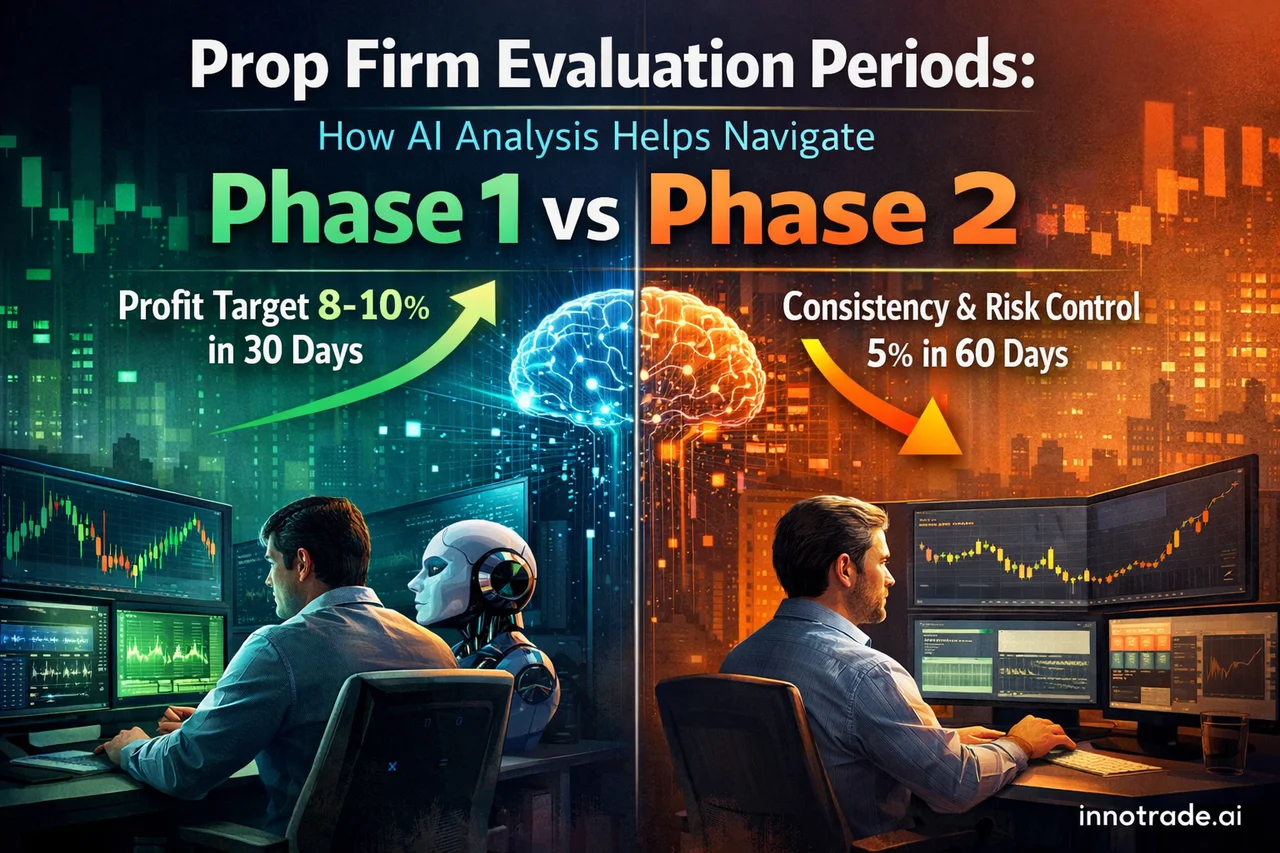
Most funded trading challenges follow a two-phase evaluation structure, but many traders fail because they use identical strategies across both phases. Phase 1 typically demands aggressive profit targets within tight timeframes, while Phase 2 shifts focus to consistency and drawdown management. Understanding how to adapt your approach—and your analytical tools—can dramatically improve your challenge success rate.
The Critical Difference: Profit Targets vs. Consistency Metrics
Phase 1 evaluation periods usually require traders to achieve 8-10% profit targets within 30 days, encouraging more aggressive position sizing and frequent trading opportunities. Phase 2 flips this dynamic entirely, typically requiring only 5% profit over 60 days while maintaining strict daily and maximum drawdown limits. This fundamental shift requires completely different analytical priorities.
During recent platform tracking, this adaptation challenge becomes evident in the data. Over the past week, AI analysis maintained a steady win rate averaging across the tracked days, but the most significant insight comes from comparing high-activity versus controlled-volume periods. Friday, May 15 delivered the strongest performance with an EV score of 1.18, combining an 80.0% win rate with a solid 1.72 average risk-reward ratio across multiple setups. This represents the kind of balanced performance that works well in both evaluation phases.
Contrast this with Saturday, May 16, which showed a weaker EV score of -0.27 on limited market activity. The 33.3% win rate and 1.18 average RR from that session illustrate why prop firm traders need consistent analytical support—even experienced traders can struggle with low-volume weekend conditions that many evaluation periods include.
Phase 1 Strategy: Leveraging High-Probability Setups
Phase 1 success depends on identifying and capitalizing on high-probability trading opportunities quickly. The AI analysis approach during this phase should focus on instruments showing consistent follow-through patterns. Recent data from the past two weeks reveals that EURUSD demonstrated strong progression through multiple take-profit levels, with reliable advancement from TP1 through TP3 completions—exactly the kind of follow-through Phase 1 traders need.
Similarly, AUDUSD showed solid TP-level advancement with multiple complete setups reaching final profit targets. This type of full completion data helps Phase 1 traders identify which instruments are most likely to deliver the substantial moves needed to hit aggressive profit targets within compressed timeframes.
The key to Phase 1 success isn't taking bigger risks—it's finding setups with higher completion probabilities and stronger average risk-reward ratios.
During Phase 1, traders should prioritize analyses with confidence levels above 3/5 from tools like ScalpHunter and focus on major currency pairs and metals that typically offer cleaner technical patterns. XAUUSD has been particularly active recently, generating numerous analysis opportunities, though traders should note that gold's volatility requires careful position sizing even during evaluation periods.
Phase 2 Strategy: Consistency Over Aggression
Phase 2 evaluation fundamentally changes the game. Instead of chasing profit targets, traders must demonstrate they can generate steady returns while maintaining strict risk parameters. This is where AI analysis becomes invaluable for its consistency metrics rather than just its win rates.
The weekly performance data shows exactly why consistency matters more than individual high-win days. While Friday's exceptional session grabbed attention, the steady performance across Monday (77.8% win rate, 1.20 RR) and Wednesday (66.7% win rate, 1.58 RR) better represents the kind of reliable output Phase 2 evaluators want to see. These sessions demonstrate the ability to generate positive expected value consistently without extreme volatility in results.
Phase 2 traders should focus heavily on the Trade Tracking dashboard to monitor their consistency metrics in real-time. The personal analytics help identify when you're maintaining the steady win rates and controlled drawdowns that prop firms reward with funded accounts.
Risk Management Adaptation Across Phases
The most critical adjustment between evaluation phases involves position sizing and risk management. Phase 1's aggressive profit targets might encourage 1-2% risk per trade, while Phase 2's consistency requirements often work better with 0.5-1% risk per position.
AI-generated analysis provides consistent entry points, stop-loss levels, and three-tier take-profit structures (TP1, TP2, TP3) that adapt well to both approaches. During Phase 1, traders might target TP2 or TP3 completions more aggressively to maximize profit per setup. In Phase 2, securing profits at TP1 and scaling out partially can help maintain the steady equity curve that evaluators want to see.
Across all tracked trades, the platform maintains an all-time win rate of 54.2% with an average RR of 2.04, providing the statistical foundation that both evaluation phases require. However, the weekly performance variations show why real-time analysis adaptation matters more than historical averages during active challenges.
Timing and Market Selection
Different evaluation phases may benefit from different market focuses. Phase 1 traders often find success with BTCUSD and major forex pairs during high-volatility sessions, as these instruments can deliver the substantial moves needed to hit profit targets quickly. The recent activity shows consistent opportunities across these markets, with reliable TP-level progressions that support aggressive profit-seeking strategies.
Phase 2 traders might shift toward more predictable instruments with tighter spreads and lower overnight risks. EURUSD's recent consistent performance exemplifies the kind of steady, manageable volatility that works well for consistency-focused trading approaches.
Common Transition Mistakes
The biggest error traders make is failing to adjust their analytical priorities when moving from Phase 1 to Phase 2. Many continue seeking the same high-impact setups that worked in Phase 1, not realizing that Phase 2 rewards steady, consistent performance over dramatic profit spikes.
Another critical mistake involves ignoring the different psychological pressures each phase creates. Phase 1's time pressure can lead to overtrading, while Phase 2's extended timeline can create complacency. AI analysis helps by providing objective, data-driven signals that remove emotional decision-making from both scenarios.
Practical Implementation Strategy
To successfully navigate both evaluation phases, develop a systematic approach that leverages AI analysis differently for each stage. During Phase 1, focus on higher-confidence signals with stronger risk-reward ratios. During Phase 2, prioritize consistency metrics and steady portfolio growth over individual trade performance.
The Analysis platform provides the flexibility to adapt your approach while maintaining the statistical edge that prop firm challenges require. Whether you're pushing for Phase 1 profit targets or maintaining Phase 2 consistency, the key is using analytical tools that provide reliable, repeatable results across different market conditions.
For traders serious about prop firm success, consider exploring the Trading Academy resources that detail specific risk management approaches for funded account challenges, or start with the 7-day free trial to experience how consistent AI analysis can improve your evaluation period performance.
Analytical software only. We do not handle funds, make investments, or provide financial advice. Trading involves substantial risk and past performance does not guarantee future results. Always conduct your own research and consider your risk tolerance before making trading decisions.