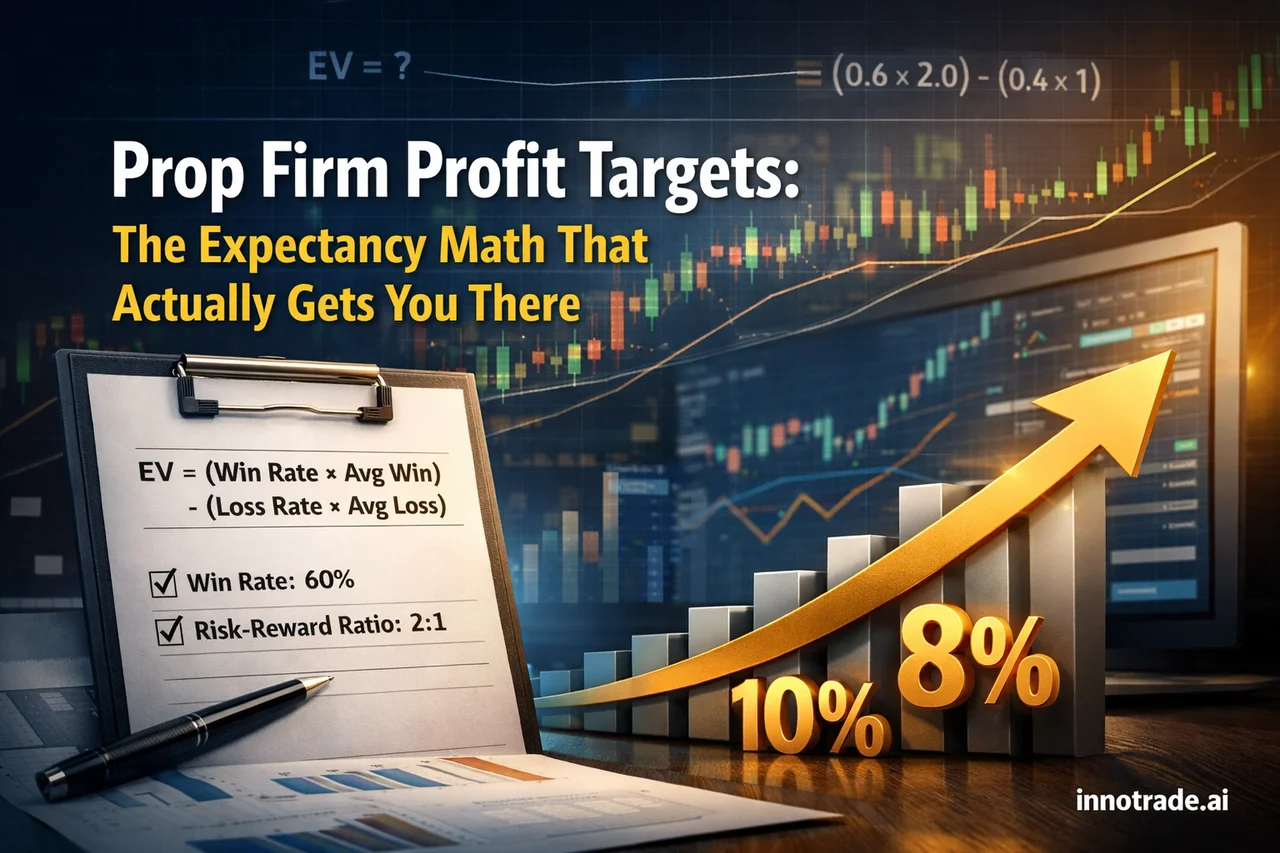
Every prop firm challenge starts with the same number staring back at you: 8%, 10%, sometimes 5% for Phase 2. Traders fixate on that target and respond the only way they know how — by taking more trades, sizing up when behind schedule, or forcing setups that aren't there. Almost none of this is necessary if you understand the actual math behind reaching a profit target, and it starts with two numbers you should already be tracking: your win rate and your average risk-reward ratio.
Profit Targets Are an Expectancy Problem, Not a Volume Problem
A profit target isn't a race to accumulate trades — it's a statement about expected value (EV). Your trading expectancy per trade is calculated as:
EV = (Win Rate × Average Win) − (Loss Rate × Average Loss)
If you risk 1% per trade with an average risk-reward ratio of 2.0 and a 50% win rate, your expectancy per trade is +0.5% of account risk. To reach an 8% target, you'd theoretically need roughly 16 similar trades — assuming consistency, which is the part most traders get wrong. They don't have a stable win rate or RR because they aren't tracking either one closely enough to know what's realistic.
This is where AI-assisted analysis earns its keep. Instead of guessing your edge, you can look at a rolling data set of your own tracked trades — entries, TP levels, stop-loss placement — and calculate real expectancy instead of a hoped-for one. Innotrade.ai's own Trade Tracking dashboard does exactly this for individual users, breaking down win rate, RR, and strategy performance so the math above isn't theoretical — it's your actual number.
What Realistic Expectancy Looks Like in Practice
Over the past seven days of tracked platform activity, aggregated daily win rates averaged roughly 48.6%, with an average risk-reward ratio of approximately 2.01. That blend produces a modestly positive expectancy per trade — nothing dramatic, but consistent, which is precisely what a prop firm evaluation rewards. Prop firms are not testing whether you can post a spectacular week; they're testing whether your process survives contact with 20-30 trading days without blowing through a drawdown limit.
Individual days inside that week tell the more useful story. Monday, September 14 was the strongest session of the period by EV score, combining a 57.1% win rate with an average RR near 3.22 — a day where a handful of trades did most of the expectancy work. Saturday, September 12, by contrast, was the weakest day of the period, with a 33.3% win rate and a tighter 1.19 average RR dragging EV into negative territory. Both days happened in the same week, under the same overall strategy. That's the point: expectancy is a weekly and monthly conversation, not a daily one, and traders who reset their confidence based on a single session are working against their own math.
Across the platform's full tracked history, the all-time win rate has held near 53.7% with an average RR around 2.03 — a useful reminder that short-term dips like September 12 are normal variance sitting inside a longer-term positive curve, not evidence that the approach is broken.
Reverse-Engineering the Target Instead of Chasing It
Once you know your real win rate and average RR — not your best week, your actual rolling average — you can reverse-engineer what a profit target requires:
- Calculate expectancy per trade using your real win rate and RR at your chosen risk percentage.
- Divide the target by that expectancy to estimate the number of trades needed, on average, to reach it.
- Compare that number against your firm's minimum trading days and time limit. If the math says you need 40 trades and you only have 15 trading days at 2 trades a day, either your risk per trade needs adjusting or your timeline is unrealistic.
- Re-run the math weekly, not daily. A single red day like September 12 shouldn't trigger a strategy change; a full week of degraded expectancy should.
This is fundamentally different from the position-sizing conversation prop firm traders usually have. Sizing tells you how much to risk per trade to survive a drawdown limit. Expectancy math tells you whether your strategy, at that size, can realistically reach the target within the time you're given. Both matter, but traders tend to only ask the first question.
Where AI Analysis Fits Into the Target Conversation
The value of structured, data-driven analysis isn't that it guarantees a win rate — no legitimate tool can promise that, and any platform claiming otherwise should be treated with suspicion. The value is that it gives you a consistent, repeatable process to measure against, so your win rate and RR numbers actually mean something over a sample size instead of being three lucky trades in a row. Every AI-generated analysis on the platform comes with a defined entry, three take-profit levels, and a stop-loss — the exact structure you need to calculate expectancy honestly, rather than rounding up in your head after a good week.
For traders who want proof this isn't just marketing language, the Live Trades Scoreboard publicly displays the platform's best-performing tracked analyses from the past two weeks, ranked by achieved risk-reward — a transparency layer, not a strategy tool, but useful for seeing what disciplined RR management looks like when it works.
The Takeaway
Stop treating your profit target as a countdown you're racing against. Treat it as an expectancy equation with your real win rate and RR as the inputs. If those numbers are honestly tracked — through your own trade tracking history or a platform's analysis tool — you'll know well before the challenge deadline whether your current approach can mathematically get you there, and you can adjust risk or timeline accordingly instead of forcing trades in the final week. Traders new to this kind of process-driven thinking can find the foundational concepts in the Trading Academy, and common questions about how tracking and analysis work together are covered in the FAQ.
Analytical software only. We do not handle funds, make investments, or provide financial advice. Trading involves substantial risk and past performance does not guarantee future results. Always conduct your own research and consider your risk tolerance before making trading decisions.