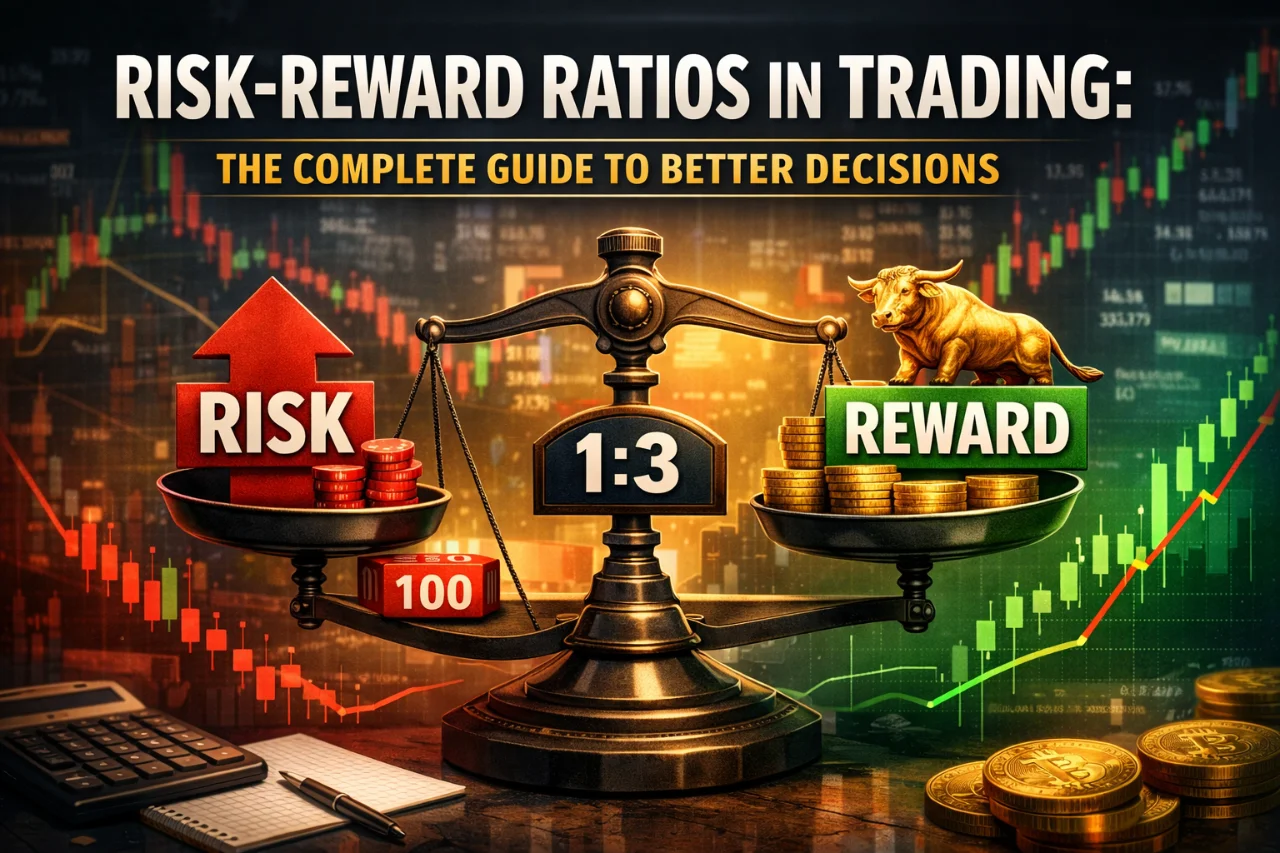
Risk-reward ratio (RR) is arguably the most critical metric separating profitable traders from those who struggle. It's the mathematical foundation that determines whether your trading strategy can survive market volatility and generate consistent returns over time. Yet many traders either ignore it completely or misunderstand how to apply it effectively.
What Is Risk-Reward Ratio?
Risk-reward ratio compares the potential profit of a trade to its potential loss. If you're risking $100 to potentially make $200, your risk-reward ratio is 1:2 (often written as 2.0). The formula is simple:
Risk-Reward Ratio = Potential Profit ÷ Potential Loss
For example, if you buy Bitcoin at $45,000 with a stop-loss at $44,000 and a take-profit at $47,000, you're risking $1,000 to make $2,000 — a 2.0 RR ratio. This metric tells you immediately whether a trade setup offers favorable mathematics.
Why Risk-Reward Ratios Matter More Than Win Rates
Here's where many traders go wrong: they obsess over win rates while ignoring risk-reward ratios. You can be profitable with a 40% win rate if your average winner makes significantly more than your average loser. Conversely, an 80% win rate means nothing if your few losses wipe out many small gains.
Consider two trading approaches:
- Trader A: 80% win rate, 0.5 average RR ratio (risking $200 to make $100)
- Trader B: 40% win rate, 3.0 average RR ratio (risking $100 to make $300)
Over 100 trades, Trader A wins 80 times for $8,000 profit but loses 20 times for $4,000 loss — net profit: $4,000. Trader B wins 40 times for $12,000 profit and loses 60 times for $6,000 loss — net profit: $6,000. The lower win rate trader actually performs better.
Calculating Your Minimum Required Win Rate
Once you know your average risk-reward ratio, you can calculate the minimum win rate needed for profitability. The formula is:
Break-even Win Rate = 1 ÷ (1 + RR Ratio)
If your strategy averages a 2.0 RR ratio, you need: 1 ÷ (1 + 2.0) = 33.3% win rate to break even. Anything above 33.3% generates profit. This mathematical certainty is why professional traders focus on RR ratios first, win rates second.
Real-World Application: AI-Assisted Trading Data
Recent platform data illustrates these concepts perfectly. Over the past week, our AI analysis demonstrated how varying risk-reward ratios impacted daily performance. The strongest trading day achieved a 64.7% win rate with a 2.33 average RR ratio, producing an impressive 1.15 EV score. Meanwhile, a day with similar 61.1% win rate but lower 1.56 RR ratio generated only a 0.56 EV score — nearly half the profitability despite comparable accuracy.
This real-world example proves the mathematical relationship between RR ratios and profitability isn't just theory. Even with AI-generated signals maintaining consistent accuracy, the trades with better risk-reward setups consistently outperformed those with lower ratios.
Setting Realistic Take-Profit and Stop-Loss Levels
The key to achieving good risk-reward ratios lies in intelligent take-profit and stop-loss placement. Your stop-loss should be placed just beyond a significant technical level — support, resistance, or a key moving average. Your take-profit should target the next meaningful resistance (for long trades) or support (for short trades).
Many traders make the mistake of setting arbitrary 1:1 or 1:2 ratios without considering market structure. A 3.0 RR ratio sounds attractive, but if there's strong resistance halfway to your target, you might be setting yourself up for failure. AI-powered analysis excels here by identifying optimal entry and exit points based on multiple technical factors simultaneously.
The Three-Level Take-Profit Strategy
Professional traders often use multiple take-profit levels (TP1, TP2, TP3) to optimize risk-reward ratios while managing position risk. This approach allows you to:
- Secure partial profits at conservative targets (TP1)
- Let remaining position run to higher-probability targets (TP2)
- Hold a small portion for maximum potential gains (TP3)
For instance, you might close 50% of your position at TP1 (2.0 RR), 30% at TP2 (3.5 RR), and 20% at TP3 (5.0+ RR). This strategy reduces overall risk while maintaining upside potential. Our platform's overall statistics show this approach working effectively across different market conditions, with individual trade tracking allowing users to optimize their own multi-level strategies.
Common Risk-Reward Mistakes to Avoid
Moving stops to avoid losses: This destroys your predetermined RR ratio and usually leads to larger losses. Stick to your plan.
Taking profits too early: Fear of giving back gains causes many traders to exit at 1.0 RR when they planned for 2.0 or higher. This systematically reduces your average RR ratio over time.
Ignoring market volatility: A 3.0 RR ratio in a low-volatility market might be unrealistic. Adjust expectations based on current market conditions.
Position sizing errors: Even perfect RR ratios won't save you if position sizes are too large relative to account equity.
Using Technology to Improve RR Ratio Consistency
Manual calculation of optimal risk-reward setups across multiple markets is time-consuming and error-prone. Modern AI-assisted platforms can analyze dozens of technical factors simultaneously to identify trades with favorable RR potential. This systematic approach removes emotional decision-making that often leads to poor RR ratio management.
The ScalpHunter feature, for example, focuses on shorter-timeframe opportunities where quick RR ratio assessment is crucial. By providing confidence levels from 1/5 to 5/5, traders can adjust their RR expectations based on signal strength — requiring higher ratios for lower-confidence setups.
Building Your Risk-Reward Trading Plan
Start by reviewing your recent trades and calculating the actual RR ratio for each. Most traders are surprised to discover their average is lower than expected. Set a minimum RR ratio threshold — many professionals won't take trades below 2.0 — and stick to it religiously.
Track both planned and actual RR ratios. Market conditions might force early exits or extended holding periods. Understanding the gap between planned and realized ratios helps identify areas for improvement in your execution.
Consider using automated analysis tools that calculate RR ratios as part of their signal generation. This removes guesswork and ensures you're seeing mathematically sound trade setups rather than gut-feeling entries.
The Psychology of Risk-Reward Trading
Understanding RR ratios intellectually is different from executing them emotionally. When a trade moves in your favor, the temptation to take quick profits can be overwhelming. When it moves against you, the urge to move your stop-loss "just a little further" destroys your carefully planned ratio.
Successful RR ratio trading requires accepting that many individual trades will hit stop-losses. This is mathematically expected and profitable long-term. Focus on the process, not individual trade outcomes. Structured education can help build the psychological discipline needed for consistent RR ratio execution.
Analytical software only. We do not handle funds, make investments, or provide financial advice. Trading involves substantial risk and past performance does not guarantee future results. Always conduct your own research and consider your risk tolerance before making trading decisions.