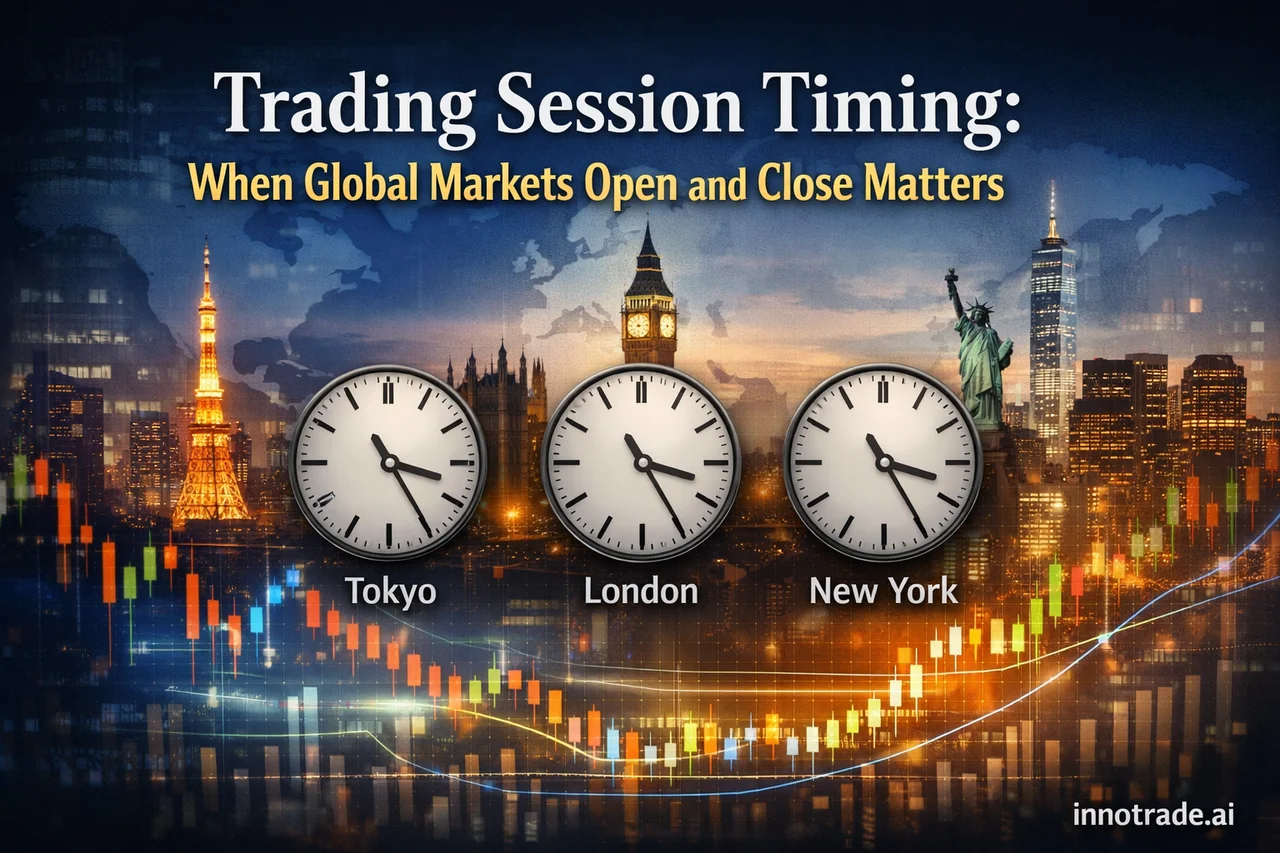
One of the most overlooked aspects of successful trading is timing. While technical analysis and risk management get most of the attention, understanding global trading sessions can be the difference between catching a breakout and missing it entirely. The forex market operates 24 hours a day, but not all hours are created equal.
The Three Major Trading Sessions
Global forex trading revolves around three primary sessions, each with distinct characteristics that affect price movement, volatility, and trading opportunities.
Asian Session (Tokyo): 00:00 - 09:00 GMT
The Asian session, dominated by Tokyo, is typically the quietest of the three major sessions. Currency pairs involving the Japanese Yen (JPY) see the most activity during these hours. Characteristics include:
- Lower volatility and tighter trading ranges
- Consolidation patterns are common
- JPY pairs like USDJPY and GBPJPY show increased activity
- Good for range trading strategies
London Session: 08:00 - 17:00 GMT
London is the forex capital of the world, accounting for roughly 43% of all forex transactions. This session typically sees the highest volatility and trading volume. Key features:
- Major economic news from Europe is released
- EUR and GBP pairs are most active
- Strong trending moves often begin here
- Highest liquidity period for most major pairs
New York Session: 13:00 - 22:00 GMT
The New York session overlaps with London for four hours (13:00-17:00 GMT), creating the most volatile period of the trading day. Characteristics include:
- USD pairs dominate trading volume
- Key US economic data releases
- Commodity currencies (CAD, AUD) see increased activity
- Reversals often occur as the session closes
Session Overlaps: Where the Magic Happens
The most profitable trading opportunities often occur during session overlaps when multiple markets are active simultaneously.
London-New York Overlap (13:00-17:00 GMT)
This four-hour window represents the most liquid and volatile period in forex trading. Major currency pairs like EURUSD, GBPUSD, and USDCAD typically see their largest daily moves during this time. Our AI analysis has shown particularly strong performance on EURUSD during these peak hours, with recent data indicating enhanced volatility leading to clearer technical setups.
Tokyo-London Overlap (08:00-09:00 GMT)
While shorter, this overlap can provide opportunities in EUR/JPY and GBP/JPY crosses as European traders react to overnight Asian developments.
Cryptocurrency and Session Timing
Unlike traditional forex, cryptocurrency markets operate continuously without session breaks. However, they still show patterns based on regional activity:
- Asian hours: Often see movement from South Korean and Japanese crypto markets
- European hours: Institutional activity increases, especially for Bitcoin and Ethereum
- US hours: Highest retail and institutional volume, major news impact
Recent platform data shows that BTCUSD analyses generated during European and US overlapping hours have demonstrated more consistent directional moves, likely due to increased institutional participation during these periods.
Applying Session Knowledge to AI-Assisted Trading
Understanding session timing enhances the effectiveness of AI-generated trading signals in several ways:
Signal Quality Enhancement
AI analysis performs best when market conditions provide clear technical patterns. During high-liquidity sessions, price movements tend to be more decisive and less prone to false breakouts. Over the past week, our platform's analyses showed stronger performance during the London-New York overlap, with the strongest trading day achieving an EV score of 1.57 compared to quieter periods.
Risk Management Considerations
Session timing affects stop-loss placement and take-profit strategies. During the Asian session's lower volatility, tighter stop-losses may be appropriate, while the London-New York overlap might require wider stops to avoid premature exits.
Strategy Adaptation
Scalping strategies work best during high-volatility sessions when quick price movements create frequent opportunities. Our ScalpHunter system adapts its confidence levels based on session timing, providing higher-confidence signals during peak liquidity hours.
Swing trading approaches benefit from session transition points, where daily ranges are established and multi-day trends often begin or end.
Economic News and Session Timing
Major economic announcements are released during specific sessions, creating predictable volatility patterns:
- European data: Released during London session (typically 09:30-10:00 GMT)
- US data: Released during New York session (typically 13:30-15:00 GMT)
- Asian data: Released during Tokyo session (varies by country)
Recent economic events like the ECB Press Conference and Core PCE data releases have demonstrated how session-specific news can create immediate directional moves that AI analysis can capitalize on when timing aligns with market hours.
Practical Session Trading Tips
For Beginners
- Start by focusing on one session until you understand its patterns
- London-New York overlap offers the most opportunities but requires experience
- Asian session is good for learning due to slower, more predictable movements
For Intermediate Traders
- Use session knowledge to filter AI signals - prioritize signals during your chosen session's peak hours
- Monitor how your tracked positions perform across different sessions using Trade Tracking
- Adjust position sizes based on expected session volatility
Weekend Gaps and Session Opens
Pay special attention to Sunday evening when markets reopen after the weekend. Gaps between Friday's close and Sunday's open can create opportunities or risks that AI analysis helps navigate with pre-market preparation.
Technology and Session Trading
Modern AI-assisted platforms adapt to session characteristics automatically. Our analysis engine considers:
- Historical volatility patterns for each session
- Currency pair activity levels during different hours
- News event timing and likely market impact
- Liquidity conditions that affect execution quality
This session-aware approach helps explain why our platform maintains consistent performance across different market conditions, with recent weekly data showing adaptability to varying volatility environments.
Building Your Session Strategy
To effectively incorporate session timing into your trading:
- Identify your available trading hours - which sessions align with your schedule?
- Choose appropriate currency pairs - trade pairs most active during your chosen sessions
- Adjust your strategy - use range strategies during quiet sessions, trend strategies during volatile ones
- Monitor and adapt - use performance tracking to see which sessions work best for your style
The Trading Academy provides additional resources for developing session-specific strategies that complement AI-generated analysis.
Common Session Timing Mistakes
- Fighting the session: Trying to scalp during quiet Asian hours or swing trade during volatile overlaps
- Ignoring news schedules: Entering trades just before major announcements without considering impact
- One-size-fits-all approach: Using the same strategy across all sessions without adaptation
- Overtrading during overlaps: Mistaking volatility for opportunity without proper analysis
Remember: Session timing is a tool to enhance your trading edge, not a guarantee of success. The best session for you depends on your strategy, risk tolerance, and lifestyle constraints.
Understanding session timing transforms trading from random entries to strategic positioning. When combined with AI-powered analysis that adapts to market conditions, this knowledge creates a powerful foundation for consistent trading performance across global markets.
Analytical software only. We do not handle funds, make investments, or provide financial advice. Trading involves substantial risk and past performance does not guarantee future results. Always conduct your own research and consider your risk tolerance before making trading decisions.