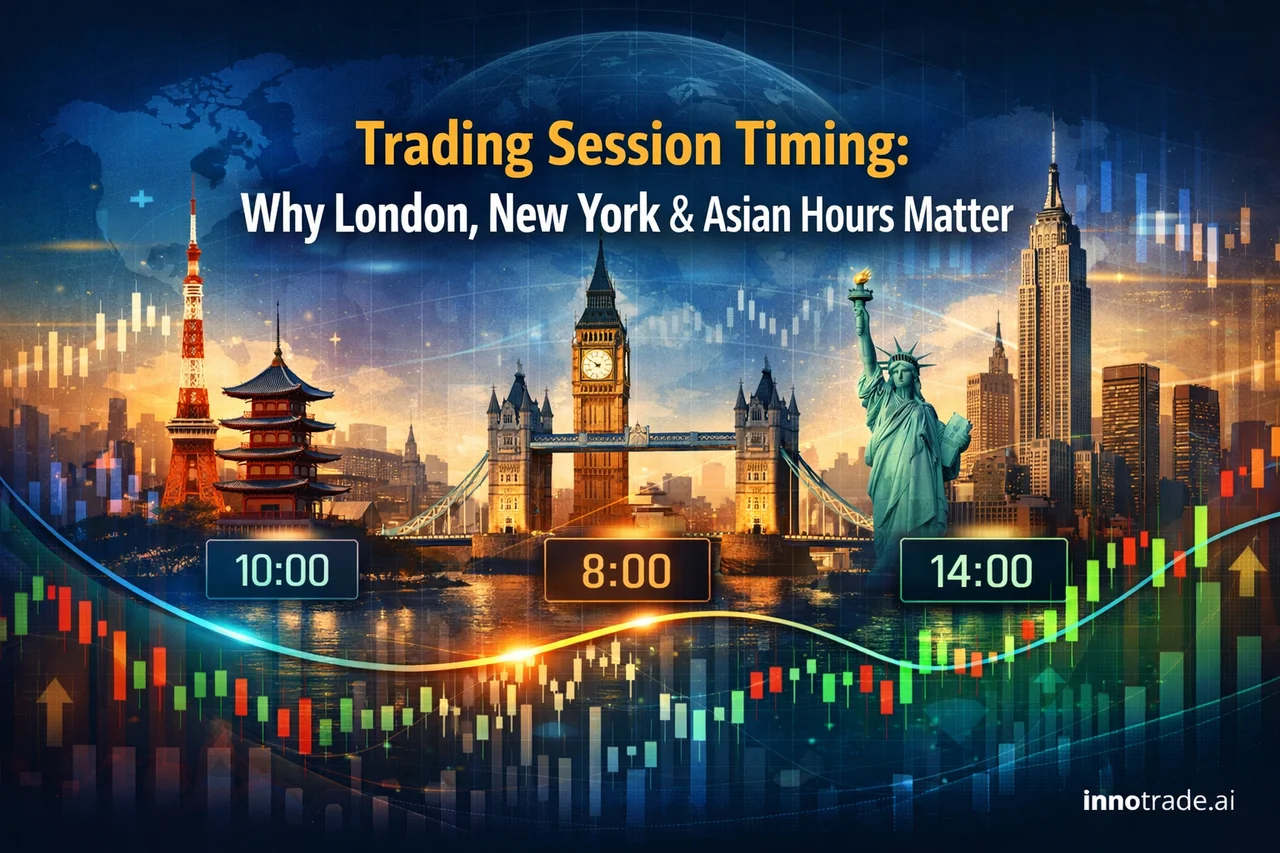
Ask ten traders why a trade failed and at least a few will blame the strategy. Far fewer will consider the actual culprit: timing. The same setup on EURUSD can behave completely differently depending on whether it's placed during the Asian lull, the London open, or the New York overlap. Understanding how sessions interact with volatility, execution, and risk is one of the most underrated skills in a trader's toolkit — and it directly affects how AI-generated analysis should be interpreted and acted upon.
The Three Major Sessions and What They Mean for Volatility
Forex and index markets run on a 24-hour cycle split into three dominant sessions: Asian (Tokyo), London, and New York. Each has a distinct personality. The Asian session tends to be range-bound and quieter, ideal for mean-reversion setups on pairs like AUDJPY or NZDUSD. London brings a sharp liquidity injection and is where many daily trends originate. New York, especially during its overlap with London, typically produces the session's highest volatility — amplified further when economic releases land, such as FOMC member speeches or an ECB President Lagarde address, both of which we track as verified events feeding into our market calendar.
A breakout strategy that works beautifully during the London-New York overlap can produce false signals and premature stop-outs if applied during the thin Asian hours. This is why our AI analysis factors in time-of-day context rather than treating every hour as equal.
Server Time vs Broker Time: Solving the Session Confusion
One of the most common — and avoidable — sources of trader confusion is mixing up server time versus broker time versus their own local time zone. Most brokers run platforms on GMT+2 or GMT+3 server time, which rarely matches your laptop's clock. A trader who thinks "London open" happens at 8:00 their local time but is actually looking at a broker time chart offset by several hours will misjudge exactly when liquidity and volatility are expected to shift. Before trading around session opens, always confirm your platform's server time against a reliable reference, and build session windows around that — not around your phone's clock.
Using Average Daily Range for Session-Appropriate Stops
Average Daily Range (ADR) measures how far an instrument typically moves in a 24-hour period, and it's a far more honest stop-placement tool than an arbitrary pip count. A stop-loss that's reasonable for EURUSD's ADR might be dangerously tight for GBPJPY, which tends to move with much larger daily swings. A practical approach many of our users apply: check the instrument's ADR, place the initial stop at a sensible fraction of that range based on the chosen strategy, and then consider a break-even stop move once TP1 is reached — locking in a no-loss trade while still leaving room for TP2 and TP3 to develop. This single habit — tightening risk after the first target instead of before it — is one of the simplest ways to protect gains without choking off a winning trade too early.
VWAP: A Session-Native Intraday Tool
Volume Weighted Average Price (VWAP) resets at the start of each trading session and tracks the average price paid for an instrument, weighted by volume, from that session open. Because it resets daily, VWAP is inherently session-aware in a way that longer moving averages are not. Intraday traders often use price's position relative to VWAP as a simple bias filter — trading with the trend when price holds above VWAP, and treating a cross below it as a warning sign for long positions. It pairs naturally with session-based thinking: VWAP from the New York open tells a different story than VWAP calculated from the Asian open.
Order Execution Mechanics Across Sessions
Session timing doesn't just affect which setups work — it affects how your orders actually get filled. During the thin liquidity of the Asian session or in the seconds after a high-impact release, requotes become more common: your broker's price moves before your order reaches the server, and you're offered a new price instead of your intended fill. This is more likely with market maker execution than with ECN brokers, who route orders directly to liquidity providers rather than taking the other side of the trade themselves — generally producing tighter, more reliable fills during volatile windows, albeit sometimes with variable commission structures.
For traders who want to catch a breakout without sitting at the screen, an OCO (One-Cancels-the-Other) order lets you place a buy-stop above resistance and a sell-stop below support simultaneously — when one triggers, the other cancels automatically. Just remember to check your pending order expiry setting; an order left active overnight can trigger during a session you never intended to trade, often on much thinner liquidity than you planned for.
Risk Management Doesn't Sleep: Margin, Equity, and Stop-Out Levels
Session gaps and overnight volatility are also where account mechanics matter most. Your equity is your balance adjusted for floating profit or loss on open trades; free margin is what's left available to open new positions after existing ones are accounted for. When equity falls far enough relative to used margin, you'll first hit a margin call warning, and if the slide continues, the broker's stop out level will begin force-closing positions automatically to protect both you and the broker. Negative balance protection, offered by most regulated brokers, ensures you can't end up owing more than you deposited even in an extreme gap move — a meaningful safety net when holding positions across a weekend or a volatile session transition.
Point Value Per Pip for Index CFDs
Index CFDs like the NDX, SPX, and DAX don't use the same pip mechanics as forex pairs — each point of movement has its own fixed monetary value per contract, which varies by instrument and broker. Combined with the fact that indices have their own distinct session hours of peak liquidity, position sizing on NDX during the US cash open requires a different mental model than sizing a EURUSD trade during the London session. Always confirm the point value before sizing an index trade — assuming it behaves like a forex pip is a common and costly mistake.
What Recent Data Shows About Session-Driven Performance
Zooming out to the past week of tracked activity, performance varied meaningfully by day — a pattern consistent with session and news-driven volatility. The strongest session of the period, ranked by expected value, landed on Sunday, November 8, with a win rate near 83.3% and an average RR around 3.03, while the weakest stretch came on Tuesday, November 10, where EV dropped to 0.11 despite a respectable average RR of 2.34 — a reminder that win rate and RR can diverge, and why EV is the more honest measure of trade quality. Averaged across the full week, tracked analyses held a win rate near 57.9% with an average RR close to 2.32, broadly in line with the platform's all-time win rate of 53.6% and all-time average RR of 2.06 across all tracked trades. Friday, November 6 was another standout session, reinforcing that certain days — often tied to session overlaps and scheduled events — consistently produce cleaner setups than others.
You can review your own session-by-session performance patterns directly in Trade Tracking, and verified historical results are also visible on our Live Trades Scoreboard as a transparent record of past outcomes.
Practical Takeaway
Before your next trade, ask three questions: which session am I actually in (by server time, not guesswork), does my stop reflect this instrument's typical daily range, and is my order type suited to the liquidity I expect right now. Traders who are still building this intuition can work through the fundamentals in our Trading Academy, while active scalpers can lean on ScalpHunter for real-time, confidence-rated signals that already account for intraday timing. Whichever approach you take, start with a free trial and let the data — not the clock on the wall — guide your next session.
Analytical software only. We do not handle funds, make investments, or provide financial advice. Trading involves substantial risk and past performance does not guarantee future results. Always conduct your own research and consider your risk tolerance before making trading decisions.