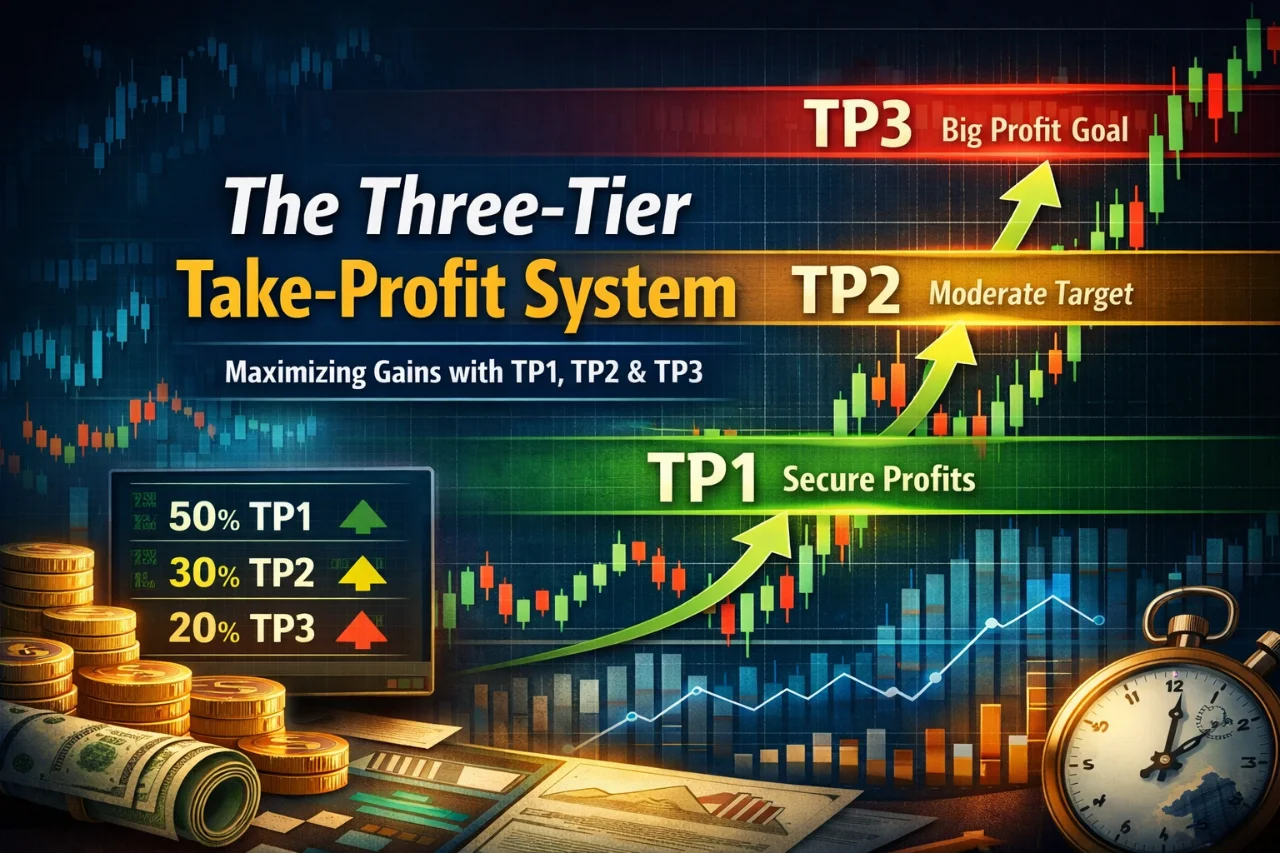
One of the most challenging aspects of trading isn't entering a position—it's knowing when to exit. The three-tier take-profit system (TP1, TP2, TP3) offers a structured approach to profit-taking that balances risk management with profit maximization. This strategy has proven particularly effective in modern AI-assisted trading environments where precise level calculations can significantly impact overall performance.
The Psychology Behind Multiple Take-Profit Levels
Human psychology often works against profitable trading. We tend to exit winning trades too early (fear of losing profits) and hold losing trades too long (hope for recovery). The TP1, TP2, TP3 system addresses this by removing emotional decision-making from profit-taking.
Each level serves a distinct psychological and strategic purpose:
- TP1: Secures early profits and reduces position risk
- TP2: Captures the main move while maintaining exposure
- TP3: Maximizes profits from extended trend moves
This systematic approach prevents the common mistake of "all-or-nothing" exits that can leave money on the table or turn winning trades into losers.
How the Three-Tier System Works in Practice
The effectiveness of tiered profit-taking becomes clear when examining real trading scenarios. Consider a typical forex trade on EUR/USD:
Entry: 1.0850
TP1: 1.0870 (20 pips, 1:1 risk-reward)
TP2: 1.0890 (40 pips, 1:2 risk-reward)
TP3: 1.0920 (70 pips, 1:3.5 risk-reward)
Stop Loss: 1.0830 (20 pips risk)
With proper position sizing, you might allocate 50% of your position to TP1, 30% to TP2, and 20% to TP3. This ensures you capture profits at the most statistically likely level (TP1) while maintaining exposure for larger moves.
Position Sizing Across Multiple Targets
The key to successful multi-level profit-taking lies in intelligent position sizing. A common approach involves:
- 50-30-20 allocation: Half your position exits at TP1, ensuring quick profits
- Equal thirds: 33% at each level for balanced exposure
- Pyramid approach: 60% at TP1, 25% at TP2, 15% at TP3 for conservative traders
The choice depends on your risk tolerance and market conditions. In volatile markets, heavier TP1 allocation protects against sudden reversals. In trending markets, more aggressive TP2 and TP3 allocations can maximize profits.
AI-Optimized Take-Profit Strategies
Modern AI trading analysis has revolutionized how we calculate optimal take-profit levels. Rather than using arbitrary risk-reward ratios, AI systems analyze historical price action, volatility patterns, and market structure to determine statistically probable exit points.
Recent platform data demonstrates this effectiveness. Over the past week, our AI analysis showed varying success rates across the three levels: TP1 targets achieved significantly higher hit rates than TP2 and TP3, as expected, with the best-performing day reaching a 71.4% overall win rate on April 6th. This data reinforces the importance of the tiered approach—while TP3 offers the highest rewards, TP1 provides the most consistent profits.
The AI advantage becomes particularly evident in symbols like BTCUSD and XAUUSD, which have shown strong TP1 performance over the past two weeks. These markets often experience sharp moves followed by retracements, making the early profit-taking at TP1 crucial for overall profitability.
When Markets Don't Cooperate: Managing Partial Fills
Not every trade will hit all three targets. Understanding how to manage partial fills is crucial:
TP1 Hit, Reversal: You've secured profits and reduced risk. Consider this a successful trade even if higher levels weren't reached.
TP1 and TP2 Hit: Excellent execution. Consider moving your stop loss on the remaining TP3 position to breakeven or TP1 level.
Direct Move to TP2: Sometimes price skips TP1 entirely. Your position sizing should account for this scenario.
Adapting to Different Trading Styles
The TP1, TP2, TP3 system adapts well to various trading approaches:
Scalping
TP levels are typically closer together (5-15 pips in forex). The focus is on quick TP1 hits with minimal TP2 and TP3 exposure. Our ScalpHunter system specializes in these rapid-fire opportunities with confidence levels to guide position sizing.
Day Trading
Moderate TP spacing (20-50 pips) allows for intraday moves while avoiding overnight risk. Day traders often use more aggressive TP2 and TP3 allocations since they can monitor positions actively.
Swing Trading
Wider TP levels (100+ pips) accommodate multi-day moves. Swing traders might use equal position sizing across all three levels since they're targeting larger market moves.
Common Mistakes to Avoid
Even with a structured system, traders make predictable errors:
- Over-optimizing TP levels: Placing targets at exact resistance levels where everyone else is selling
- Ignoring market context: Using the same TP spacing in volatile and calm markets
- Poor position sizing: Risking too much on lower-probability TP2 and TP3 levels
- Abandoning the system: Getting greedy and holding through TP1 hits hoping for TP3
Technology Integration and Monitoring
Modern trading platforms make multi-level profit management easier than ever. Features like partial close orders and automated position sizing help implement these strategies consistently.
For users leveraging AI analysis, the Trade Tracking dashboard becomes invaluable for monitoring which TP levels perform best across different market conditions and symbols. This data helps refine your position sizing strategy over time.
The Live Trades Scoreboard also provides transparency into how top-performing analyses utilize multiple TP levels, offering real-world examples of successful implementation.
Building Your TP Strategy Framework
Developing an effective take-profit strategy requires testing and refinement. Start with these steps:
- Analyze your current exit patterns: Are you taking profits too early or too late?
- Define your risk-reward preferences: Conservative traders favor TP1, aggressive traders weight TP2 and TP3 higher
- Test position sizing allocations: Track performance across different allocation methods
- Adapt to market conditions: Trending markets may justify more TP2/TP3 exposure
Remember that the best TP strategy is one you can execute consistently without emotional interference. The three-tier system provides a framework, but your specific implementation should match your trading personality and risk tolerance.
The Future of Profit-Taking
As AI continues to evolve, we're seeing more sophisticated approaches to take-profit optimization. Machine learning algorithms can now analyze thousands of historical scenarios to suggest optimal TP placement based on current market conditions, volatility, and price patterns.
This technological advancement doesn't replace human judgment—it enhances it. Traders who combine AI-generated insights with solid understanding of TP1, TP2, TP3 principles position themselves for more consistent profitability.
The key is remembering that no system guarantees success, but structured approaches to profit-taking significantly improve your odds of long-term trading success. Whether you're using our AI Analysis tools or trading manually, the principles of tiered profit-taking remain fundamental to sustainable trading performance.
Analytical software only. We do not handle funds, make investments, or provide financial advice. Trading involves substantial risk and past performance does not guarantee future results. Always conduct your own research and consider your risk tolerance before making trading decisions.