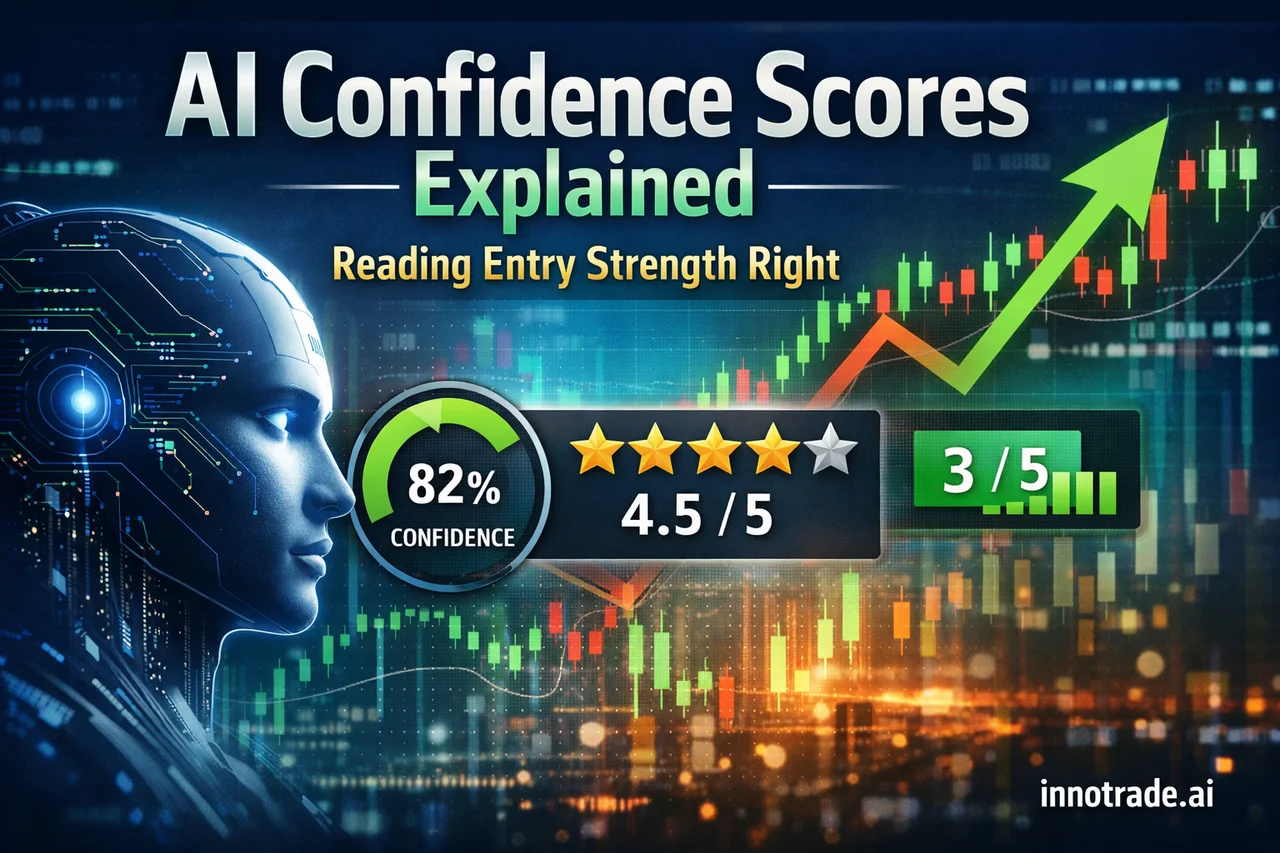
If you've spent any time around AI-assisted trading tools, you've seen it: a signal pops up with a confidence rating attached — maybe a percentage, maybe a star rating, maybe a simple 1-to-5 scale. It looks precise. It looks like certainty. And that's exactly where most traders go wrong with it.
An AI confidence score is not a prediction of outcome. It's a measure of how strongly current market conditions align with the patterns the model was built to recognize. Understanding that distinction — and knowing how to actually use the score — separates traders who extract real value from AI tools from those who either blindly follow every signal or dismiss the whole concept as a gimmick.
What a Confidence Score Is Actually Measuring
When an AI system generates a trade idea — whether that's a full multi-target analysis or a faster scalping call — it isn't pulling a number out of thin air. The confidence rating reflects a combination of factors: how cleanly price structure aligns with the model's training patterns, how current volatility compares to historical norms for that instrument, and how many independent signals within the model's logic are pointing the same direction at once.
On innotrade.ai's ScalpHunter tool, this is expressed directly as a 1-to-5 confidence rating. A 5/5 reading means multiple internal conditions lined up tightly — not that the trade is guaranteed to win. A 2/5 reading doesn't mean the setup is bad; it means fewer confirming conditions were present, so the probability edge is thinner. Treating a 5/5 as "certain" and a 2/5 as "worthless" is the single most common misread of this data.
Why Confidence Thresholds Matter for Position Sizing — Not Just Entry Decisions
The more useful way to think about a confidence threshold is as a dial on your position size, not a binary switch on whether to trade at all. Many experienced users scale exposure to the confidence tier: full planned size on higher-confidence setups, reduced size on lower-confidence ones, rather than skipping low-confidence signals entirely or treating every signal identically.
This is where confidence scoring connects directly to risk-reward structure. A trade idea typically carries three take-profit levels, each representing a different distance from entry. The first level is reached most often, the second less frequently, and the third least often of all — not because the system is inconsistent, but because price naturally has to travel further and survive more noise to hit a deeper target. A higher confidence reading doesn't change that decay pattern; it simply reflects a stronger starting probability that the move materializes at all. Traders who understand this tend to scale out progressively rather than holding for a single all-or-nothing exit — a concept worth exploring further in our Trading Academy.
What Recent Data Actually Shows About Signal Variability
It's worth being honest about something here: even a well-built AI model has good weeks and rough weeks, because markets themselves are inconsistent. Looking at the platform's tracked performance over the past seven sessions, the daily win rate swung noticeably — from a standout session early in the week down to a stretch where conditions clearly worked against the signals, before recovering again toward the end of the period. The strongest session of the week, ranked by expected value rather than win rate alone, posted an EV score above 2.1 with a healthy average risk-reward ratio near 2.5. The weakest session of the same week landed with a negative EV score, a reminder that no confidence rating — AI-driven or otherwise — eliminates drawdown periods.
Averaged across the full week, the win rate sat in the high-40s percentage range with an average risk-reward ratio hovering around 1.9 — a reasonable reflection of normal week-to-week variance rather than a one-off lucky stretch. This is exactly why relying on a single day's figures, or a single high-confidence signal, to judge a system's edge is a mistake. Edge shows up over a sample, not a snapshot.
Reading Confidence Scores Alongside Instrument Behavior
Confidence thresholds also interact with the instrument itself. Over the past two weeks of tracked activity, pairs like AUDJPY saw a high volume of analysed setups but a comparatively lower hit-through rate to deeper profit targets — typical of a cross that chops more than it trends. BTCUSD, by contrast, showed stronger follow-through toward its later take-profit levels, consistent with how trending crypto moves tend to reward patience once a confirmed direction is established. Neither pattern means one instrument's signals are "better" — it means the confidence score has to be read in context of how that specific market typically behaves.
A Practical Framework for Using Confidence Scores
- Treat high confidence as reduced uncertainty, not guaranteed direction. Size up moderately, not maximally.
- Treat low confidence as a smaller, not forbidden, opportunity. A thinner edge is still an edge if your risk is sized appropriately.
- Judge performance over a run of trades, not a single signal. Use a proper trade tracking dashboard to see your personal hit rate across confidence tiers over time, rather than reacting to any one outcome.
- Respect the TP structure. Don't expect a high-confidence signal to hit every target just because the entry looked clean.
Across all tracked trades on the platform historically, the all-time win rate has held near 53.5% with an average risk-reward ratio around 2.05 — figures that reflect a genuine, if modest, statistical edge built up over a large sample, not a promise of what any individual trade will do. You can review the full feature set, including how confidence scoring fits into the broader analysis engine, or compare verified historical outcomes on the Live Trades Scoreboard, which exists purely as a transparent record of past results.
The Takeaway
An AI confidence score is a probability lens, not a crystal ball. The traders who get the most out of it aren't the ones who only take 5/5 signals or who ignore scoring altogether — they're the ones who adjust size and expectations to match the strength of the read, track their own results honestly, and accept that even the strongest setup is still a probability, not a certainty. If you're new to the platform, the 7-day free trial is a practical way to observe how confidence scoring behaves across a real sample before committing capital to any single tier.
Analytical software only. We do not handle funds, make investments, or provide financial advice. Trading involves substantial risk and past performance does not guarantee future results. Always conduct your own research and consider your risk tolerance before making trading decisions.