Understanding the Two Main Trading Cost Structures
Every retail trader faces a fundamental choice when selecting a broker: commission-based pricing or spread-based pricing. This decision significantly impacts your profitability, especially when using AI-assisted trading tools that may generate multiple signals throughout the day.
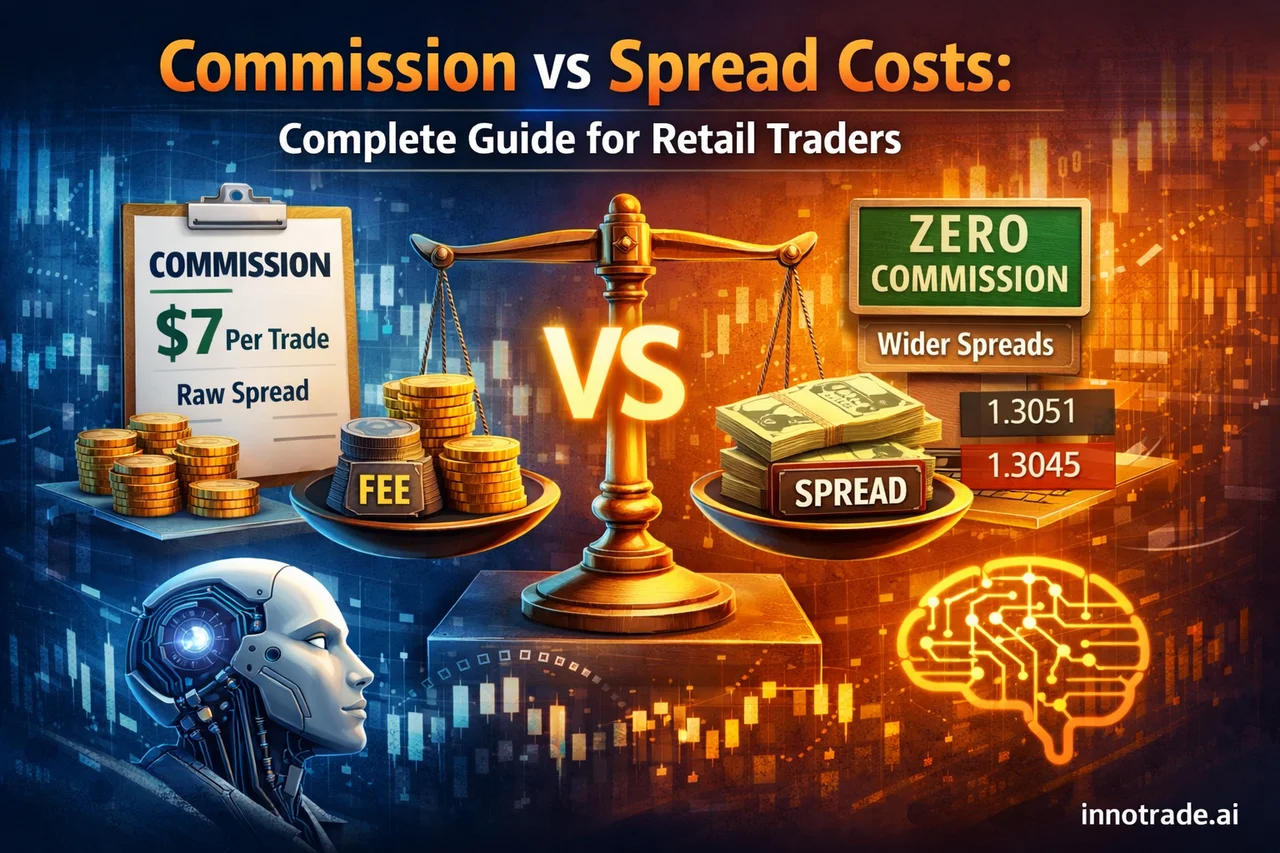
Commission-based brokers charge a fixed fee per trade (typically $3-7 per side) plus a raw spread that represents the true market price difference between bid and ask. Spread-based brokers build their profit into wider spreads while advertising "commission-free" trading.
Commission Structure Breakdown
Commission brokers offer transparency but require careful calculation of total costs. A typical structure might charge $7 per 100k lot plus a raw spread of 0.1-0.3 pips on EUR/USD. For a standard lot trade, you pay:
- $7 commission to open
- $7 commission to close
- 0.2 pips average spread cost = $2
- Total cost: $16 per round trip
The advantage becomes clear with larger position sizes. Whether you trade 0.1 lots or 2.0 lots, the commission remains $14 total, while the raw spread scales proportionally with position size.
Spread-Based Pricing Reality
"Zero commission" brokers typically widen spreads to 0.8-2.0 pips on major pairs during normal market hours. Using the same EUR/USD example with a 1.2 pip spread:
- $0 commission
- 1.2 pips spread cost = $12
- Total cost: $12 per round trip
This appears cheaper initially, but the cost structure favors smaller traders and penalizes volume. The spread widens significantly during news events or low liquidity periods, sometimes reaching 3-5 pips when you need to execute most urgently.
How Trading Style Impacts Cost Efficiency
Your optimal choice depends heavily on trading frequency and position sizing. Scalpers and day traders executing 10+ trades daily often benefit from commission structures despite higher per-trade costs, as raw spreads provide more predictable execution quality.
Swing traders holding positions for days or weeks typically prefer spread-based pricing, as the fixed commission becomes a larger percentage of potential profits on longer-term trades.
Recent platform data shows interesting patterns across different trading approaches. Over the past week, the AI analysis generated signals across multiple timeframes with varying cost implications. Wednesday, June 10 delivered the strongest expected value performance with a 70.6% win rate and 2.08 average risk-reward ratio, demonstrating how execution quality during volatile periods can significantly impact profitability regardless of fee structure.
The Hidden Cost: Execution Speed and Slippage
Beyond advertised costs lies execution quality - the difference between the price you see and the price you get. Commission brokers often provide faster execution and less slippage because they profit from volume, not from trader losses.
Spread-based brokers may introduce requotes, delayed execution, or asymmetric slippage that costs more than the commission savings. When trading AI-generated signals with specific entry levels, execution speed becomes critical to achieving the intended risk-reward ratios.
"The cheapest broker on paper often becomes the most expensive in practice when slippage and execution delays compound over hundreds of trades."
Cost Analysis for Different Account Sizes
Small accounts ($1,000-$5,000): Spread-based pricing usually offers better value due to smaller position sizes. Commission costs can consume 2-3% of account value monthly with active trading.
Medium accounts ($5,000-$25,000): Break-even point where either structure works, depending on trading frequency. Calculate total monthly costs under both models.
Large accounts ($25,000+): Commission structures become increasingly advantageous as raw spreads provide significant savings on larger position sizes.
Platform Integration and Cost Optimization
AI trading analysis platforms can help optimize cost efficiency by providing clearer entry and exit signals, reducing the number of low-confidence trades that generate unnecessary costs. The ScalpHunter system, for example, provides confidence levels from 1/5 to 5/5, allowing traders to focus on higher-probability setups and avoid marginal trades that primarily benefit brokers.
Over the past week's data, tracking individual trade outcomes shows how proper signal selection can minimize trading frequency while maintaining profitability. The strongest day this period combined a high win rate with an optimal risk-reward ratio, suggesting that quality over quantity approaches reduce total trading costs while improving net results.
Evaluating Your Current Broker Costs
Calculate your true trading costs by tracking these metrics for one month:
- Total round-trip commission payments
- Average spread paid per trade (use screenshots before entry)
- Instances of slippage beyond expected spread
- Overnight financing charges for held positions
- Currency conversion fees for non-base currency trades
Most traders underestimate their total costs by 30-50% when they don't account for execution quality and hidden fees.
Making the Switch: Transition Strategy
If analysis shows your current broker is suboptimal, plan the transition carefully. Test execution quality with small positions before transferring large accounts. Many traders maintain accounts with both commission and spread-based brokers, using each for their optimal trade types.
Consider opening a small account with an alternative broker structure and tracking comparative costs over 30 days of similar trading. This provides real data for decision-making rather than theoretical calculations.
The Trade Tracking dashboard can help monitor performance differences across broker accounts, providing concrete data on how fee structures impact your specific trading patterns and outcomes.
Advanced Cost Considerations
Professional traders consider additional factors beyond basic commissions and spreads:
Market access: Commission brokers often provide direct market access (DMA) or electronic communication networks (ECN) that offer better liquidity and price discovery.
Data feeds: Real-time market data quality affects entry timing, especially for short-term strategies guided by AI analysis.
Regulatory environment: Different broker jurisdictions offer varying levels of protection and leverage limits that impact cost calculations.
The goal isn't finding the cheapest broker, but optimizing total cost of trading including opportunity costs from poor execution. A slightly higher commission structure that provides better fills often generates superior net returns for active traders.
Analytical software only. We do not handle funds, make investments, or provide financial advice. Trading involves substantial risk and past performance does not guarantee future results. Always conduct your own research and consider your risk tolerance before making trading decisions.