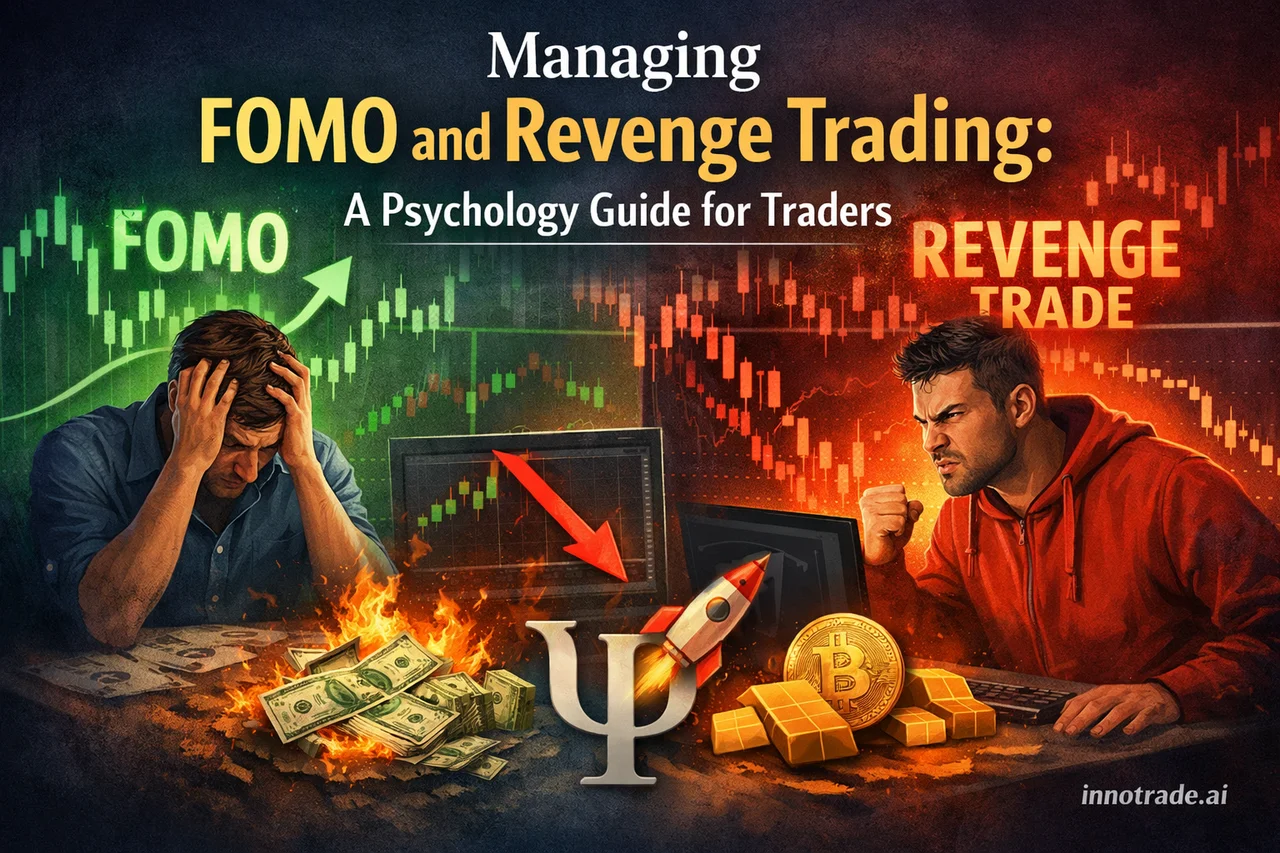
Most traders don't blow up their accounts because they lack a good strategy. They blow up because of what happens after a loss, or after watching a move they didn't catch. Two psychological patterns — FOMO (fear of missing out) and revenge trading — are responsible for more damaged accounts than any indicator failure or bad entry ever could be. Understanding these triggers, and building systems that counteract them, is one of the highest-leverage skills a retail trader can develop.
What FOMO and Revenge Trading Actually Look Like
FOMO shows up when a market makes a strong, visible move — say XAUUSD rips $30 in an hour, or BTCUSD breaks a key level with obvious momentum — and a trader jumps in late, without a plan, purely because they don't want to miss further upside. There's no defined stop-loss logic, no confirmed setup, just urgency.
Revenge trading is the mirror image. A trade hits stop-loss, and instead of stepping back, the trader immediately re-enters — often larger size, often the same instrument — trying to "win back" the loss in the next five minutes. Both behaviors share the same root cause: the trader has stopped following a process and started reacting to emotion.
Why These Triggers Are So Powerful
FOMO and revenge trading both hijack the same mental shortcut: the brain treats a missed opportunity or a fresh loss as an urgent problem that needs immediate correction. But markets don't reward urgency — they reward patience and consistency. A single emotionally-driven trade, sized outside your normal risk parameters, can undo weeks of disciplined, rule-based gains.
The market will always offer another setup. It will never offer you back the capital lost to an emotional decision that ignored your own rules.
Building a Trading Journal for Pattern Recognition
One of the most effective countermeasures is learning how to read a trading journal for pattern recognition — not just logging wins and losses, but tagging why each trade was taken. Over a few weeks, clear patterns tend to emerge: perhaps most of your losing trades cluster right after a previous stop-loss, or most of your FOMO entries happen during high-volatility news windows. Once you can see the pattern in writing, it becomes much harder to repeat unconsciously.
This is where structured tracking tools help. Platforms like innotrade.ai's Trade Tracking dashboard let you review your own analyses over time — performance graphs, win rates, and strategy breakdowns that make emotional blind spots visible instead of anecdotal. If you notice your win rate consistently drops on trades taken within minutes of a prior loss, that's not bad luck — that's a psychological pattern worth addressing directly.
Position Sizing Calculators Reduce Emotional Trading
Another practical defense is mechanical: pre-committing to position size before you ever see a live chart move. Position sizing calculators reduce emotional trading because they remove the in-the-moment decision of "how much should I risk on this one" — a question that gets answered very differently when you're calm versus when you're chasing a loss. If your risk per trade is fixed at a defined percentage of account equity before the session starts, there's no room for a revenge trade to suddenly become 3x your normal size.
Letting the Data Do the Talking
This is also where AI-assisted analysis earns its value — not by removing emotion entirely, but by giving you a defined entry, stop-loss, and three take-profit levels (TP1, TP2, TP3) before the trade begins. Traders often scale out at each TP level rather than holding for an all-or-nothing outcome, which naturally reduces the temptation to abandon the plan mid-trade. When the analysis and the risk parameters are already set, there's less psychological space for FOMO to creep in after the fact.
Looking at the past week of tracked platform activity illustrates the point well. Across the seven days of data, win rates swung from a difficult session with roughly a 25.0% win rate and an average RR of 1.06, up to a standout session where nearly every setup lined up — the kind of day that could easily tempt an undisciplined trader into oversized follow-up bets the next morning. The strongest session by expected value came midweek, posting a healthy win rate alongside an average RR above 3.4, while the weakest session by EV score came later in the week with that lower win rate and compressed RR. A trader reacting emotionally to either extreme — doubling down after the strong day or forcing trades to recover the weak one — would have ignored the actual lesson: performance varies day to day, and the edge shows up over a sample, not a single session.
Across all tracked trades on the platform, the broader picture has held at an all-time win rate near 53.8% with an average RR around 2.03 — figures that only make sense in aggregate, not judged trade-by-trade or day-by-day. That's precisely the mindset revenge trading violates: it treats one outcome as the whole story instead of one data point in a larger series.
A Practical Framework to Interrupt the Cycle
- Set a daily loss limit before you start. Decide in advance how many consecutive losses trigger a full stop for the day — and honor it regardless of how the next setup looks.
- Separate the decision from the emotion. Use a pre-built analysis with defined entry, stop-loss, and TP levels so the plan exists before the emotional trigger does.
- Review, don't react. Log every FOMO or revenge impulse in your journal even if you didn't act on it — this builds self-awareness faster than reviewing executed trades alone.
- Use transparency as a reality check. Public performance records, such as the Live Trades Scoreboard, are useful reminders that even strong results are built from a mix of outcomes over time — not a single lucky trade to chase.
The Takeaway
FOMO and revenge trading aren't signs of weakness — they're predictable psychological responses that every trader experiences. The traders who last are the ones who build systems, journals, and sizing rules that catch the impulse before it becomes a trade. If you're still building that discipline, the Trading Academy covers risk management fundamentals in more depth, and the AI Analysis tool can provide the structured entry, stop, and target framework that makes it easier to stick to a plan when emotions run high. Questions about how tracking or analysis works day to day are also covered in the FAQ.
Analytical software only. We do not handle funds, make investments, or provide financial advice. Trading involves substantial risk and past performance does not guarantee future results. Always conduct your own research and consider your risk tolerance before making trading decisions.