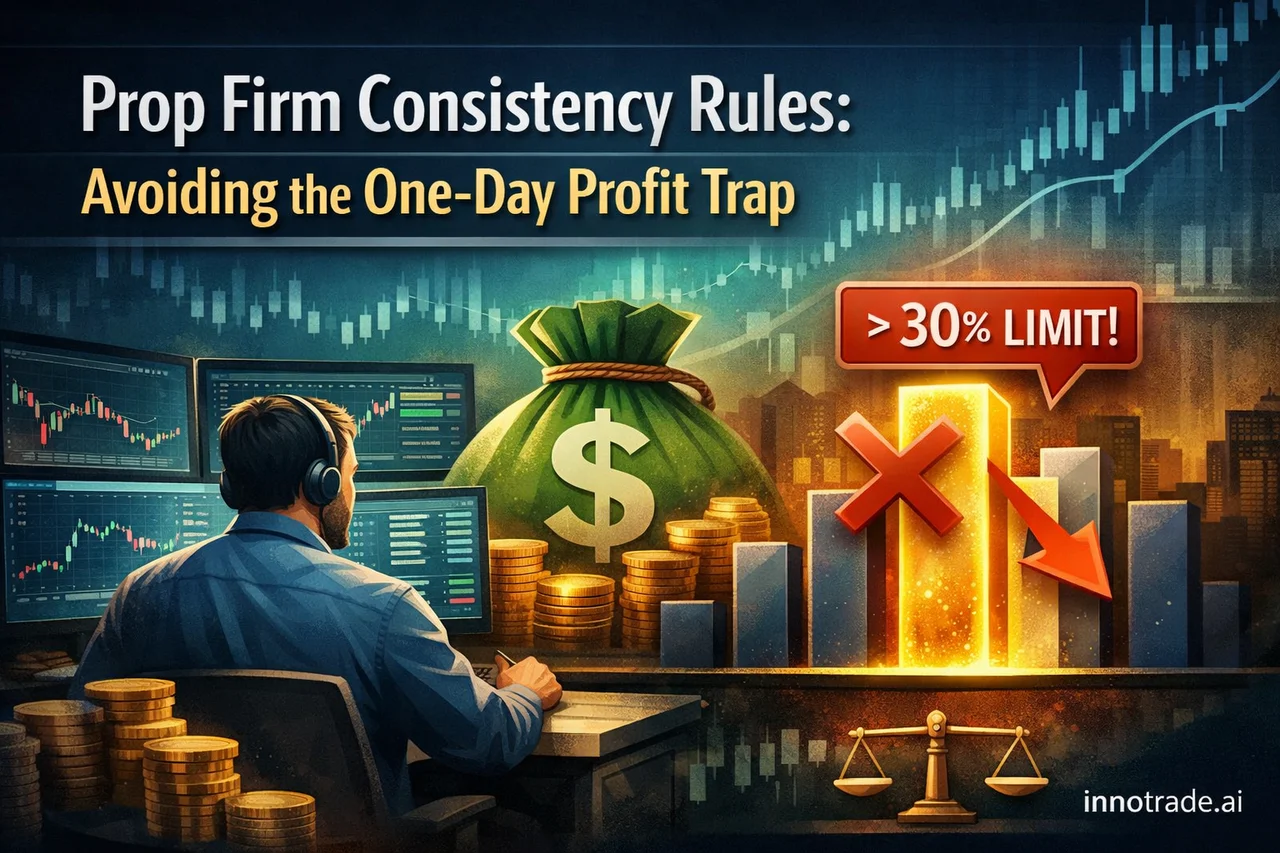
Most traders preparing for a prop firm challenge focus on two things: hitting the profit target and staying under the drawdown limit. Far fewer pay attention to a third requirement that quietly disqualifies a surprising number of otherwise successful challenge attempts — the consistency rule.
A consistency rule typically states that no single trading day can account for more than a set percentage (often 20-30%) of your total profit during the evaluation or payout period. The logic makes sense from the firm's side: they want evidence of a repeatable process, not a trader who got lucky on one volatile news day and coasted on that result. But for traders, it means a single oversized win — the exact kind of trade everyone dreams about — can actually work against you if it dwarfs the rest of your trading period.
Why Consistency Rules Catch Traders Off Guard
The problem isn't usually bad trading. It's uneven trading. A trader might go three weeks producing modest, steady gains, then catch a huge breakout on a Non-Farm Payrolls release or a surprise CPI print that nets 40% of their entire profit target in one session. Objectively, that's a great trade. Under a consistency rule, it can mean a rejected payout or a reset requirement, because the firm can't distinguish a well-managed breakout trade from a lucky swing.
This is precisely where high-volatility, high-importance news events deserve extra caution. Data releases like Non-Farm Employment Change or Unemployment Rate prints are exactly the kind of catalyst that produces outsized single-day moves — valuable for your account balance, potentially problematic for your consistency ratio. Traders chasing funded accounts need to think not just about whether a setup is good, but whether winning big on it will distort their profit distribution.
Where Steady, Data-Backed Analysis Helps
This is one of the more underrated advantages of working from structured, AI-generated trade analysis rather than impulse-driven trading: the output tends to produce a steadier distribution of outcomes across a week rather than one dramatic session carrying the whole account. Looking at the platform's own tracked data over the past seven days illustrates the point well.
Across the week, the average win rate on tracked analyses landed at roughly 57.3%, with an average risk-reward ratio around 2.05 and an average daily EV score of approximately 0.80 — a reasonably stable baseline rather than one spike pulling the numbers up. That stability matters more for consistency-rule compliance than any single blockbuster day ever could.
Within that week, performance wasn't flat — it never is in live markets. Midweek, on Tuesday, September 29, conditions were clearly tougher: the win rate dropped to 33.3% with an average RR of 1.13, producing a negative EV score of -0.29, the weakest session of the period. By contrast, Friday, September 25 showed healthier follow-through, with a 75.0% win rate and an average RR of 1.96 for an EV score of 1.22. And the standout session of the week — Sunday, September 27 — produced an EV score of 2.67, the strongest of the seven days, reflecting a stretch where the setups lined up unusually well across the tracked analyses. Days like that are exciting to look back on, but from a consistency-rule perspective, the real value is that it was one strong day among several solid ones — not the only good day in an otherwise flat week.
What This Looks Like at the Symbol Level
The same pattern shows up when comparing instruments. Over the past two weeks, AUDJPY and BTCUSD both maintained consistent TP1 follow-through across a high volume of tracked setups, suggesting steadier, more repeatable behavior rather than a handful of oversized wins. XAUUSD, on the other hand, went through a notably weak stretch recently, with tracked setups failing to reach their profit targets — a useful reminder that no instrument or analysis engine is immune to rough patches, and that risk management has to hold regardless of which pair is in focus.
Building a Consistency-Friendly Trading Habit
If you're working toward a funded account with a consistency rule in your contract, a few practical habits help:
- Cap position size on high-volatility news days. If a release like Average Hourly Earnings or Core CPI is on the calendar, consider trading smaller size even on a high-confidence setup, specifically to avoid one trade skewing your weekly profit distribution.
- Track your own daily P&L distribution, not just your total. Reviewing performance through Trade Tracking lets you see your win rate, RR, and daily breakdown in one place — which makes it far easier to spot an uneven profit curve before a prop firm reviewer does.
- Favor repeatable setups over one-off home runs. Scalping and day trading strategies that produce smaller, more frequent wins are often easier to keep consistency-rule compliant than swing trades that occasionally produce oversized single-day gains.
- Use structured analysis as a discipline check, not a crutch. Reviewing the Analysis output alongside your own judgment helps you avoid both over-trading and the temptation to let one big winner carry an entire week.
It's also worth noting that steady performance isn't something you need to take on faith. The platform's verified statistics — published transparently and synced with Myfxbook — exist specifically so traders can review historical performance for themselves rather than relying on marketing claims. Across all tracked trades, the platform has maintained an all-time win rate of 53.6% with an average RR of 2.04 — a figure that reflects the kind of steady baseline consistency-rule compliance depends on, rather than a few exceptional sessions propping up the average.
The Takeaway
Consistency rules exist because prop firms are trying to fund traders who can repeat their process, not traders who got one trade spectacularly right. The fix isn't to avoid big winning days — it's to make sure they're part of a broader pattern of steady, risk-managed execution rather than the entire story. If you're preparing for a challenge, spend as much time reviewing your daily profit distribution as you do your overall win rate. For traders new to structured risk management concepts, the Trading Academy covers the fundamentals, and the FAQ addresses common questions about how tracked performance data is calculated and verified.
Analytical software only. We do not handle funds, make investments, or provide financial advice. Trading involves substantial risk and past performance does not guarantee future results. Always conduct your own research and consider your risk tolerance before making trading decisions.