The Hidden Challenge Inside Prop Firm Evaluations
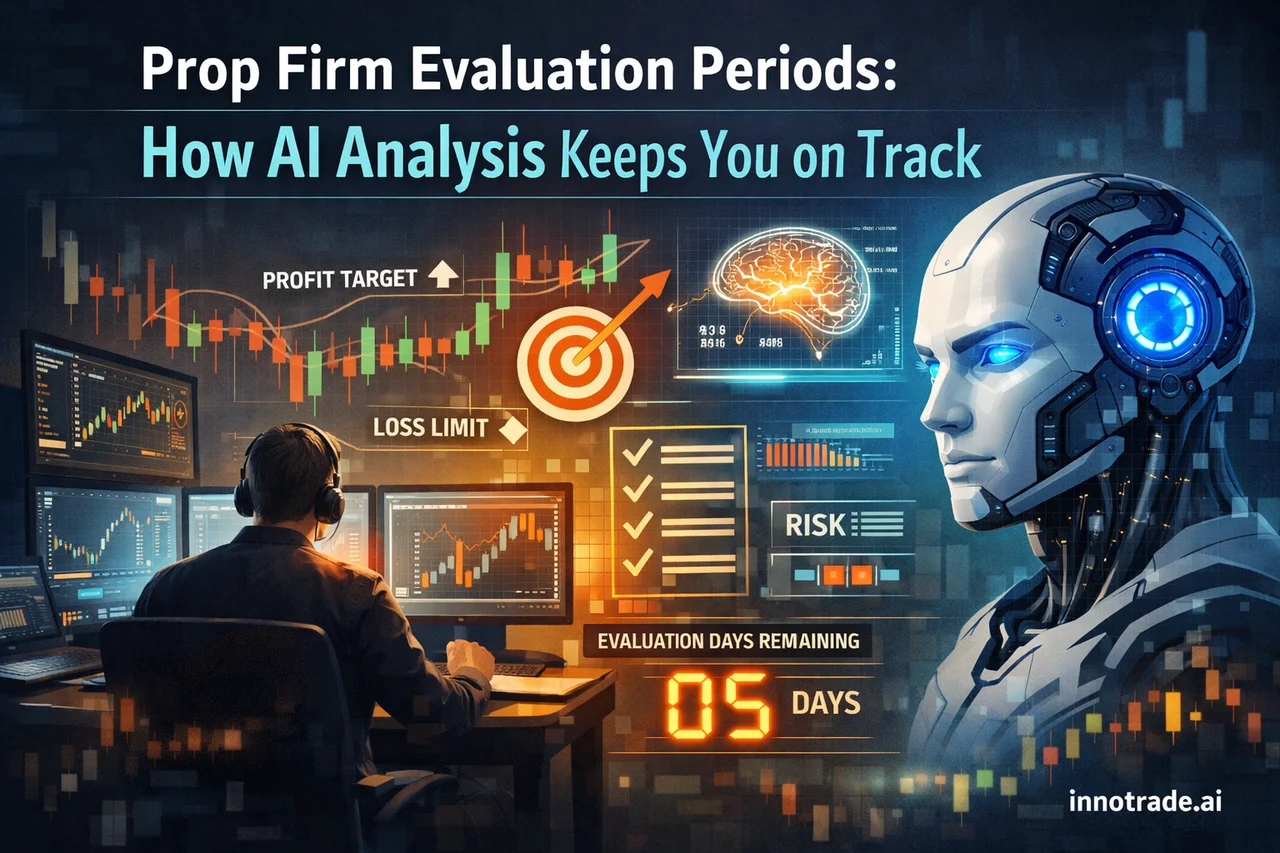
Most traders who fail a prop firm challenge don't blow the account in one dramatic trade. They fail gradually — through a slow erosion of discipline, inconsistent position sizing, or a string of low-quality setups taken out of impatience. The evaluation window creates a unique psychological pressure: a hard deadline, a profit target looming ahead, and a loss limit that punishes any moment of recklessness.
This is precisely the environment where AI-assisted analysis earns its value. Not because it removes risk — nothing does — but because it provides a structured, repeatable framework for identifying setups, sizing positions, and managing exits across the entire evaluation period, not just on your best days.
What Prop Firms Are Actually Testing
Before exploring how AI analysis supports evaluation performance, it helps to understand what prop firms are genuinely evaluating. Despite the profit target being the most visible metric, what evaluators are really looking for is consistency under constraints. Specifically:
- Maximum daily loss compliance — can you stop trading when the day turns against you?
- Maximum total drawdown management — is your equity curve controlled, or does it spike and crash?
- Positive expectancy over time — do your winning trades outweigh your losers on a risk-adjusted basis?
- Strategy consistency — are you trading the same way on day 20 as you were on day 1?
Notice that three out of four of those criteria have nothing to do with raw profit. They are about process, restraint, and repeatability. AI-generated analysis directly addresses all of them.
The Risk-Reward Alignment Problem
One of the most common mistakes during a prop firm evaluation is letting risk-reward discipline slip as the deadline approaches. A trader who is 2% short of their profit target with three days remaining will often start forcing trades — widening targets, tightening stops, or entering setups that don't meet their normal criteria. This is where most challenges unravel.
AI-generated analyses solve this by providing pre-calculated entry points, stop-loss levels, and three distinct take-profit targets (TP1, TP2, and TP3) before a trade is placed. The trader's job becomes execution and position sizing — not on-the-fly decision-making under pressure. This separation of analysis from execution is enormously valuable when emotions are running high near the end of an evaluation window.
Structurally, the three-level exit system also maps well onto prop firm risk management. A trader can take partial profit at TP1 to lock in a small gain, reduce exposure, and let the remainder run toward TP2 or TP3. This approach reduces the temptation to hold a full position through volatility and protects against giving back gains — a behaviour that frequently triggers daily loss limit breaches late in an evaluation.
For a deeper understanding of how the TP1-TP2-TP3 structure works in practice, the Trading Academy covers multi-target exit management in detail.
What This Week's Data Shows About Consistency
Prop firm evaluations typically run for 30 to 60 calendar days, but your performance quality is assessed trade by trade. Looking at innotrade.ai's performance data from the past week illustrates something important: even in a strong week, individual days vary considerably — and that variance is normal, manageable, and not a reason to deviate from your process.
Across the seven days tracked, the week produced a meaningful spread of outcomes. The strongest session of the period — Saturday, June 28 — delivered an exceptionally high win rate alongside a solid average RR, reflected in an EV score of 1.30, the highest of the week. That kind of session is genuinely rare and shouldn't be treated as a baseline. More representative were the mid-week sessions: Wednesday, June 25 logged a win rate of 75.0% with an average RR of 1.24, while Tuesday, June 24 delivered a 66.7% win rate paired with a notably high average RR of 1.94, resulting in the second-strongest EV score of the week at 0.96.
The weakest day by EV score was Thursday, June 26, with a win rate of 43.8% and an average RR of 1.65 — a perfectly ordinary underperformance that any serious trader should expect to encounter. Crucially, even on that weaker day, the average RR remained well above 1.0. That means the setups identified still had a positive expected value structure; the win rate simply ran below its typical range.
For a prop firm trader, this is the critical lesson: a single weak day does not invalidate the system. If your analysis framework maintains a positive-expectancy structure even on off days, your equity curve should remain manageable as long as position sizing is controlled. The traders who fail evaluations are not usually the ones who have bad days — they are the ones who respond to bad days by abandoning their framework entirely.
You can monitor your own analyses day-by-day throughout a challenge using the Trade Tracking dashboard, which gives you a personal breakdown of performance statistics, win rates by strategy, and equity progression — exactly the kind of structured review that keeps prop firm traders accountable.
Instrument Selection During an Evaluation
Not all instruments behave equally across an evaluation window, and the data from recent performance highlights meaningful differences worth considering.
Over the past two weeks, gold (XAUUSD) dominated tracked volume and demonstrated consistent TP1 follow-through, with a solid proportion of setups progressing beyond TP1 toward deeper targets. For prop firm traders, this matters because gold's combination of liquidity, clear structure, and active volatility makes it a reliable vehicle for consistent analysis — it rarely gaps unexpectedly or freezes at key levels the way lower-liquidity pairs can.
USDCAD also showed a notably high proportion of TP3 completions relative to its total analysed setups over the same period, suggesting strong directional follow-through when entries aligned. Meanwhile, AUDJPY presented a more mixed picture — high volume of setups but lower conversion to deeper TP levels — a reminder that not every instrument suits every market environment, and that disciplined instrument selection is part of the process.
During a prop firm evaluation, it is worth focusing on instruments where your AI analysis has historically performed well, rather than chasing volatility in unfamiliar pairs simply because they are moving. The AI Analysis tool covers a wide range of forex pairs, metals, indices, and crypto — but that range is an option, not a requirement. Trade the instruments where your data supports confidence.
Managing the Psychological Weight of the Deadline
The evaluation deadline is the single most corrupting influence on trader behaviour during a prop firm challenge. It introduces a time dimension that normal trading doesn't have, and it creates cognitive distortions — particularly the tendency to oversize positions when behind target or to overtrade on the final days of the window.
One practical counter to this is tracking expected value (EV) rather than just profit or loss. If your analysis is generating positive-EV setups consistently, the profit target should accumulate naturally over a 30-day window without forcing anything. innotrade.ai's EV score — which combines win rate and risk-reward into a single quality metric — is displayed publicly in the daily data, and users can see this reflected in their own analyses through the personal dashboard.
Across all tracked trades on the platform, the all-time win rate sits at 53.9% with an average RR of 1.99. At those figures, a trader who sizes positions consistently and doesn't deviate from their process should comfortably generate positive expectancy over a 30-60 day evaluation window — which is exactly the timeline most prop firm challenges operate on. That is not a performance guarantee; markets are unpredictable and individual results vary. But it illustrates that the analytical framework, applied consistently, is built for the kind of sustained performance prop firms want to see.
If you have questions about how the platform's analysis aligns with specific prop firm rules, the FAQ covers common platform questions that can help clarify the setup.
Practical Steps for AI-Assisted Prop Firm Trading
Here is how to structure your evaluation approach using AI-generated analysis:
- Set a daily risk budget before markets open — decide the maximum you'll risk that day, expressed as a percentage of your challenge account, not a dollar amount. This disconnects your sizing from emotions.
- Only trade analyses that match your strategy type — if your challenge rules require day trading, don't act on swing trade setups. The platform distinguishes between scalping, day trading, and swing trading strategies.
- Use TP1 as your floor — in the early phase of an evaluation, prioritise TP1 hits. Lock in gains, build your buffer, then take more aggressive positions toward the final phase when your cushion allows it.
- Review your personal analytics weekly — use the Trade Tracking dashboard to assess whether your win rate and RR are tracking in line with what the analysis is producing. If they're not, the gap is almost always in your execution, not the signal quality.
- Don't revenge trade after a bad day — the data from this week shows that a weak EV day is not a trend; it's noise. Stay with the process.
The Bottom Line
Prop firm evaluations are won by traders who can maintain discipline and positive expectancy over an extended window — not by traders who have one spectacular week. AI-assisted analysis provides the structural consistency that makes this possible: pre-defined entries, pre-set exits, and performance data that shows you exactly where your process is working and where it isn't.
The evaluation window is not your enemy. Inconsistency is. Use the tools, respect the data, and trade the process — not the deadline.
New to the platform? A 7-day free trial gives you full access to test AI analysis across the evaluation instruments and strategies before committing to a subscription tier.
Analytical software only. We do not handle funds, make investments, or provide financial advice. Trading involves substantial risk and past performance does not guarantee future results. Always conduct your own research and consider your risk tolerance before making trading decisions.