The Rule That Ends More Challenges Than Any Losing Trade
Most traders entering a prop firm challenge focus on hitting the profit target. That's understandable — it's the finish line. But the rule that actually eliminates the majority of funded applicants isn't the daily loss limit or even the maximum drawdown ceiling. It's the trailing drawdown — a moving threshold that follows your equity upward and never comes back down.
Understanding how trailing drawdown works, and how to trade around it with genuine discipline, is arguably the most important skill a funded trader can develop. AI-assisted analysis doesn't replace that discipline — but it can reinforce it in ways that manual trading rarely achieves alone.
What Trailing Drawdown Actually Means
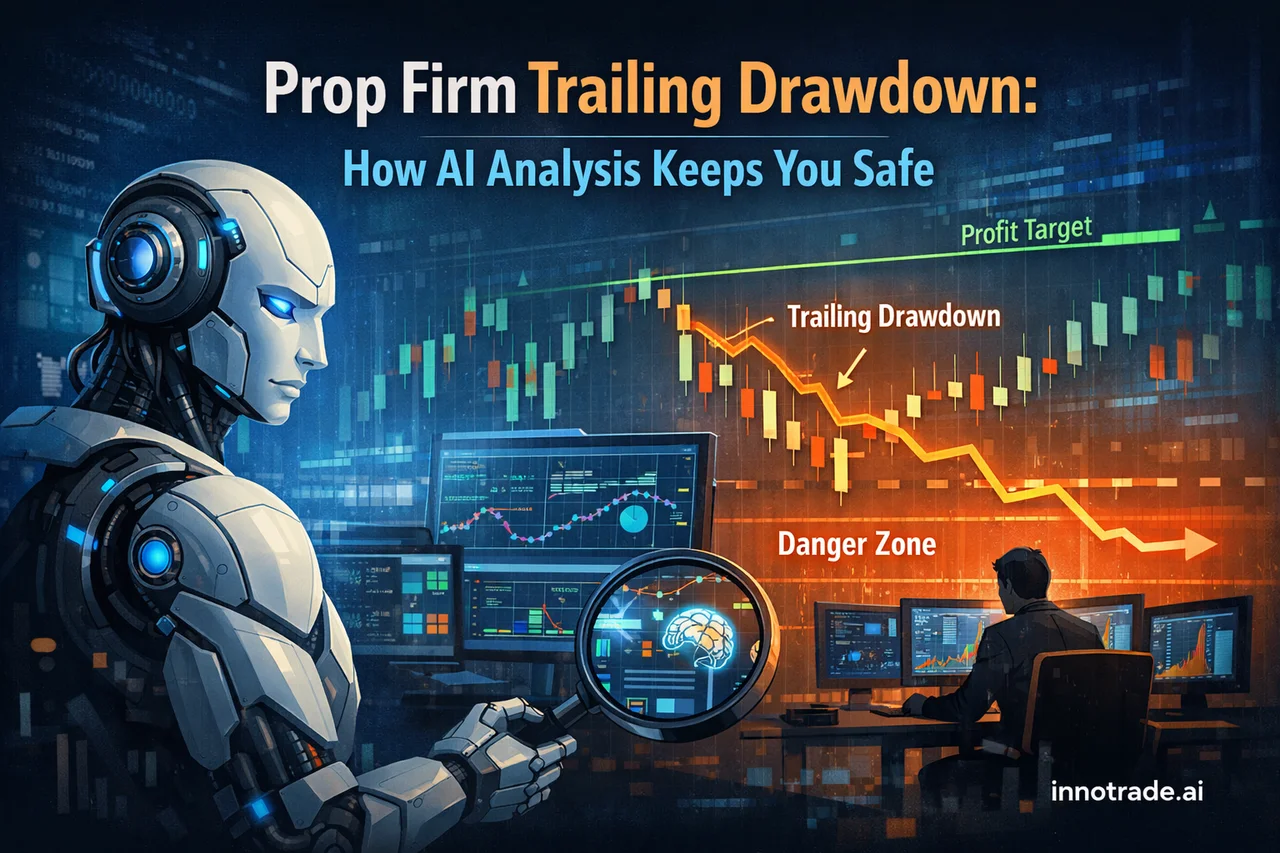
Unlike a fixed maximum drawdown (e.g., "your account can never drop more than 10% from the starting balance"), a trailing drawdown follows your highest achieved equity. Every time your account reaches a new peak, the drawdown floor rises with it — and it stays there permanently, even if your account pulls back.
Here's a simplified example: suppose your challenge account starts at $100,000 with a 5% trailing drawdown. Your floor begins at $95,000. You trade well and grow the account to $106,000. Your floor has now risen to $101,000 — and it will never drop below that level again, regardless of what happens next. You now have only $5,000 of breathing room from a higher base than where you started.
The practical consequence is severe: a string of winning trades can actually shrink your usable risk budget if those wins are followed by losses. Many traders pass the first half of a challenge comfortably, only to breach the trailing floor in the final stretch — not from reckless trading, but from a failure to adjust their risk as the floor rose.
Why Inconsistent Analysis Makes This Worse
The trailing drawdown mechanism punishes variance above almost everything else. A trader who generates steady, moderate returns week after week is in a far safer position than one who posts a brilliant run followed by a choppy correction — even if both traders end the month at the same profit level.
This is where the quality of trade selection becomes a prop firm survival issue, not just a profitability issue. Inconsistent entry logic, poorly placed stop-losses, and chasing setups in low-probability conditions all create the kind of equity swings that inch the trailing floor upward and then leave you overexposed.
Looking at recent platform data from innotrade.ai, this dynamic is visible in practice. Over the past week of tracked analyses, daily win rates ranged from a challenging session on Thursday, July 2 — the weakest day of the period by EV score — through to the strongest day of the week on Saturday, June 27, where conditions aligned unusually well for the AI's setups. Between those two poles, Tuesday, June 30 and Friday, June 26 both delivered win rates above 65%, with average risk-reward ratios of 1.69 and 1.67 respectively. Wednesday, July 1 added further consistency with a positive EV score and a healthy average RR of 1.91.
The point isn't that every day is a winner — it's that week-level consistency in RR and EV is what protects a trailing drawdown floor. Across the seven days tracked, the average risk-reward across sessions remained comfortably above 1.5, which means that even on below-average win rate days, the math still works in the trader's favour.
How AI Analysis Supports Trailing Drawdown Management
There are three specific ways that structured AI analysis — particularly the kind with pre-defined entry points, stop-losses, and tiered take-profit levels — helps traders navigate trailing drawdown rules more safely than discretionary approaches.
1. Stop-Loss Discipline Is Non-Negotiable
Every analysis generated through innotrade.ai's AI analysis tool includes a specific stop-loss level calculated as part of the setup. This isn't decorative — it's the mechanism that prevents any single trade from doing disproportionate damage to your equity curve. For prop firm traders, this matters enormously: a stop-loss that's too wide doesn't just lose more money on a failed trade, it inflates the drawdown that then pulls your trailing floor higher than your gains can justify.
When stop-losses are sized appropriately relative to the expected move — which is what a risk-reward calculation enforces — each losing trade costs a predictable, pre-agreed amount. Over time, this is the difference between a smooth equity curve and a jagged one that erodes your trailing buffer.
2. Tiered Take-Profits Let You Bank Gains Incrementally
The TP1, TP2, TP3 structure built into every innotrade.ai analysis is particularly well-suited to prop firm environments. Rather than holding an entire position for a large target and risking a full reversal, traders can take partial profits at TP1 — securing a gain and reducing exposure — while leaving a portion running toward TP2 or TP3 for maximum return.
This approach directly benefits trailing drawdown management. Partial profits at TP1 mean your equity line ticks upward more frequently, in smaller increments, rather than swinging between large wins and open-trade exposure. The floor rises with your equity, yes — but it rises in measured steps rather than volatile leaps that leave you overexposed on the next trade.
Naturally, win rates decay from TP1 through to TP3 — TP1 is the most reliably achieved level, TP2 is hit less frequently, and TP3 represents the least common but highest-reward outcome. For prop firm traders managing a trailing floor, scaling out at TP1 or TP2 and only letting a small portion of the position run toward TP3 is often the more conservative and appropriate approach. Understanding this structure is covered in depth in our Trading Academy if you want to build a more systematic exit framework.
3. EV-Positive Analysis Means the Math Compounds in Your Favour
Expected Value (EV) is the single most honest measure of a trading system's long-term viability. A positive EV means that on average, across a sufficient number of trades, the system produces profit — accounting for both win rate and the size of wins versus losses. A negative EV system will eventually deplete any account regardless of short-term luck.
Across all tracked trades on the platform, the all-time win rate has held at 53.8% with an average risk-reward ratio of 1.98. At those parameters, the expected value per trade is meaningfully positive — and it's the kind of consistency that prop firm evaluation periods are specifically designed to test over time. You can track your own personal EV and performance breakdown in detail through the Trade Tracking dashboard, which gives you session-by-session visibility into whether your execution is staying true to the system.
Practical Rules for Protecting Your Trailing Floor
Even with sound analysis behind you, there are discipline-level habits that specifically protect a trailing drawdown account:
- Reduce position size after a new equity high. Every time you hit a new peak and your floor rises, your usable risk buffer may be smaller in dollar terms than it was before. Recalibrate your sizing to reflect the new floor, not the starting balance.
- Avoid overtrading on strong days. A session with exceptionally aligned setups can tempt traders into adding positions they wouldn't otherwise take. Additional exposure at an equity high is where trailing drawdown accounts get hurt most.
- Treat the weakest analysis days as rest days. When market conditions are choppy or EV signals are weaker — as the July 2 data illustrates for this past week — selective traders who skip low-conviction setups protect both their capital and their trailing floor. Not every day demands a trade.
- Use ScalpHunter signal confidence levels as a filter. On ScalpHunter, confidence levels range from 1/5 to 5/5. For traders in a prop firm evaluation with a thin trailing buffer, restricting entries to higher-confidence signals is a straightforward risk filter that discretionary trading rarely enforces as cleanly.
The Honest Reality: AI Analysis Is a Risk Management Tool, Not a Guarantee
No analysis system — AI-powered or otherwise — eliminates drawdown. Markets produce losing trades, and any funded trader who tells you otherwise is either very new or not being honest. What structured analysis does is reduce the randomness of losses: stop-losses are placed intentionally, targets are calibrated to actual market structure, and the risk-reward framework means you don't need an exceptional win rate to remain profitable.
For prop firm challenges specifically, this distinction matters. You don't need to be a hero trader. You need to be a consistent one — and consistency under trailing drawdown pressure is exactly what a well-calibrated AI analysis workflow is built to support.
If you're considering whether AI-assisted analysis is the right fit for your prop firm approach, the FAQ covers the most common questions from traders evaluating the platform. A 7-day free trial is available across all tiers at Pricing — enough time to run a meaningful set of analyses before committing.
Analytical software only. We do not handle funds, make investments, or provide financial advice. Trading involves substantial risk and past performance does not guarantee future results. Always conduct your own research and consider your risk tolerance before making trading decisions.