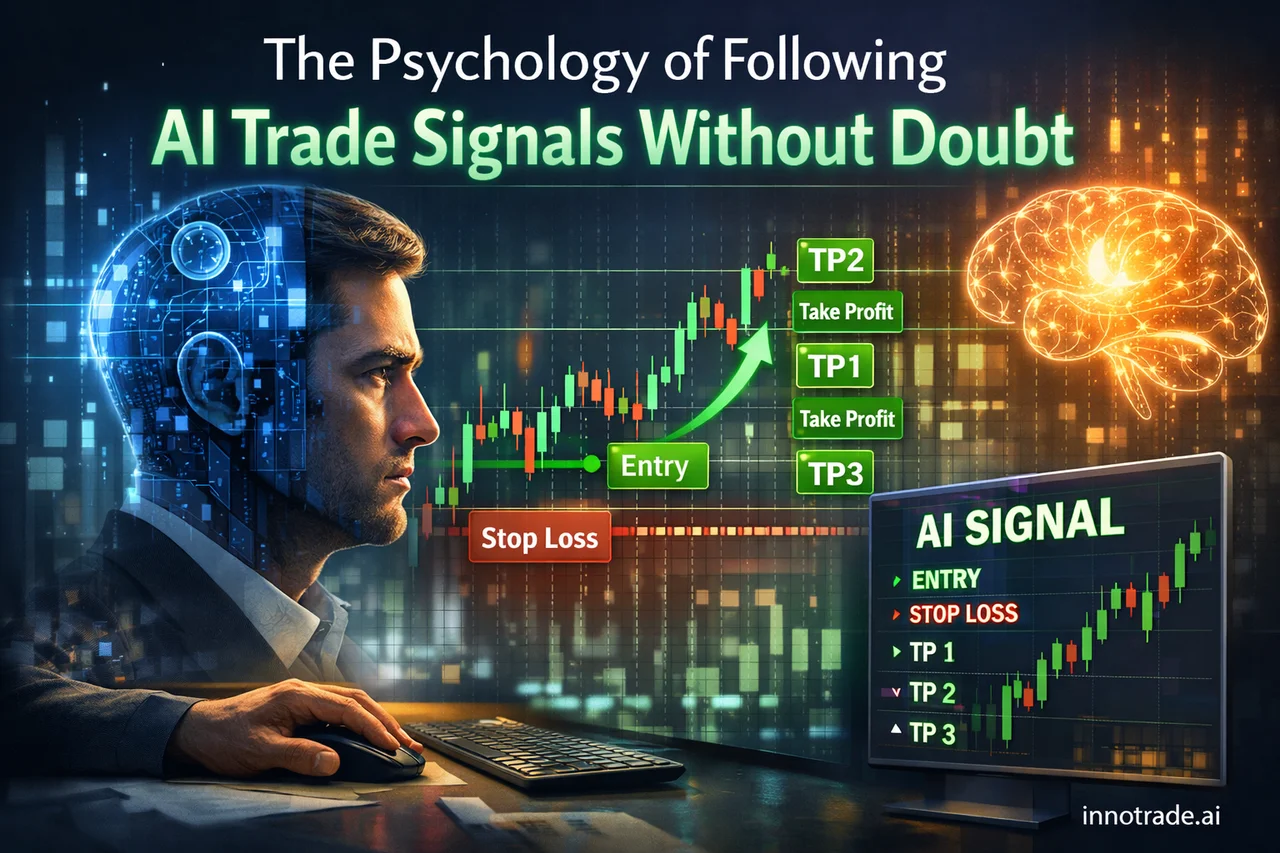
An AI-generated trade analysis can do a lot of heavy lifting: it scans price action, calculates a risk-reward profile, and hands you an entry, a stop-loss, and three take-profit targets in seconds. What it cannot do is stop you from closing the trade early out of nerves, moving your stop-loss further away because "it just needs a bit more room," or skipping the setup entirely because the last two trades lost. That gap — between a statistically sound signal and a human being executing it under pressure — is where most retail trading results actually get decided.
Why the Signal Isn't the Hard Part
Generating a trade idea has never been easier. Platforms like innotrade.ai's AI Analysis tool can produce a structured setup with entry, stop-loss, and TP1/TP2/TP3 levels almost instantly, drawing on patterns across forex, crypto, metals, and indices. The actual challenge for most traders isn't finding a setup — it's sitting with it once it's live. Price pulls back 15 pips before continuing in your favor, and the instinct is to exit at breakeven out of fear. Or a setup is still within its normal range of volatility, but it feels wrong, so the stop gets moved. Neither reaction is based on new information — both are emotional overrides of a plan that was already calculated with a defined risk-reward ratio.
This is the core psychological tension of signal-based trading: the model doesn't get tired, doesn't remember the last losing trade, and doesn't feel anxious watching a candle wick toward the stop. You do. Recognizing that asymmetry is the first step toward actually benefiting from AI-assisted analysis instead of quietly undermining it.
Confirmation Bias Works Both Ways
Traders often assume confirmation bias only applies to ignoring bad news about a position they want to win. But it also shows up as selective trust in signals — taking every AI-generated setup that confirms a personal bias ("I think gold is going up anyway") while second-guessing or skipping setups that contradict it, even when the underlying data and structure are identical. Over time this creates a distorted, cherry-picked track record that has nothing to do with the actual quality of the analysis.
One practical defense is detachment from any single outcome. A single trade result — win or loss — tells you almost nothing about whether a strategy has an edge. What matters is the behavior of a strategy across many trades, which is exactly why performance needs to be tracked and reviewed over time, not judged trade-by-trade in the moment.
What the Recent Data Actually Shows
Looking at the platform's own tracked performance over the past week illustrates why patience with a system matters more than reacting to any individual session. Tuesday, October 20 stood out as the strongest session of the period by expected value, posting a win rate of 87.5% with an average risk-reward ratio of 3.58 — the kind of day that feels like validation. Just one day later, on Wednesday, October 21, conditions shifted: the win rate dropped to 66.7% with a lower average RR of 2.48, still profitable overall but clearly a weaker stretch by EV score. A trader who only judged the system based on Wednesday's session, in isolation, might have abandoned a perfectly functional process right before it reasserted itself.
This is precisely the pattern that trips up discretionary overrides: the single-day noise looks meaningful in the moment, but it's the sequence across days that tells the real story. Across all tracked trades on the platform, the all-time win rate has held at 53.6% with an average RR of 2.06 — numbers that only make sense in aggregate, not from any one session.
Trust the Structure, Not the Feeling
Every AI-generated analysis on the platform comes with three take-profit levels for a reason. TP1 is typically where a trader might secure a partial win and reduce exposure; TP2 represents a more extended move that confirms the trade's thesis is playing out as expected; TP3 is the stretch target reached only when momentum fully cooperates. It's completely normal — and mathematically expected — for a smaller share of trades to reach TP3 than TP1, since each level is measured independently rather than stacked. Understanding this structure in advance helps prevent the common psychological trap of treating a TP1 exit as "not a real win" just because the trade didn't run all the way to TP3.
The same discipline applies to stop-losses. A stop placed by an AI-driven analysis reflects a calculated invalidation point for the trade idea — not a suggestion to be renegotiated mid-trade. Traders who consistently widen stops in the moment are, in effect, running a different risk profile than the one the original analysis was built around, which makes the resulting performance data meaningless for future decision-making.
Building Psychological Distance From Individual Trades
- Predefine your exit behavior before entering — decide whether you'll scale out at TP1/TP2/TP3 or hold for a single target, and commit to it before emotions are in play.
- Review performance in batches, not trade-by-trade — a personal Trade Tracking dashboard showing win rate trends across weeks is far more useful than reacting to any single result.
- Separate signal quality from outcome — a well-reasoned setup that hits stop-loss isn't automatically a "bad" signal; it's a normal part of a strategy with a positive expected value over time.
- Use transparency, not anecdotes, to calibrate expectations — the public Live Trades Scoreboard exists purely to show verified past results across all users, reinforcing that strong outcomes are tracked and visible rather than cherry-picked.
The Takeaway
AI-assisted trading doesn't remove psychology from the equation — it just relocates it. Instead of agonizing over where to draw a trendline or whether RSI is overbought, the trader's real job becomes managing the discipline to execute a plan that's already been calculated for them. That's a different skill, but it's still the deciding factor between a trader who benefits from a positive-EV system over months and one who sabotages it one emotional override at a time. If you're new to structured risk management, the Trading Academy covers the fundamentals of risk and discipline, and the FAQ addresses common questions about how analyses and performance tracking work. For traders ready to see this discipline applied in practice, a free trial is the lowest-friction way to start building that track record for yourself.
Analytical software only. We do not handle funds, make investments, or provide financial advice. Trading involves substantial risk and past performance does not guarantee future results. Always conduct your own research and consider your risk tolerance before making trading decisions.