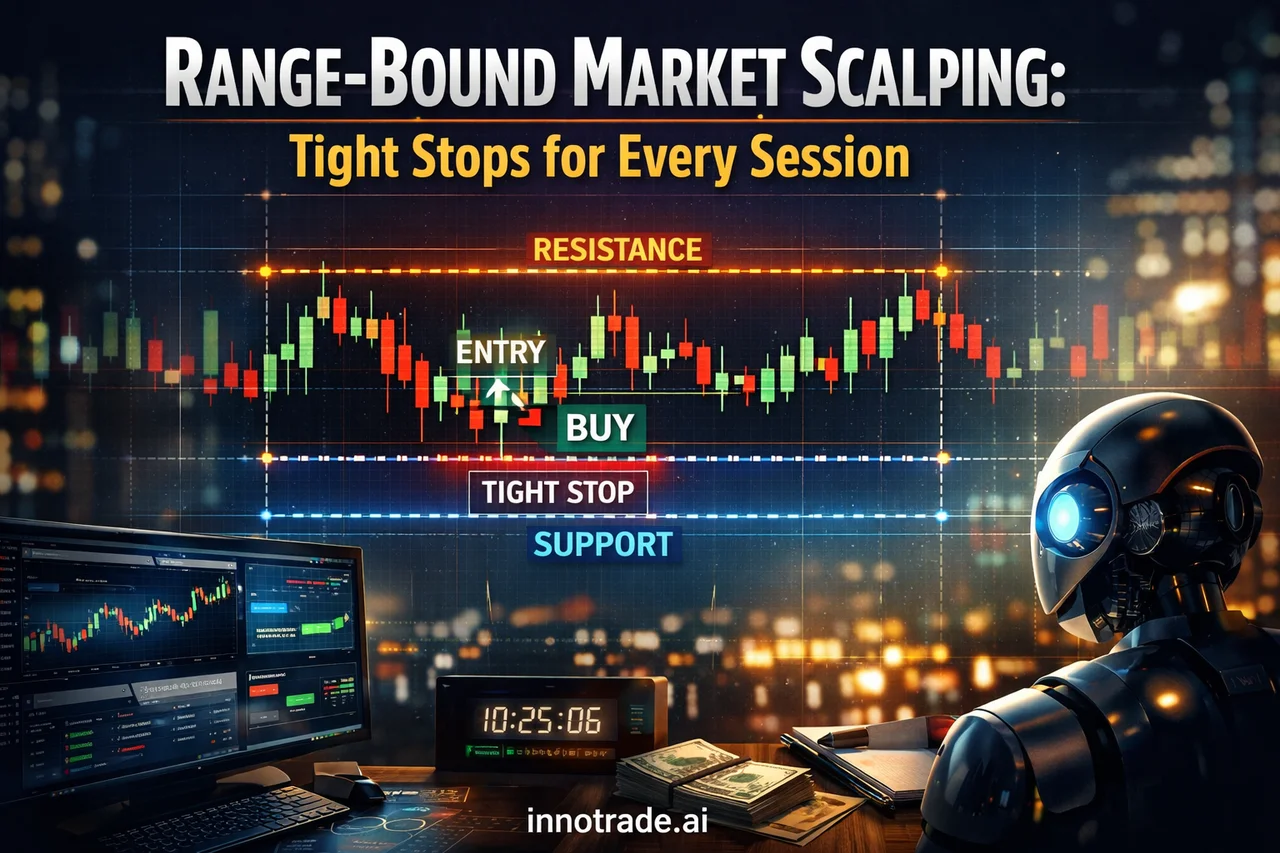
Most trading content obsesses over breakouts and trends. But a huge portion of market hours — especially during the Tokyo session, midweek consolidations, or the hours before a major news release — are spent going nowhere. Range-bound conditions are not "dead" markets; they're a different game with different rules. The traders who lose money here are usually the ones applying trending-market stop distances to a market that isn't trending at all.
This guide breaks down how to scalp, day trade, and swing trade range-bound and low-volatility conditions using tighter, structure-based risk parameters — and how AI-generated analysis on Analysis helps you size entries, stops, and staggered targets without guessing.
Why Range-Bound Conditions Demand a Different Playbook
In a trending market, price gives you room — a stop placed a reasonable distance from structure rarely gets clipped by noise. In a range, that same stop distance often sits right where price naturally oscillates, meaning wide stops in low-volatility conditions don't add safety, they just guarantee a worse risk-reward ratio for no benefit. The fix isn't to avoid these sessions — it's to tighten everything: entry precision, stop placement, and target expectations.
Scalping Range-Bound Markets: Tight Stops Across Sessions
The Tokyo session on USDJPY is a textbook example. Volatility typically compresses between the London close and the London open, and price often respects a tight band around the Asian range high and low. A scalping approach here means entering near range extremes with a stop just beyond the wick, not the whole range — and treating TP1 as a quick, high-probability target near the midpoint of the range rather than reaching for a breakout that may not materialize during low-liquidity hours. TP2 becomes the opposite range boundary, and TP3 is typically skipped or set conservatively unless volatility clearly expands.
The same logic applies to ETHUSD scalping during quieter crypto hours. Because crypto pairs can spike suddenly even in "quiet" periods, tight risk parameters matter even more — a scalp stop that's too loose on ETH can erase several winning trades in one adverse wick. Our ScalpHunter signal system is built around this exact problem: it flags short-term opportunities with a confidence rating from 1 to 5, letting traders size conviction and stop distance accordingly rather than treating every setup the same.
Day Trading the Overlap: Gold, GBPUSD, and Index Breakout Retests
Once the London–New York overlap begins, volatility typically expands and range-bound tactics give way to day-trading structures. Gold day trading around key levels — prior day highs/lows, round numbers, or session opens — benefits from waiting for a clean rejection or retest rather than chasing the first move. Entry timing around these levels, paired with a stop just beyond the level itself, tends to produce cleaner risk-reward outcomes than reactive entries mid-move.
On GBPUSD, the overlap session often allows for TP3 extension that wouldn't be realistic during the Asian session — the added liquidity and directional follow-through give room for a third target to actually get reached rather than stall. Similarly, US30 and other index breakout setups often work best on a retest of the breakout level rather than the initial break, with staggered targets (TP1 near the measured move's first leg, TP2 at a prior structural level, TP3 at an extension) giving traders a way to bank partial profit while letting a portion of the position run.
Swing Trading Structure: EMA Pullbacks and Silver's Range-Based Stops
Swing trades operate on a completely different risk clock. An EMA pullback entry on a higher timeframe needs a stop that respects the broader trend structure — typically beyond the most recent swing low or high, not a tight scalp-style distance that gets stopped out by ordinary daily noise. Multi-timeframe stop adjustment matters here: a stop that looks reasonable on the 1-hour chart might sit inside normal 4-hour or daily volatility, triggering an early exit on what was actually still a valid setup.
Silver swing trades illustrate this well. XAGUSD tends to have sharper, faster moves than gold, so structure-based stops — placed beyond a clear consolidation zone or prior swing point rather than an arbitrary pip distance — help avoid getting shaken out during normal volatility while still protecting capital if the broader structure genuinely breaks down.
The Three-Target Exit Plan: Aggressive vs Conservative TP3 Placement
Every AI-generated analysis on the platform includes three take-profit levels alongside the stop-loss, but how you treat TP3 should shift depending on the asset and strategy. TP1 is designed to lock in a high-probability partial win early. TP2 extends that further into the move, and by design, fewer trades reach it than reach TP1. TP3 is the stretch target — reached least often, but disproportionately rewarding when it hits.
For volatile crypto pairs, a more conservative TP3 (closer to the level where momentum typically stalls) often produces better long-run results than an aggressive one, because crypto reversals can be violent. For trending forex pairs or index breakouts during high-liquidity sessions, a more aggressive TP3 makes sense since follow-through is statistically more common. There's no universal answer — it depends on the instrument's volatility profile and the session you're trading it in.
What Recent Data Tells Us About Range Conditions
Looking at the past week of tracked performance across the platform, the aggregated daily figures show an average win rate near the low-to-mid 60% range with an average risk-reward ratio around 2.2 — a healthy sign that TP-level discipline is holding up even through mixed sessions. Not every day looked the same, though. The weakest session of the week, ranked by EV score, landed on Tuesday, September 29, where the win rate slipped to 33.3% and average RR fell to 1.13, pushing EV into negative territory — a reminder that range conditions and choppy setups can bite even a data-driven process. By contrast, the strongest session of the week came Sunday, September 27, where setups aligned unusually well across the board and the risk-reward outcome for the day stood out clearly on the EV chart.
Zooming out, across all tracked trades on the platform, the all-time win rate has held near 53.6% with an average RR around 2.04 — useful background context, though weekly data is always the more relevant reference for current conditions. Symbol-level patterns are worth noting too: AUDJPY has shown consistent follow-through to deeper TP levels over the past two weeks, while XAUUSD recently went through a rough stretch where the large majority of setups stopped out before reaching first targets — a good illustration of why range-bound and low-momentum periods call for the tighter, more selective approach outlined above rather than standard trend-following stop distances.
Building Your Own Range-Bound Playbook
The core takeaway: match your stop distance and target aggressiveness to the actual volatility regime, not a fixed formula. Tight stops for tight ranges, structure-based stops for swing trades, and TP3 aggressiveness calibrated to the instrument's typical follow-through. Reviewing your own trade history on Trade Tracking is the fastest way to see which of your setups are getting stopped out by noise versus genuine invalidation — a pattern that's often invisible until you look at aggregated win rates and RR side by side. For traders newer to structuring entries and stops around live conditions, the Trading Academy covers the fundamentals in more depth, and performance transparency — including verified past results — is always visible on the Live Trades Scoreboard.
Analytical software only. We do not handle funds, make investments, or provide financial advice. Trading involves substantial risk and past performance does not guarantee future results. Always conduct your own research and consider your risk tolerance before making trading decisions.