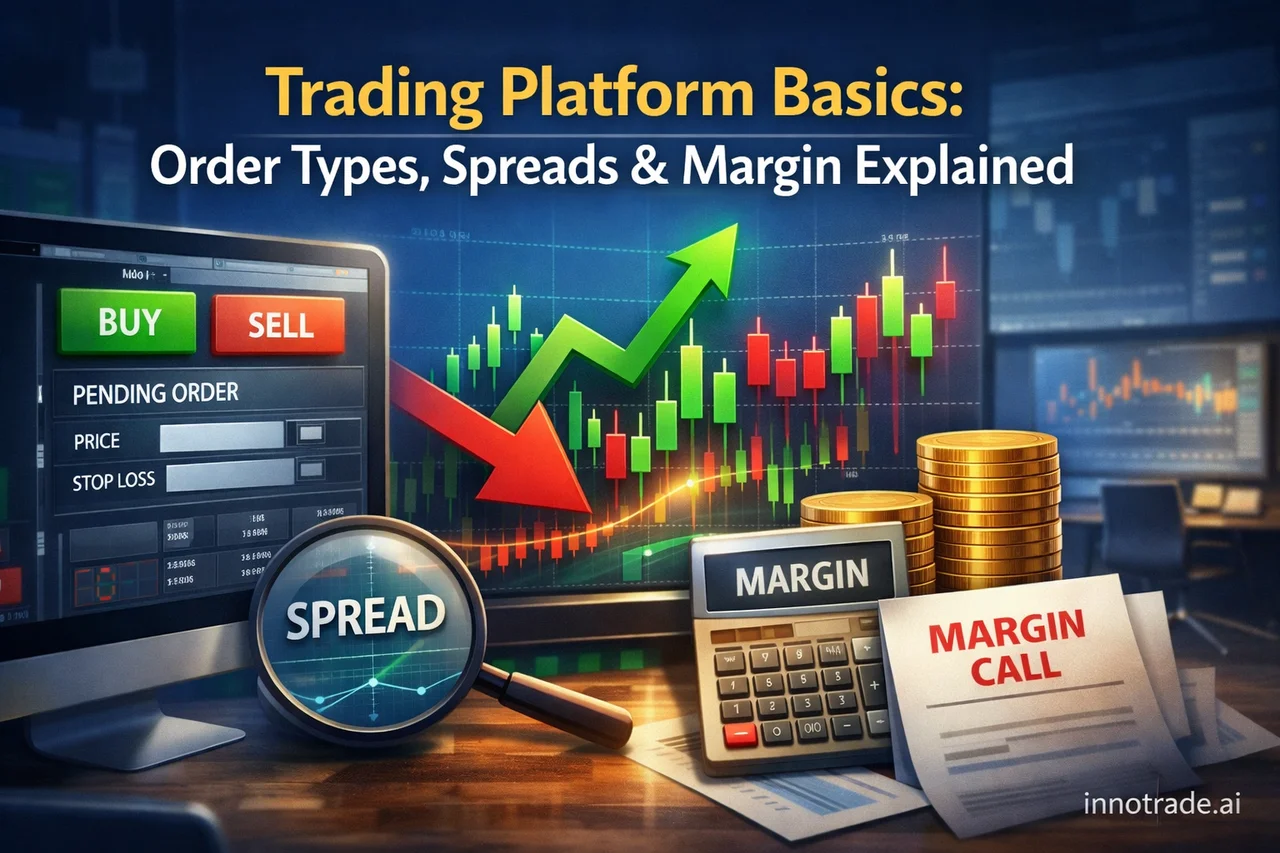
Most new traders spend their first weeks learning chart patterns and indicators, then get blindsided by something far more basic: they don't fully understand how their trading platform actually executes and manages their trades. A perfectly timed entry can still lose money to slippage, a misunderstood margin level, or an unexpected rollover charge. Before layering AI-generated analysis on top of your strategy, it pays to master the mechanics underneath it.
Market Orders vs. Pending Orders: Choosing Your Entry
Every trade starts with an order type decision. A market order executes immediately at the best available price — useful when you need to be in a fast-moving market like XAUUSD during a news spike, but it offers no price control. A pending order instead waits for the market to reach a specific level before filling, giving you precision at the cost of certainty that it will ever trigger.
Limit Orders vs. Stop Orders
Within pending orders, the distinction between limit and stop orders trips up a surprising number of traders. A limit order is placed to buy below the current price or sell above it — you're betting the market will reverse at a better level. A stop order does the opposite: it buys above the current price or sells below it, typically used to join a breakout once momentum confirms direction. If an AI analysis on EURJPY flags a breakout above a resistance zone, a buy-stop order placed just above that level is the structurally correct way to enter — a buy-limit would instead be fading the move, which is a different thesis entirely.
Slippage on Limit Entries
Even a well-placed limit order isn't guaranteed to fill at your exact price. Slippage occurs when the market moves through your level so quickly — often during high-impact news — that your broker fills you at the next available price instead. This is especially relevant around scheduled data releases; for example, when the ISM Manufacturing PMI print lands and deviates from its forecast, USD pairs like USDJPY and USDCAD can gap through pending levels in seconds. Widening your entry tolerance slightly or avoiding limit entries in the minutes around major releases is a simple way to manage this risk.
Quote Conventions and Pip Value
Every currency pair follows a quote convention: the first currency listed is the base, the second is the quote. In EURGBP, you're expressing how many British pounds one euro buys. This matters because it determines which currency your profit or loss is denominated in, and it directly feeds into pip value — the monetary worth of a one-pip move given your position size. A pip value calculator does this math for you, but understanding the underlying quote convention helps you sanity-check the output before you risk real capital on a position size that doesn't match your account.
Bid-Ask Spread: Forex vs. Crypto
The bid-ask spread — the gap between the price you can sell at and the price you can buy at — is effectively the cost of entering a trade before it's even moved in your favor. Major forex pairs like USDJPY typically carry tight spreads during liquid sessions, while spreads on crypto exchanges for assets like XRPUSD or SOLUSD can be noticeably wider, particularly during low-liquidity hours or sudden volatility. A trade that looks profitable on a chart can underperform in practice if the spread eats a meaningful chunk of a tight take-profit target, which is why position sizing and target selection should always account for the instrument's typical spread, not just its price action.
Margin Level, Margin Calls, and Drawdown
Your margin level is the ratio of your account equity to the margin currently used by open positions, usually shown as a percentage. When that ratio falls below your broker's threshold, you receive a margin call — a warning that positions may be forcibly closed if equity keeps declining. This is closely tied to drawdown, the percentage decline from a peak in your account balance to a subsequent low. Drawdown is a health metric, not just a loss count — a trader who wins most of their trades but allows single losses to erase 10% of their account in one go is still running an unsustainable system. Across all tracked trades on innotrade.ai, the platform has maintained an all-time win rate of 53.6% with an average risk-reward ratio of 2.06 — figures that only hold up because losing trades are sized to keep drawdown contained, not because every trade wins.
Using Your Platform's Tools: Watchlist, Depth of Market, and Risk Calculators
A watchlist keeps the instruments you actually trade front and center instead of scrolling through hundreds of irrelevant symbols — useful for staying focused on a core set like NDX, SPX, or your preferred FX majors. Depth of market (DOM) shows the stacked buy and sell orders waiting at different price levels, giving a sense of where liquidity is concentrated and where a large order might cause slippage. And before any trade — AI-generated or manual — running it through a risk calculator to confirm position size, stop distance, and dollar risk against your account balance is a non-negotiable habit, not an optional extra.
Don't Forget Rollover Fees
If you hold a forex position overnight, you'll be charged or credited a rollover fee (sometimes called swap), based on the interest rate differential between the two currencies in the pair. This is largely irrelevant for scalpers closing trades within the hour, but swing traders holding AUDJPY or NZDUSD positions for several days need to factor rollover into their overall cost of the trade, especially when compounding it over multiple nights.
Bringing It Together With AI-Assisted Analysis
None of this mechanical knowledge replaces a trading edge — but it protects one. An AI-generated analysis on Analysis can hand you a precise entry, stop-loss, and three take-profit levels, but it's still your responsibility to choose the right order type, understand the spread on that instrument, and size the position correctly using a risk calculator before clicking confirm. Traders who want to see how these mechanics play out across real positions can review their own execution and performance over time on Trade Tracking, while the Live Trades Scoreboard offers a transparent, read-only look at some of the platform's best-performing closed analyses for proof of past results. If any of these terms still feel unfamiliar, the Trading Academy and FAQ both cover platform mechanics in more depth for traders building their foundation.
Key Takeaway
Chart analysis gets the attention, but execution mechanics determine whether a good idea survives contact with the live market. Know your order type, respect the spread, watch your margin level, and size every position with a calculator before you enter — regardless of whether the idea came from your own analysis or an AI-generated signal.
Analytical software only. We do not handle funds, make investments, or provide financial advice. Trading involves substantial risk and past performance does not guarantee future results. Always conduct your own research and consider your risk tolerance before making trading decisions.