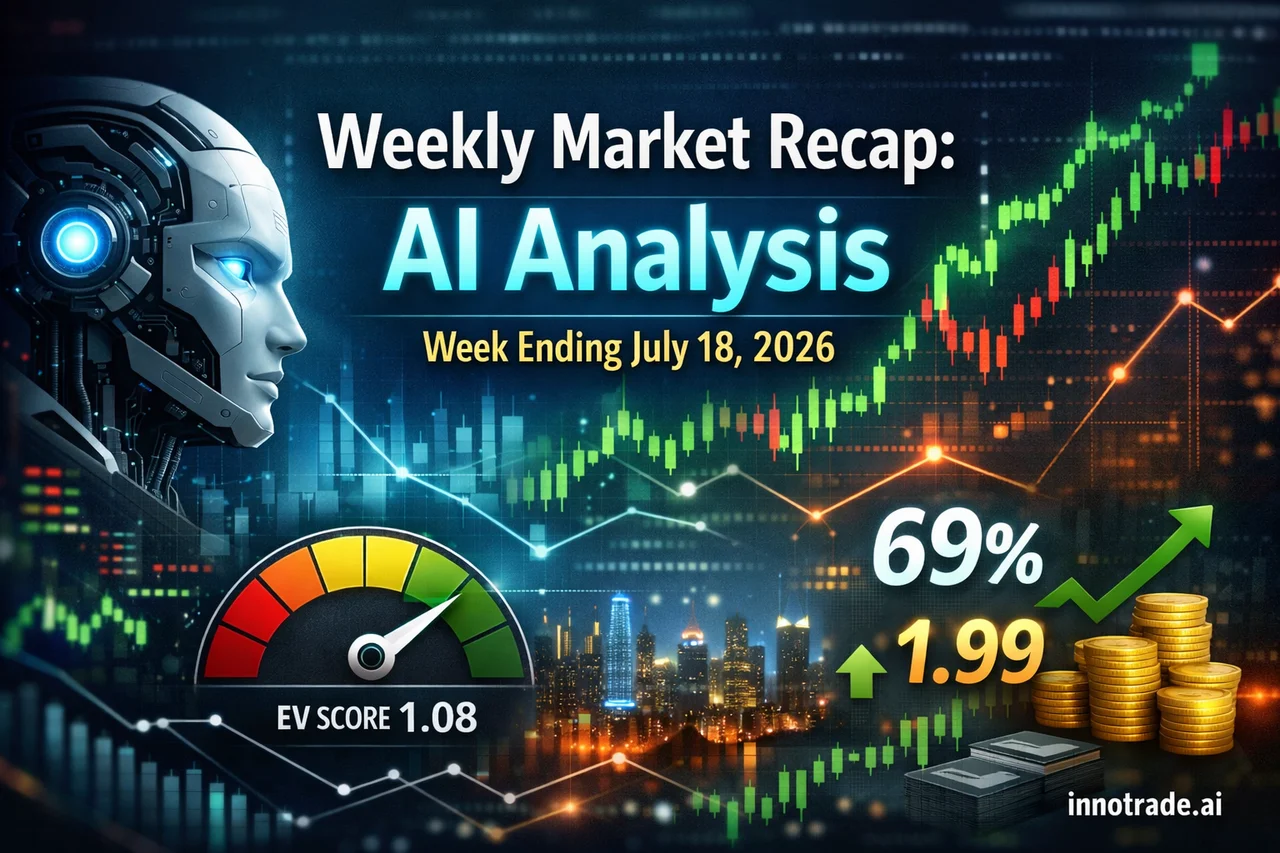
The trading week ending Saturday, July 18, 2026 gave the AI analysis engine a genuinely mixed bag of conditions — a quiet start, a mid-week acceleration, and a strong finish. When we aggregate the daily performance data across the full seven-day window, the picture that emerges is one of consistent, above-breakeven execution with a few standout sessions worth digging into.
Weekly Performance Summary
Averaged across the seven tracked days this week, the platform's AI analyses produced a win rate of roughly 69.0% with an average risk-reward ratio near 1.99, translating to a healthy average expected value (EV) score of approximately 1.08 per day. EV score matters more than win rate alone here — it's the metric that blends how often trades win with how much they win by, and it's the fairest way to judge whether a strategy is genuinely adding value over time versus just getting lucky on a handful of setups.
Not every day contributed equally to that average. The standout session of the week came midweek, when tracked trades closed out with a win rate near 84.6% and an average RR above 2.0, producing the highest EV score of the entire period. It was the kind of day where entries, take-profit sequencing, and stop-loss placement all lined up cleanly across multiple instruments — a good reminder of what the AI's models are designed to capture when trend conditions are clean and volatility is orderly rather than choppy.
On the other end, the earlier part of the week included a noticeably quieter session where win rate dipped to 50.0% and average RR softened to 1.65, pulling that day's EV score down to the lowest point of the week. This wasn't a broken system — it was simply a lighter trading day with fewer qualifying setups, which naturally produces more statistical noise in the daily numbers. This is exactly why we always recommend looking at weekly aggregates rather than any single day in isolation, and why traders using their own Trade Tracking dashboard should watch trends over rolling periods, not just yesterday's result.
The back half of the week recovered well, with Friday closing out at a win rate near 66.7% and an average RR above 2.5 — one of the stronger RR readings of the period even though the win rate itself was moderate. That combination is a useful lesson on its own: a lower win rate paired with a strong average RR can still produce excellent expected value, which is precisely why EV score — not win rate alone — is the metric worth anchoring to.
Notable Symbol Activity Over the Past Two Weeks
Looking at the broader two-week window rather than just this single week, a handful of instruments dominated trade volume and produced some instructive contrasts in follow-through behavior.
- XAUUSD (Gold): The most actively analysed instrument over the past two weeks, gold showed strong TP1 follow-through and reasonably consistent progression into TP2 and TP3 territory — a pattern consistent with the steady, news-sensitive grind that's defined gold price action recently.
- USDCAD: A high volume of tracked setups here too, with solid TP1 conversion, though follow-through to deeper targets was more selective — typical of a pair that tends to respect key levels early in a move before losing momentum.
- XRPUSD: Delivered some of the better TP2/TP3 follow-through among the crypto pairs tracked, suggesting cleaner trend continuation on the setups that got going.
- BTCUSD: Saw plenty of tracked activity but noticeably weaker progression into deeper take-profit levels compared to XRPUSD, with a larger share of setups stopping out before reaching further targets — a reminder that BTC's sharper volatility spikes can invalidate a setup quickly even when the initial directional read was sound.
- AUDJPY: Delivered fairly balanced TP1 through TP3 follow-through, benefiting from its sensitivity to broader risk sentiment shifts during the period.
The gap between XRPUSD's and BTCUSD's follow-through is worth sitting with for a moment. Both are crypto pairs, both saw comparable trade volume, yet one showed meaningfully better continuation toward deeper profit targets. This usually comes down to volatility character rather than direction being wrong — BTC's larger intraday swings can tag a stop-loss even on a trade that was directionally correct, while XRP's slightly steadier moves over the period allowed more setups to run further before reversing.
Economic Backdrop
USD-driven data releases were a recurring theme this week. Preliminary University of Michigan consumer sentiment data showed forecasts improving from a previous reading of 48.9 toward an anticipated 51.0, alongside inflation expectations still elevated near the 4.6% mark from the prior release. Supporting releases — including Industrial Production, Capacity Utilization, Housing Starts, and Building Permits — added incremental context to the broader USD picture without producing any single shock event. This kind of steady data drip tends to favour instruments like USDCAD and gold, where medium-importance USD releases shift sentiment gradually rather than triggering violent single-candle repricing — consistent with the more measured TP progression we saw on those pairs this week.
What to Watch Next Week
With sentiment and inflation-expectation data now in hand, traders should watch for any follow-through commentary from policymakers referencing these figures, along with how gold and USD pairs respond to the next wave of scheduled releases. Given this week's pattern — strong midweek execution following a quieter start — it's worth paying attention to whether volatility builds gradually again next week or arrives in a single sharp session, since that shapes which strategy style (scalping versus swing) is likely to perform better.
The Educational Takeaway
This week is a useful case study in why a single day's win rate can be misleading in isolation. A 50% win rate day with modest RR produced the weakest EV score of the week, while an 84.6% win rate day with strong RR produced the best — but even Friday's more moderate win rate, paired with an unusually strong RR, still contributed positively to the week's overall EV. The lesson: consistently positive expected value comes from the combination of hit rate and reward size, not either one alone. That's the same principle behind how the AI structures TP1, TP2, and TP3 levels on every trade — TP1 exists to bank probability-weighted gains early, while TP2 and TP3 exist to capture the outsized RR on the setups that keep running.
For traders who want to see how these principles play out on verified, individual trades rather than just aggregate weekly numbers, the Live Trades Scoreboard offers a transparent, read-only look at some of the platform's best-performing recent analyses across all users — useful purely as a proof point of past results, not as a signal source. And if you're newer to concepts like EV score, RR ratios, or TP-level structuring, the Trading Academy breaks these fundamentals down in plain language before you dive into live AI analysis.
Analytical software only. We do not handle funds, make investments, or provide financial advice. Trading involves substantial risk and past performance does not guarantee future results. Always conduct your own research and consider your risk tolerance before making trading decisions.