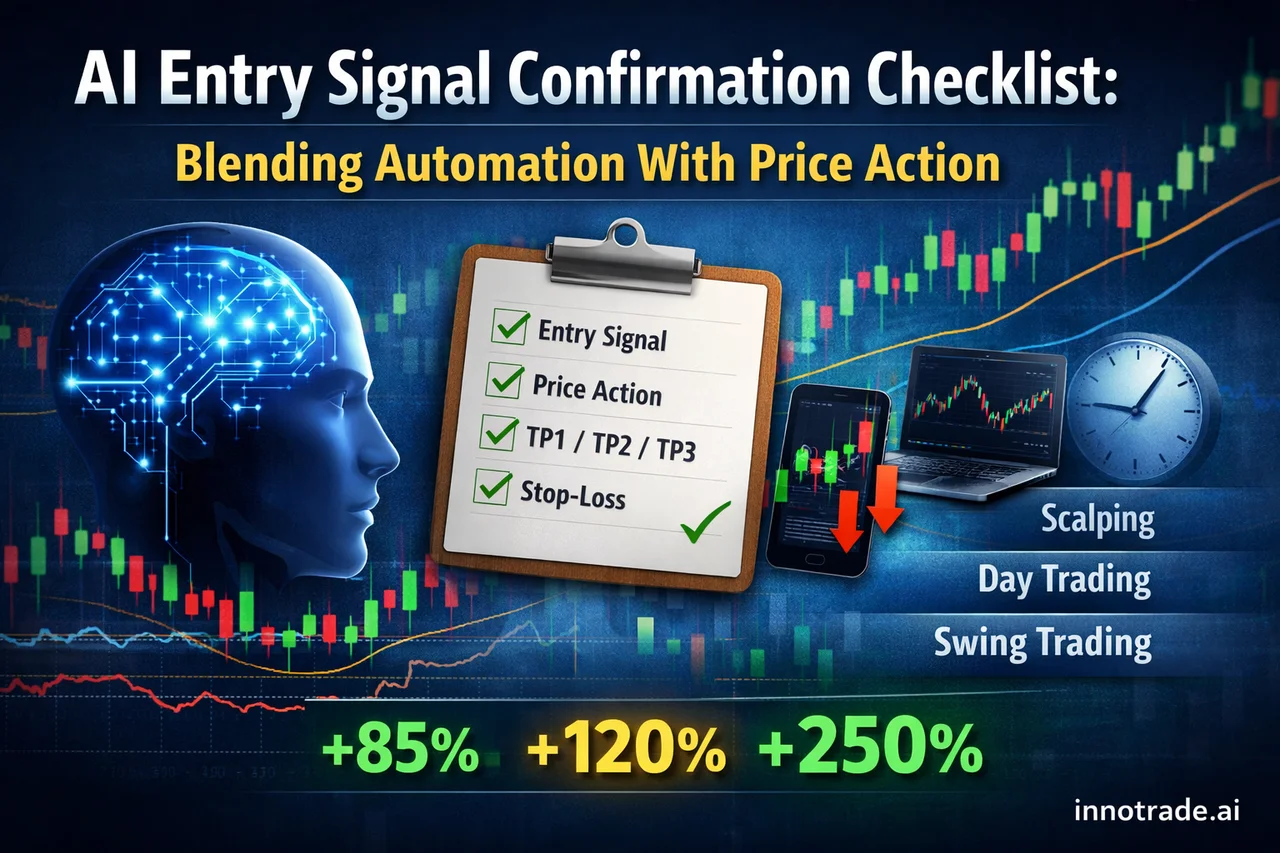
An AI-generated entry signal is a starting point, not a finish line. The most consistent traders on any platform, including ours, treat the entry, TP1/TP2/TP3 structure, and stop-loss as a proposal that still needs a final human filter. This guide walks through a practical confirmation checklist and shows how it plays out differently across scalping, day trading, and swing trading — with real recent performance data to back it up.
Why Even a Great AI Signal Needs a Confirmation Layer
AI analysis is excellent at processing volatility, momentum, and historical structure faster than a human can. What it can't always account for is the exact moment you click the trade — a stray news headline, a thin liquidity pocket, or a candle that's already 80% of the way to your entry zone. Combining AI entries with manual chart confirmation isn't about second-guessing the model; it's about respecting execution risk. This is one of the simplest ways to reduce false signals in an AI scalping strategy, and it applies just as much to swing setups that sit open for days.
The AI-Generated Entry Signal Confirmation Checklist
- Structure check: Does the suggested entry sit near a real swing high/low, order block, or session range — or is it floating in the middle of no-man's-land?
- Momentum check: Is price action agreeing with the signal's direction on your execution timeframe, or is it still fighting the opposite way?
- RR sanity check: Does the risk-reward ratio to TP1 justify the trade given current spread and volatility?
- TP spacing check: Are TP1, TP2, and TP3 spread out in a way that matches the instrument's typical daily range, or are they compressed on top of each other?
- Stop-loss logic check: Is the stop placed beyond a real structural level, or does it look arbitrary?
Running a setup through Analysis gives you the raw signal; running it through this checklist is what turns it into a trade you can actually defend afterward.
Scalping: 5-Minute Chart TP1 Exit Rules and Gold Timing
On a 5-minute chart, scalping is a game of seconds, not conviction. The most reliable approach is treating TP1 as your primary exit target and closing the full position there unless price is showing unusually strong continuation — chasing TP2 or TP3 on a scalp timeframe often gives back gains to a reversal. Gold scalpers in particular should pay attention to entry timing around session opens; XAUUSD tends to produce cleaner AI signal entries in the early London and New York windows, when liquidity is deeper and false breakouts are less common. Waiting for the first five-minute candle close after a signal, rather than entering mid-candle, is a small habit that meaningfully cuts down on false triggers.
Day Trading: TP2 Partial Profit Locks and Index Futures Spacing
Day traders working NDX, SPX, or DAX setups benefit from a structured partial-exit approach: bank a portion of the position at TP1, move the stop to breakeven, and let the remainder run toward TP2 with a trailing buffer. Locking in partial profit at TP2 protects the trade from giving back an entire day's gain on a late-session reversal. Because index futures can trend hard on macro catalysts, watch the spacing between TP1, TP2, and TP3 on the signal — wide, evenly staggered targets usually indicate the AI is reading a trending session, while tightly bunched targets suggest a choppier, range-bound day where TP3 may be optimistic.
Swing Trading: Stops Beyond Structure, Crypto Below Support
Swing trades need room to breathe, and that starts with the stop-loss. Rather than accepting a fixed pip or percentage distance, place — or verify — your stop beyond the nearest meaningful structure level: a prior swing low for longs, a swing high for shorts. For crypto swing positions on BTCUSD or XRPUSD, this typically means placing the stop below the last confirmed support zone rather than an arbitrary round number, since crypto often wicks through round levels before reversing. This single adjustment is one of the most effective ways to avoid getting stopped out by noise on a trade you fundamentally still believe in.
Matching AI Stop-Loss Placement to Your Risk Tolerance
The stop-loss on any AI-generated analysis reflects a technically sound invalidation point — but it may not reflect your account's risk tolerance. If a suggested stop implies a position size larger than you're comfortable with, the fix isn't to move the stop closer to price arbitrarily (that just increases your odds of getting stopped early); it's to reduce position size so the technically correct stop still fits your risk budget. This is a habit worth building through the Trading Academy if risk sizing isn't yet second nature.
Adjusting TP3 for Trending vs Ranging Markets
TP3 represents the extended, full-conviction target — and it should be treated differently depending on market regime. In a clearly trending market, letting a small portion of the position run toward TP3 with a trailing stop can capture meaningfully more upside. In a ranging market, TP3 becomes far less reliable, and many experienced traders simply skip scaling for it, treating TP1 and TP2 as the realistic exits. This is exactly why TP-level win rates decay from TP1 through TP3 — each level is a smaller, more selective subset of winning trades, not a guaranteed progression.
What Recent Data Says About Confirmation Discipline
Over the past week of tracked activity, the platform's daily win rate averaged roughly 52%, with an average risk-reward ratio near 2.05 — a healthy baseline for the kind of setups this checklist is designed to filter. The strongest session of the period was Tuesday, August 25, which posted a notably higher win rate alongside solid EV, while Sunday, August 23 lagged behind on EV score despite a respectable win rate — a reminder that win rate alone doesn't tell the full story; EV blends win rate and RR into a more honest performance measure.
Symbol-level behavior over the past two weeks reinforces the confirmation approach. USDCAD showed strong TP1 follow-through with a healthy share of those setups extending all the way to TP3, consistent with clean directional structure. XAUUSD, by contrast, was the most heavily analysed instrument in the same window, but only about half of its setups reached TP1 and full TP3 conversion was comparatively rare — a pattern that lines up with gold's tendency toward choppier, news-sensitive price action, and a good example of why an extra layer of manual confirmation matters most on the busiest, most-traded pairs.
Building Your Own Confirmation Workflow
The takeaway isn't to distrust AI-generated signals — it's to use them as a high-quality starting point that still passes through your own structure, momentum, and risk checks before you commit capital. Track how your confirmed trades perform over time using Trade Tracking, and compare your discipline against verified historical outcomes on the Live Trades Scoreboard, which exists purely as a transparent record of past top-performing analyses. If you're still refining your checklist, the Pricing page outlines the free trial period, which is enough time to test this workflow across a handful of real setups before committing further.
Analytical software only. We do not handle funds, make investments, or provide financial advice. Trading involves substantial risk and past performance does not guarantee future results. Always conduct your own research and consider your risk tolerance before making trading decisions.