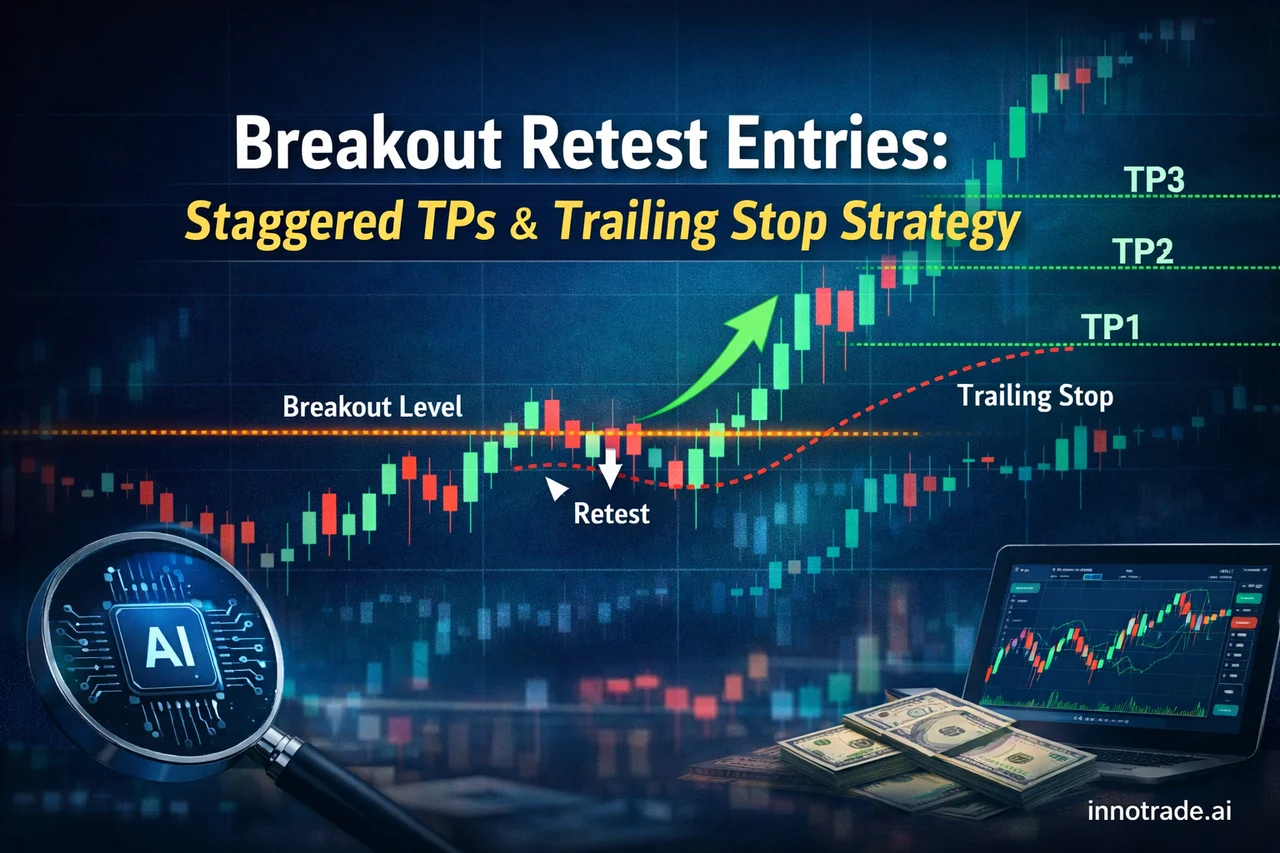
A clean breakout is exciting, but chasing it the moment it happens is one of the fastest ways to get stopped out by a false move. The more reliable approach — and one that maps naturally onto how AI analysis structures its trade calls — is the breakout retest entry: wait for price to break a level, then re-test it before committing capital. Combined with staggered take-profits and a trailing stop-loss once TP1 is hit, this gives traders a way to capture extended moves without giving back gains when momentum stalls.
Why the Retest Matters More Than the Breakout Itself
When price pushes through resistance or support, the initial candle often reflects liquidity grabs and stop-hunts rather than genuine conviction. A retest — price returning to the broken level and holding — filters out a large share of these fakeouts. It's the difference between entering on emotion and entering on confirmation. This is exactly why an AI-generated entry point on a breakout setup is rarely the exact breakout candle itself; it typically waits for the structure to confirm before publishing a level, stop-loss, and the three take-profit targets.
Staggered Take-Profits: TP1, TP2, TP3 as a Scaling Framework
Once you're in a retest-confirmed breakout, the next decision is how to exit. This is where the three-tier take-profit structure earns its value. Conceptually:
- TP1 is the first realistic target — often the next minor structure level. It's designed to be hit most frequently, which is why it naturally has the highest win rate of the three levels.
- TP2 extends further into the move, capturing traders who want to let a portion of the position run once momentum is confirmed. Fewer trades reach this level than TP1, which is expected and healthy — it doesn't mean the strategy is failing.
- TP3 targets the extended leg of the breakout, reserved for the smallest surviving portion of the position. It hits less often by design, but the reward on that final slice compensates for the lower frequency.
A common lot-allocation approach traders use with this structure is to close roughly half the position at TP1, another portion at TP2, and let the remainder ride toward TP3 — locking in profit progressively while still participating in the full extension of a strong breakout.
Trailing the Stop-Loss After TP1
The single biggest improvement most retail traders can make to breakout trading isn't a better entry — it's better stop management after the first target is hit. Once TP1 is achieved, moving the stop-loss to breakeven (or trailing it just behind the most recent swing low/high) removes the risk of a winning trade turning into a loss. For day trading setups, this trailing stop can be tightened using recent pivot points; for swing positions, it often makes sense to trail behind a level derived from the daily ATR range rather than a tight intraday structure, since swing trades need room to breathe through normal volatility.
How This Plays Out Across Strategies
Scalping
On a five-minute chart, a breakout retest might only offer a few pips of confirmation before the move continues. Scalpers using AI-generated entries typically want TP1 close and the stop-loss tight, accepting a lower reward per trade in exchange for a higher hit-rate and faster turnover. ScalpHunter is built around this exact rhythm — surfacing short-term opportunities with a confidence rating so scalpers can filter for the highest-conviction retests rather than trading every minor pullback.
Day Trading
Day traders have more room to work with. Pivot points from the prior session are a natural place to anchor TP2, since institutional order flow tends to cluster around them. A breakout that retests and then clears the daily pivot with volume behind it is a materially stronger setup than one that stalls beneath it.
Swing Trading
Swing traders benefit most from a multi-timeframe filter — confirming the retest on a lower timeframe (like the 1-hour) while the broader trend on the 4-hour or daily chart supports the direction of the breakout. Because swing trades are held longer, the stop-loss generally needs to sit beyond the recent daily ATR range rather than tight to the entry candle, or normal volatility will stop the trade out before TP3 has a chance to develop.
What the Data Actually Shows
Over the past week of tracked activity, the platform's daily win rate averaged in the mid-40% range with an average risk-reward ratio sitting just under 2.0 — a combination that reflects the staggered-exit philosophy described above: more trades close at TP1, fewer stretch to TP2 and TP3, but the ones that do carry a meaningfully larger reward. The strongest session of the week, midweek, produced a win rate in the mid-50s alongside a risk-reward ratio above 2.6 and the highest EV score of the period — a clear illustration of what a well-confirmed breakout day looks like when retests hold and trailing stops protect the runners. The weakest session of the week, by contrast, saw win rate and RR both compress, a reminder that not every day offers clean breakout structure and that risk controls matter most precisely on those slower sessions.
Zooming out, the platform's all-time win rate across tracked trades sits at 54.1% with an average RR of 2.00 — figures that are independently trackable and synced with Myfxbook for third-party verification. Recent instrument activity has also shown solid TP1 follow-through on pairs like USDCAD and encouraging progression toward TP3 on assets like XRPUSD — exactly the kind of staggered-exit behaviour this strategy is designed to capture.
Tuning Risk-Reward for the Strategy You're Running
A scalp and a swing trade should never use the same risk-reward math. A tight scalp with a 1:1 or 1:1.5 ratio can still be profitable at a high win rate, while a swing trade needs a wider ratio — often 1:2.5 or beyond — to justify the wider stop required by ATR-based placement. When reviewing AI-generated analysis, check that the stated risk-reward ratio matches the strategy label; a scalping call with a swing-sized stop-loss (or vice versa) is a mismatch worth questioning before entry.
Putting It Into Practice
Before trading a breakout retest live, backtest the concept mentally against a few historical examples on your instrument of choice. Then use Trade Tracking to monitor how your own executions compare to the AI's published entry, TP levels, and stop-loss over time — including how often you actually move your stop after TP1 versus how often you should have. For proof that this exit discipline works across real market conditions, the Live Trades Scoreboard displays the best-performing recent analyses across all users, offering a transparent look at what a well-executed staggered exit can achieve.
If you're still building the fundamentals behind entries, stops, and target placement, the Trading Academy covers the core concepts in more depth, and the FAQ answers common questions about how the platform's analysis structure works before you commit to a plan.
Analytical software only. We do not handle funds, make investments, or provide financial advice. Trading involves substantial risk and past performance does not guarantee future results. Always conduct your own research and consider your risk tolerance before making trading decisions.