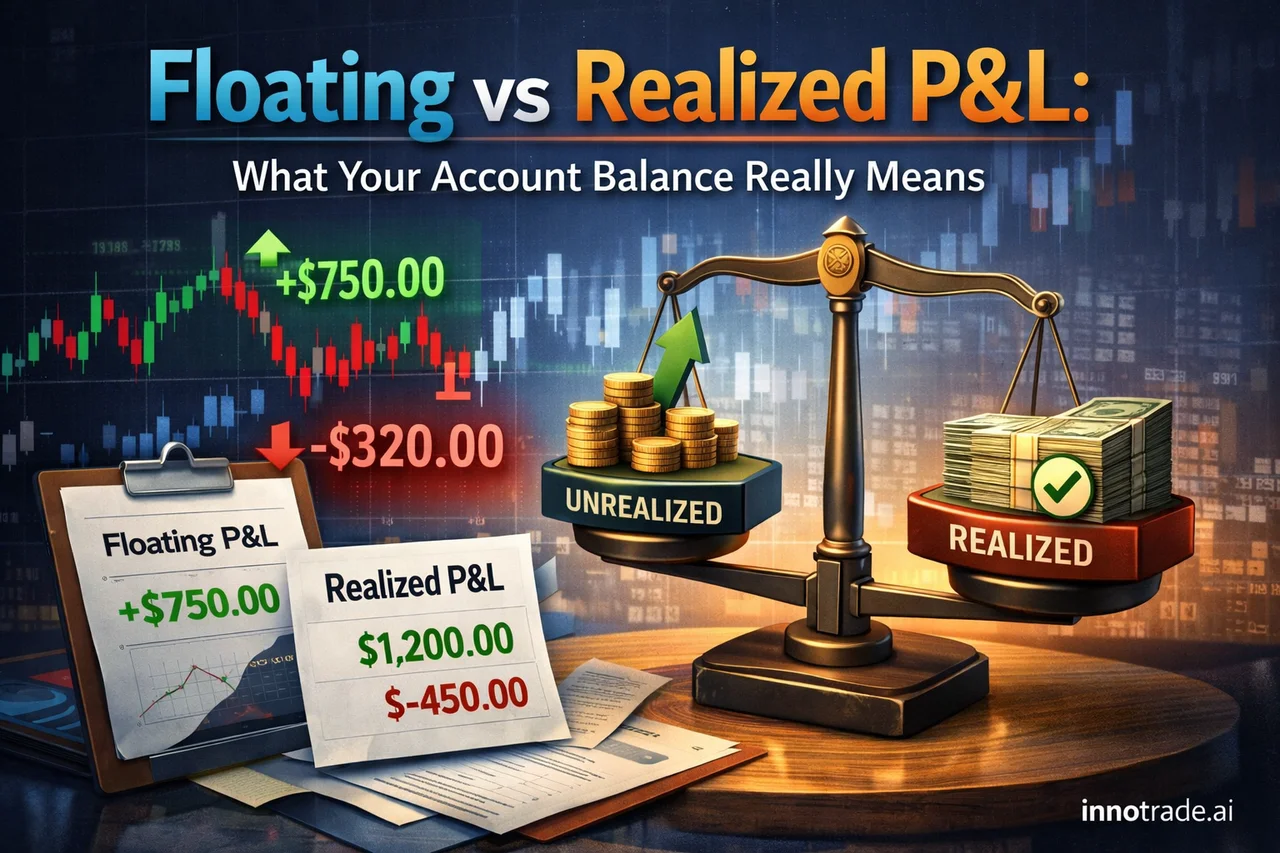
Open any trading platform and you'll see a number that moves constantly — sometimes green, sometimes red, ticking up and down with every price fluctuation. New traders often mistake this number for their actual account balance. It isn't, not entirely. Understanding the difference between floating (unrealized) P&L and realized P&L is one of the most underrated skills in trading, and misunderstanding it is a common reason traders make poor decisions under pressure.
Floating P&L: The Number That Isn't Final Yet
Floating P&L — also called unrealized profit and loss — is the paper gain or loss on a trade that is still open. If you bought EUR/USD and price has moved 40 pips in your favor, your platform shows a floating profit. But that profit exists only on paper. It hasn't been locked in, and it can evaporate just as quickly as it appeared if the market reverses before you close the position or before your stop-loss and take-profit levels are hit.
This is precisely why platforms like Trade Tracking separate open positions from closed history — so traders can see, at a glance, which numbers are confirmed outcomes and which are still in motion. Watching floating P&L swing wildly during a news release can trigger impulsive decisions: closing a winning trade too early out of fear, or holding a losing trade too long hoping it recovers. Both are symptoms of treating floating P&L as if it were already real money.
Realized P&L: The Only Number That Counts Toward Your Track Record
Realized P&L is the profit or loss that becomes permanent the moment a trade closes — whether that's because price hit your take-profit, your stop-loss, or you manually exited. This is the figure that actually changes your account balance and the only figure that should feed into your performance statistics, win rate, and risk-reward calculations.
This distinction matters when evaluating any trading system, including AI-generated analysis. Over the past week of tracked trades on the platform, the average realized win rate across closed positions sat at roughly 53.2%, with an average realized risk-reward ratio near 2.14 — figures calculated only from trades that had actually closed, not from open positions still fluctuating in value. The strongest session of that stretch, Monday, August 17, closed with a 60.0% win rate and a 2.63 average RR across a high volume of tracked setups, while Saturday, August 22 was the weakest, with EV score dipping to -0.38 as conditions worked against several setups. Both figures are meaningful precisely because they're realized, not floating.
A floating gain is a possibility. A realized gain is a fact. Sound risk management treats them very differently.
Why This Distinction Changes How You Manage Trades
Once you internalize that floating P&L can reverse at any moment, several practical habits follow naturally:
- Don't let floating gains change your risk tolerance mid-trade. A trade sitting at a healthy floating profit is not "safe" money — your original stop-loss and take-profit logic should still hold unless the underlying setup has genuinely changed.
- Avoid moving your stop-loss further away to "give a trade room" after it moves against you. This converts a defined, planned loss into an undefined, floating one that can spiral.
- Track your realized statistics separately from your open exposure. This is exactly the separation tools like Trade Tracking are built for — comparing your actual closed-trade performance against your current live exposure gives a far more honest picture than watching the balance ticker alone.
Negative Balance Protection: The Safety Net Most Traders Never Read About
Negative balance protection is a broker-level (not platform-level) safeguard that prevents your account balance from going below zero, even in extreme volatility events like a flash crash or a major news gap where slippage causes losses to exceed your available margin. Without this protection, in rare scenarios a trader could theoretically owe their broker money beyond their deposited funds. With it, the broker absorbs that gap and resets the account to zero rather than into negative territory.
This matters most around high-impact economic releases. Events like Flash Manufacturing PMI prints or scheduled remarks from figures such as Treasury Secretary Bessent can move markets sharply within seconds, and execution during these windows doesn't always happen at the exact price you expected — a phenomenon distinct from ordinary spread widening. Negative balance protection is not a substitute for good risk management, but it is a meaningful backstop worth confirming with your broker before trading through volatile sessions.
Where Demo Accounts Fall Short
Demo accounts are a reasonable starting point for learning platform mechanics, but they have real limitations that traders should understand before assuming demo success will translate directly to live results:
- Emotional weight is different. Watching floating P&L swing on a demo account doesn't trigger the same stress response as watching it swing with real capital — which is exactly when impulsive decisions tend to happen.
- Execution can differ. Demo environments don't always replicate the exact liquidity conditions, spread widening, or fill behavior you'll encounter live, particularly during fast-moving news windows.
- There's no negative balance protection test. Demo accounts can't meaningfully simulate the psychological relief (or the account impact) of protections that only matter in real capital scenarios.
None of this means demo accounts are useless — they're genuinely valuable for learning how an interface works, how take-profit levels are structured, and how to read AI-generated analysis before committing real funds. Innotrade's Trading Academy covers this progression in more depth for traders moving from practice to live execution.
Bringing It Together
Across all tracked trades on the platform, the all-time win rate has held around 53.8% with an average RR near 2.02 — a reminder that even a system with a consistent statistical edge will show floating drawdowns along the way before trades resolve into realized outcomes. Understanding this gap between what your screen shows in the moment and what actually lands in your account history is foundational to trading with discipline rather than emotion.
If you're evaluating whether an analytical approach is working, look at realized outcomes over a meaningful stretch of time rather than any single open position. The platform's Live Trades Scoreboard exists for exactly this kind of transparency — a public, read-only record of the strongest closed-out results across users over the past two weeks, useful as proof of past performance rather than a tool for making new decisions.
Before risking live capital, it's worth reviewing your broker's negative balance protection policy, understanding the practical gap between demo and live execution, and getting comfortable separating floating numbers from realized ones. You can explore how AI-generated analysis structures entries, stops, and take-profit levels through the Analysis tool, and check the FAQ for common questions about account mechanics before getting started.
Analytical software only. We do not handle funds, make investments, or provide financial advice. Trading involves substantial risk and past performance does not guarantee future results. Always conduct your own research and consider your risk tolerance before making trading decisions.