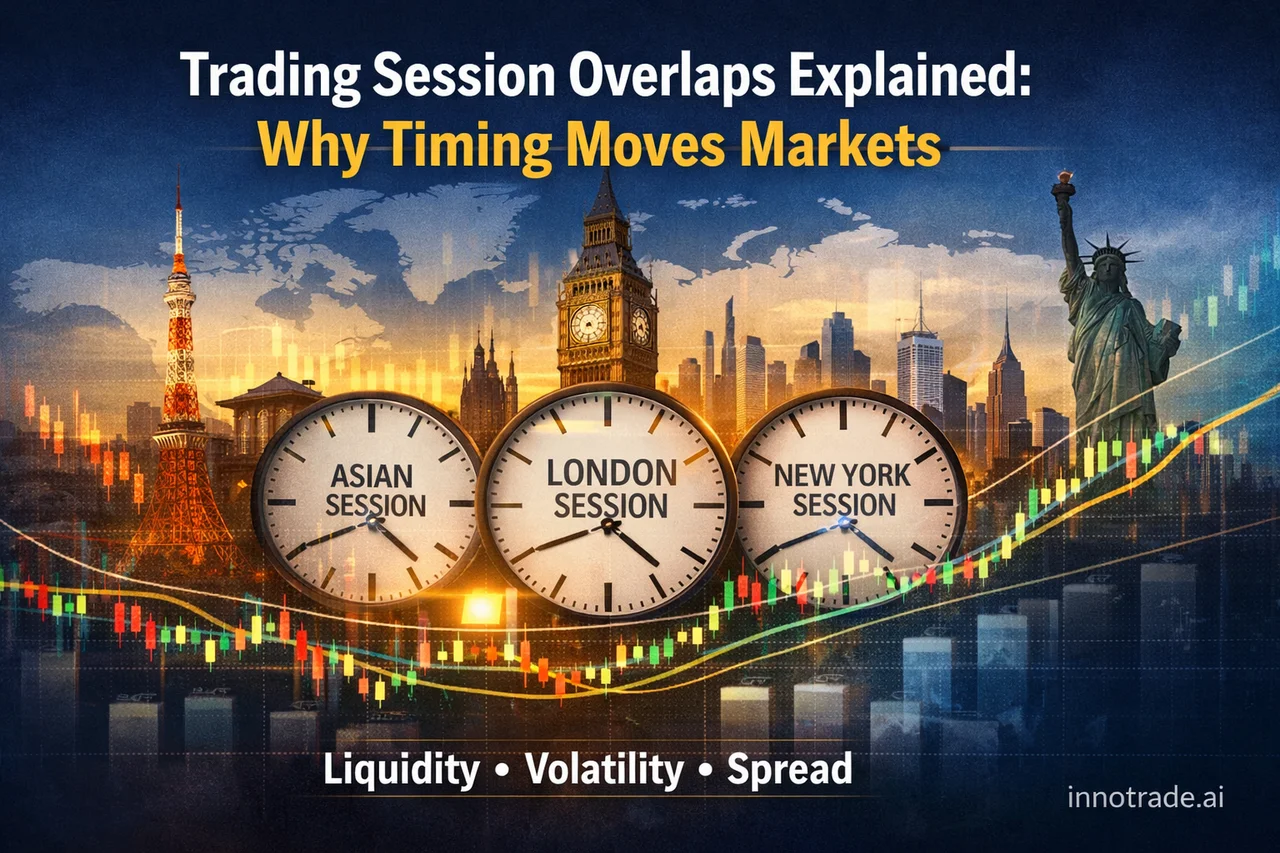
Ask any experienced trader what separates a clean breakout from a choppy, spread-eating mess, and the answer often has nothing to do with the chart pattern itself. It has to do with when the trade was taken. The forex and CFD markets run 24 hours a day, but they are not equally active every hour. Understanding trading session overlaps — and how liquidity, volatility, and spreads shift throughout the day — is one of the most underrated skills a retail trader can develop.
What Are the Major Trading Sessions?
Global currency and index markets are generally split into three major sessions, named after their financial hubs:
- Asian Session (roughly Tokyo/Sydney hours) — typically quieter, with lower volume outside of JPY and AUD pairs.
- London Session — the single largest share of daily forex volume, driving much of the day's directional movement.
- New York Session — heavily influenced by US economic data, equity index moves, and USD-denominated pairs.
Each session has its own personality. The Asian session tends to produce tighter, range-bound price action, while London and New York often generate the bulk of a currency pair's daily range.
The London-New York Overlap: Where Liquidity Peaks
The few hours where London and New York trading hours overlap are widely regarded as the most liquid window of the trading day. Two major financial centers are active simultaneously, order flow deepens, and the bid-ask spread on major pairs like EURUSD or GBPUSD typically compresses to its tightest levels. For retail traders, this matters directly: a tighter spread means a lower effective cost per trade, which is especially important for scalpers and day traders who enter and exit frequently.
Compare that to the late Asian session, when liquidity thins out. Spreads on the same pairs can widen noticeably, and a stop-loss that looked reasonably placed during the London overlap might get clipped by a spread spike during a quiet overnight hour — not because the analysis was wrong, but because the execution conditions changed.
Spread vs. Commission: Why Session Timing Affects Your Cost
Every trade carries a cost, whether it's baked into the spread or charged as a separate commission. Brokers that charge via spread will typically show that cost widen during low-liquidity hours, while commission-based accounts keep the fee fixed but may still show wider raw spreads on the underlying instrument. Either way, the lesson is the same: the hour you place a trade can materially change what you're paying to get in and out of it. A trader who ignores this and trades a volatile news release during a thin-liquidity overnight window may find their realized cost far higher than expected — even before the market has moved against them.
How News Events Interact With Session Timing
Economic calendar events don't land randomly across the 24-hour clock — they cluster around the session of the currency they affect. A few recent examples from the economic calendar illustrate this well:
- BOE Gov Bailey Speaks (high importance, GBP) — this kind of high-impact commentary typically lands during London hours, exactly when GBP pairs already carry the heaviest volume of the day. The combination of a high-importance speaker and peak session liquidity can produce sharp, fast moves.
- Unemployment Claims (medium importance, USD) — a recurring US data release that lands squarely in the New York session, often triggering a short burst of volatility in USD pairs and US indices.
- FOMC Member Musalem Speaks (low importance, USD) — a reminder that not every scheduled event carries the same weight. Session timing tells you when volatility is more likely, but importance tiers tell you how much.
Traders who understand both dimensions — session timing and event importance — are far better equipped to size their risk appropriately heading into a release, rather than being caught off-guard by a spread widening or a sudden spike through their stop.
Why This Matters for AI-Assisted Analysis
One of the reasons platforms like innotrade.ai generate fresh AI analysis continuously throughout the day — rather than once in the morning — is precisely because market conditions shift session to session. A setup that looks clean during the London-New York overlap can look entirely different six hours later once liquidity dries up. This is also why performance can vary meaningfully from one day to the next, even when the underlying strategy logic stays consistent.
Looking at a recent seven-day stretch of tracked analyses, the week's aggregate win rate landed close to the low-50% range with an average risk-reward ratio a little above 2.0 — broadly in line with the platform's longer-term tendencies. But the day-to-day spread told a more interesting story. Tuesday, October 6 stood out with an 85.7% win rate and a 2.49 average RR, reflecting a session where setups tracked cleanly from entry to target. Monday, October 5 posted the single strongest EV score of the week, a sign of an unusually efficient session for the AI's calls. On the other end, Friday, October 2 was the weakest day by EV score, with a win rate of 33.3% and a lower average RR of 1.35 — a reminder that even a well-tested analytical process will have off days when market conditions turn choppy or thin.
That kind of daily variance is normal in any systematic approach, and it's exactly why tools like Trade Tracking exist — so traders can see their own results laid out by day and strategy, rather than judging performance off a single lucky or unlucky session.
Practical Takeaways
- Favor the London-New York overlap window for tighter spreads and deeper liquidity, especially if you're trading smaller timeframes.
- Be cautious trading through thin, low-liquidity hours (late Asian session) unless you specifically understand the instrument's behavior at that time.
- Check which session a high-importance news event falls into before entering a position — volatility compounds when a major release lands during an already-liquid session.
- Remember that daily performance naturally fluctuates. Judge any strategy, AI-assisted or otherwise, over a run of sessions rather than a single day.
If you're new to these concepts, the Trading Academy covers session mechanics, spread costs, and risk basics in more depth. And if you want to see how session-aware timing plays out in live conditions, the ScalpHunter tool flags real-time scalping opportunities as liquidity conditions shift throughout the day.
Timing isn't everything in trading — but ignoring it is a quiet, often invisible cost that adds up fast. Understanding when the market is actually working in your favor is just as important as understanding why.
Analytical software only. We do not handle funds, make investments, or provide financial advice. Trading involves substantial risk and past performance does not guarantee future results. Always conduct your own research and consider your risk tolerance before making trading decisions.