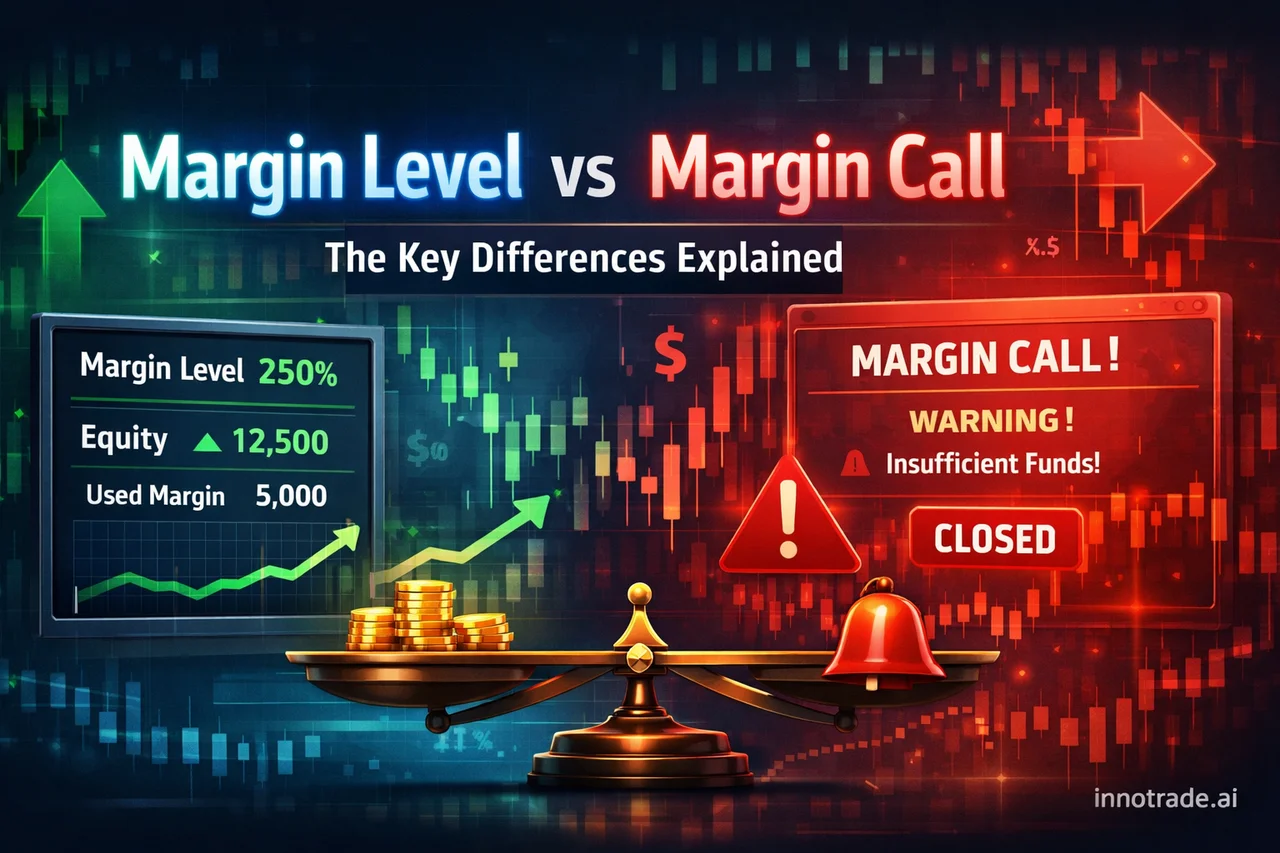
Every leveraged trader eventually runs into two terms that sound almost interchangeable but mean very different things: margin level and margin call. Confusing the two — or worse, ignoring both — is one of the fastest ways to blow up an account that was otherwise trading well. Understanding the mechanics behind them isn't optional knowledge; it's the difference between managing a drawdown and watching your broker close every position for you.
What Is Margin Level, Exactly?
Margin level is a real-time percentage that tells you how healthy your account is relative to the capital currently tied up in open trades. The formula brokers use is simple:
Margin Level = (Equity ÷ Used Margin) × 100
Equity is your account balance adjusted for the floating profit or loss of open trades. Used margin is the amount your broker has set aside as collateral for those same open positions. As long as your equity comfortably exceeds your used margin, your margin level stays high and your account has breathing room. The moment floating losses start eating into equity while used margin stays fixed, that percentage drops — sometimes fast.
What Is a Margin Call?
A margin call is not an action your broker takes against you directly — it's a warning threshold. Most brokers define a specific margin level (commonly somewhere between 100% and 150%, though this varies by broker and account type) at which they notify you that your account is under-margined. At this stage, you can typically still manage the situation yourself: close a losing position, reduce size, or deposit additional funds to restore equity.
The real danger is what comes after an ignored margin call — the stop-out level. This is a lower threshold (often 50% or below) at which the broker automatically begins closing your open positions, starting usually with the largest loser, until your margin level climbs back above the stop-out line. This is not negotiable and happens without your input. The margin call is the warning; the stop-out is the consequence of not acting on it.
A Practical Example
Imagine a trader with $2,000 equity holding a position that requires $500 in used margin. Their margin level sits at 400% — healthy. If the position moves against them and floating losses shrink equity to $600 while used margin stays at $500, margin level falls to 120%. If the broker's margin call threshold is 100%, they're now one adverse move away from forced liquidation. This is exactly the kind of scenario where a wider stop-loss without adjusted position sizing quietly turns a manageable trade into an account-threatening one.
Where Negative Balance Protection Fits In
Even with stop-out mechanisms in place, extreme volatility — a surprise high-impact news print, a weekend gap, or a flash crash — can occasionally cause a broker to close positions at a worse price than the stop-out level intended, pushing equity below zero. This is where negative balance protection matters. Most regulated retail brokers now guarantee that your account balance cannot go below $0, absorbing that shortfall themselves rather than passing it on to you as debt. It's a safety net, not a substitute for proper risk management — but it's worth confirming your broker offers it before you trade with any real leverage.
Why This Matters More Than It Seems
Margin level and margin call are ultimately downstream consequences of upstream decisions: position size, stop-loss distance, and how many trades you're running simultaneously. Traders who size positions relative to account equity — rather than maximum available leverage — rarely see their margin level anywhere near call territory, even during losing streaks. This is one reason risk-reward discipline and consistent stop-loss placement matter more than any single winning trade.
Looking at our own recent tracked analyses illustrates the point well. Over the past week, the platform's daily win rate averaged in the high 50s with an average risk-reward ratio around 2.4 — but the days told very different stories depending on execution discipline. One session posted an EV score of 2.41, the strongest of the period, while a rougher Sunday session came in with a 22.2% win rate and an EV score of -0.31. The lesson isn't that losing days are avoidable — they aren't — it's that consistent position sizing and stop-loss structure kept even the weak day from becoming account-threatening. That's the same principle that keeps margin level healthy over time: it's not about avoiding losses, it's about sizing them so no single one matters much.
How This Applies When Trading With AI-Assisted Analysis
AI-generated trade analysis, like the entries, stop-loss levels, and staged take-profits produced on Analysis, gives you a defined risk per trade — but it's still your responsibility to size that trade appropriately against your account equity. A signal with a tight, well-placed stop-loss is only protective if your position size respects it. Pulling up your own historical execution on Trade Tracking is a useful habit here: reviewing how your equity curve behaved during losing streaks tells you whether your position sizing is actually keeping margin level in safe territory, or whether you've been getting lucky.
For traders newer to leverage mechanics generally, the Trading Academy covers margin, leverage, and risk management fundamentals in more depth, and the FAQ addresses common account-level questions worth reviewing before increasing position size or leverage on any account, live or funded.
Key Takeaways
- Margin level is a live health percentage; margin call is a warning threshold, not an automatic account action.
- Ignoring a margin call risks hitting the stop-out level, where the broker closes positions automatically without your input.
- Negative balance protection is a backstop against extreme volatility — not a reason to oversize positions.
- Proper position sizing relative to equity is what actually keeps margin level safe, regardless of how good any individual trade idea is.
Whether you're trading manually or using AI-assisted signals, margin mechanics don't discriminate — an unsized position can threaten your account just as easily whether the entry came from your own analysis or an algorithm's. Understanding what happens between a margin call and a stop-out isn't glamorous, but it's the kind of knowledge that determines whether a bad week is a setback or the end of an account.
Analytical software only. We do not handle funds, make investments, or provide financial advice. Trading involves substantial risk and past performance does not guarantee future results. Always conduct your own research and consider your risk tolerance before making trading decisions.