One AI Signal, Three Ways to Trade It
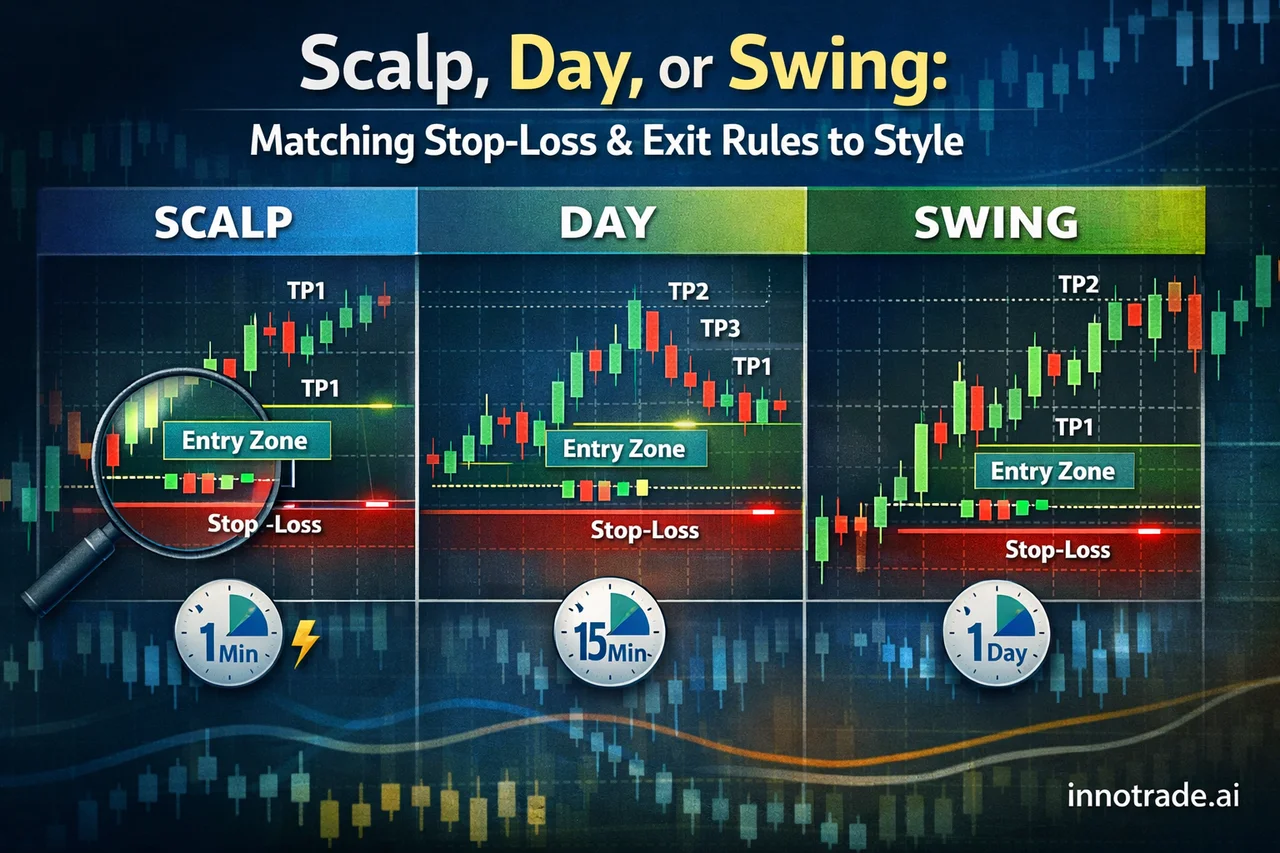
Every AI-generated analysis on innotrade.ai includes the same core components: an entry zone, three take-profit levels (TP1, TP2, TP3), and a stop-loss. What most traders overlook is that a single analysis can be traded three completely different ways depending on whether you approach it as a scalp, a day trade, or a swing position. The signal doesn't change — your execution mechanics should. Getting this wrong is one of the fastest ways to turn a statistically sound setup into a losing trade, because a stop-loss distance that makes sense for a 5-minute scalp will get you stopped out instantly on a swing chart, and vice versa.
Why Stop-Loss Placement Changes With Your Timeframe
Stop-loss distance isn't a fixed number — it's a function of the noise inherent to the timeframe you're trading. The same AI analysis entry can carry very different practical stop placements once you decide how you're going to execute it.
Scalping: Tight Stops Anchored to Micro-Structure
For scalp entries, the stop needs to sit just beyond the nearest micro swing point — usually the low or high of the last one or two candles on a lower timeframe. On gold (XAUUSD), where intraday volatility can be extreme, this typically means a stop distance tight enough to keep risk small but wide enough to avoid being clipped by normal wick noise. Many scalpers pair this with ScalpHunter's confidence scoring (1/5 to 5/5) — a lower confidence reading is a signal to tighten the stop further and reduce size, while a higher confidence read can justify a slightly wider buffer since the setup has more statistical backing behind it.
Day Trading: Session-Range Stops With Trailing Potential
Day traders working the same analysis on a 15-minute to 1-hour chart should place stops beyond the session's opening range or the most recent consolidation zone, not the tiny wicks that scalpers worry about. This wider stop tolerates intraday chop while still respecting the trade's invalidation point. Once price clears TP1 and is pushing toward TP2, a trailing stop mechanism — moved up behind each new higher low (or down behind each new lower high) — lets day traders stay in the trade toward TP3 without giving back the bulk of open profit if momentum stalls.
Swing Trading: Stops Beyond Structural Highs/Lows
Swing traders should ignore intraday noise entirely and place the stop beyond the most recent significant structure — a daily swing low for a long, or a swing high for a short — even if that means a wider stop-loss in absolute pip or dollar terms. The trade-off is a lower position size to keep risk constant. A common adjustment: once TP1 is hit, move the stop to breakeven or just beyond it, locking in a risk-free trade while leaving room for the position to develop toward TP2 and TP3 over subsequent sessions.
Partial Exits at TP1: How Much Should You Take Off?
One of the most practical decisions in trade management is how much size to close when TP1 hits. A workable framework many traders use: close roughly 40–50% of the position at TP1, shift the stop-loss to breakeven on the remainder, and let the balance run toward TP2 and TP3. This locks in a partial win immediately, removes emotional pressure, and converts the rest of the trade into a genuinely risk-free opportunity. Scalpers often take a larger chunk off at TP1 (given the shorter holding period and tighter targets), while swing traders may take a smaller percentage off, preferring to let more of the position ride the larger structural move.
Setting TP2 With Signal Confidence in Mind
Not every setup deserves the same treatment at TP2. When a signal carries a higher confidence reading — more confluence, cleaner structure, stronger momentum behind the entry — it makes sense to hold more of the remaining position toward TP2 rather than trimming further. Lower-confidence setups, by contrast, are reasonable candidates for taking additional profit at TP2 rather than pushing for TP3, since the probability of the move extending that far is inherently lower. This is where matching your strategy style to the signal's underlying risk profile matters: aggressive TP3 targeting suits high-confidence, high-momentum setups; conservative TP1/TP2 scalping suits choppier, lower-confidence conditions.
Choosing the Right Timeframe for Entry Timing
The entry price on an AI-generated signal is a zone, not a single tick — and the timeframe you use to time your entry into that zone should match your strategy. Scalpers should be watching 1-minute to 5-minute charts for a confirmation candle inside the zone. Day traders can be more patient, waiting for a 15-minute or 1-hour candle close to confirm the level is holding. Swing traders can afford to enter across a full 4-hour or daily candle, prioritizing the quality of the structural level over precise timing.
When TP1 Hits But TP2 Doesn't: Exit Rules for Scalpers
Not every trade continues cleanly from TP1 to TP2. Scalpers need a predefined rule for what happens when price reaches TP1, stalls, and starts reversing before TP2. A sensible approach is a time-based or structure-based exit: if price fails to make a new push toward TP2 within a defined number of candles after tagging TP1, close the remainder of the position rather than waiting for the trade to round-trip back to breakeven or the stop. This discipline protects the partial win already banked at TP1 and prevents a good trade from turning into a scratch or a loss.
Combining TP3 Targets With a Trailing Stop for Day Trades
For day traders aiming at TP3, a trailing stop combo works well: once TP2 is hit, trail the stop behind each new higher low on the execution timeframe rather than leaving it fixed at breakeven. This captures more of the move if momentum continues into TP3 while still protecting the bulk of unrealized profit if the trend reverses before the final target is reached.
Building a Multi-Strategy Trade Plan on the Same Pair
Because innotrade.ai's analysis structure supports scalping, day trading, and swing trading simultaneously, it's entirely possible to build a single trade plan around one instrument that layers all three. On a strong XAUUSD setup, for example, a trader might scalp the initial push into TP1 with tight size, hold a separate day-trading position toward TP2 with a trailing stop, and carry a smaller swing position with a wider structural stop toward TP3 — effectively diversifying execution style around one directional thesis rather than one execution risk profile.
What the Data Says About Recent Strategy Performance
Looking at the past week of tracked activity, the platform's daily win rate averaged in the mid-40% range with an average risk-reward ratio hovering around 2.19 — consistent with the kind of asymmetric setups that make partial-exit strategies worthwhile even when the win rate isn't dramatically above 50%. The strongest session of the week, by EV score, came on Saturday, August 1, where a small number of high-RR setups pushed the day's expected value well above the weekly norm. The weakest stretch landed on Sunday, August 2, where thinner conditions and lower follow-through dragged the EV score negative — a useful reminder that stop-loss discipline matters most on exactly these lower-quality sessions. Zooming out, gold-based setups have seen a high volume of tracked entries over the past two weeks with solid TP1 follow-through, though — as expected — fewer of those trades stretched all the way to TP3, illustrating exactly the kind of win-rate decay across TP levels that a tiered exit strategy is built to capture. Across all tracked trades on the platform, the all-time win rate has held near 54.0% with an average RR around 2.01, figures independently mirrored on the platform's Live Trades Scoreboard, which offers a transparent, read-only view of the best-performing recent results.
The Takeaway
The AI analysis gives you the entry, the targets, and the stop — but the execution decisions around lot sizing, partial exits, stop adjustments, and timeframe selection are yours to make, and they should be shaped by which strategy you're actually running. Traders who are new to structuring these rules can find foundational risk management concepts in the Trading Academy, while more experienced traders can track how their own scalp, day, and swing executions perform side by side using Trade Tracking. Matching your stop-loss and exit mechanics to your chosen strategy style is a small adjustment that compounds into a meaningfully different equity curve over time.
Analytical software only. We do not handle funds, make investments, or provide financial advice. Trading involves substantial risk and past performance does not guarantee future results. Always conduct your own research and consider your risk tolerance before making trading decisions.