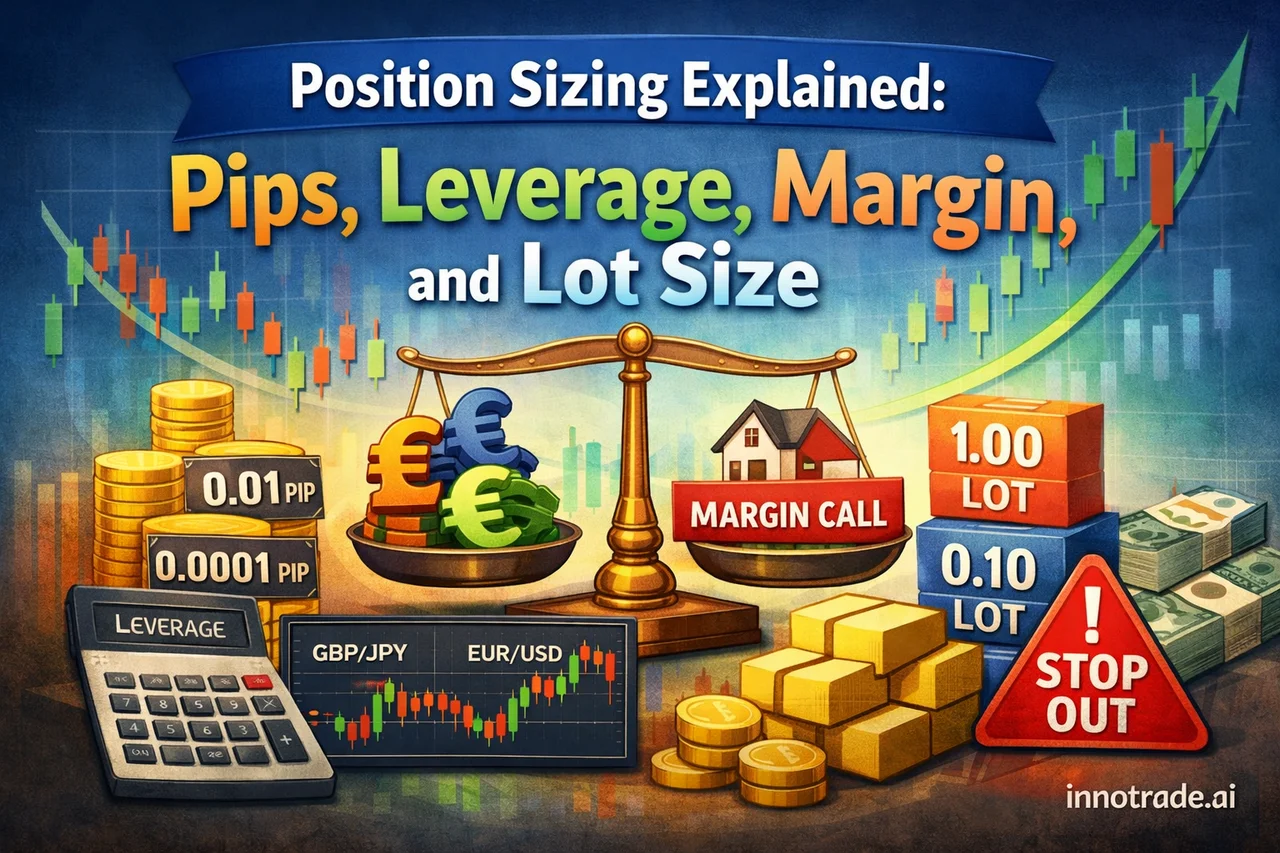
Ask ten new traders what a pip is worth on GBP/JPY versus EUR/USD, and most will guess. Ask them the difference between a margin call and a stop out, and the room goes quiet. These aren't advanced concepts — they're the basic vocabulary of trading, and skipping them is one of the fastest ways to turn a good setup into an account-blowing mistake. Before position sizing, stop-loss placement, or take-profit planning mean anything, you need to understand the mechanics underneath them.
What Is a Pip, and Why Does Its Value Change?
A pip ("percentage in point") is the smallest standardized price movement in most currency pairs — typically the fourth decimal place (0.0001) for pairs like EUR/USD, or the second decimal (0.01) for JPY pairs. That distinction trips up beginners constantly: a 20-pip stop on EUR/USD and a 20-pip stop on USD/JPY represent completely different price distances and, more importantly, different dollar risks.
Pip value also shifts depending on the pair and your account currency. On a standard lot of EUR/USD, one pip is roughly $10. On a standard lot of USD/JPY, it's a different figure entirely because JPY is quoted with fewer decimal places. This is exactly why a stop-loss distance shown in pips on an AI-generated analysis can't be judged in isolation — you have to translate it into actual currency risk for the pair you're trading.
Lot Size vs Position Size: They're Not the Same Thing
Lot size refers to the standardized contract size you're trading — a standard lot (100,000 units), a mini lot (10,000), or a micro lot (1,000). Position size is the broader concept: how much capital you're actually exposing to the market once leverage, lot size, and stop-loss distance are all factored in together.
Two traders can both open "one lot" on the same pair and still carry wildly different risk if one has a 15-pip stop and the other has a 60-pip stop. Position sizing is the discipline of working backward from your risk tolerance — say, 1% of account equity — to determine the correct lot size for a given stop distance, rather than picking a lot size first and hoping the risk works out.
Leverage, Margin, and the Line Between a Margin Call and a Stop Out
Leverage lets you control a larger position than your account balance would normally allow — 1:30, 1:100, 1:500, depending on your broker and jurisdiction. Margin is the portion of your balance set aside as collateral for that leveraged position. The two are inseparable: more leverage means less margin required per trade, but it also means your account can move against you faster in percentage terms.
A margin call is a warning — your broker notifying you that your equity has dropped close to the margin required to keep positions open. A stop out is what happens if you ignore that warning: the broker automatically closes positions to prevent your balance from going negative. Traders who don't understand this distinction often assume they have more breathing room than they actually do, especially when running multiple trades simultaneously and depleting free margin without realizing it.
Spread, Slippage, and the Cost of Getting In and Out
The bid-ask spread is the built-in cost of every trade — the gap between the price you can sell at and the price you can buy at. On liquid pairs like EUR/USD during active hours, spreads are typically tight; on exotic pairs or during low-liquidity windows, they widen, quietly eating into smaller take-profit targets.
Slippage is different: it's the gap between the price you expected and the price you actually got filled at, usually during fast-moving markets or around high-impact news releases. Neither spread nor slippage is a flaw in a trading system — they're structural realities of how markets execute orders, and factoring them in is part of realistic trade planning, not a reason to distrust an entry signal.
Market Orders, Pending Orders, and Reading Your Order Ticket
A market order executes immediately at the current price. A pending order — a limit or stop order — sits and waits for the market to reach a specified level before triggering. Understanding which one you're placing matters enormously when translating an AI-generated entry point into an actual trade: an entry listed as a specific price level is typically meant as a pending order, not an instruction to chase the market with a market order the moment you see the alert.
Before confirming any order ticket, get in the habit of checking four fields every time: order type, lot size, stop-loss price, and take-profit price. It sounds basic, but a mistyped lot size or a stop-loss left on the wrong side of the entry is one of the most common — and entirely preventable — sources of real trading losses.
Long vs Short, and Why Session Overlap Matters
Going long means buying in anticipation of a price rise; going short means selling first with the intent to buy back lower. Both are equally valid directions — the mechanics of pip value, spread, and margin apply identically either way.
Timing matters too. The London-New York session overlap is typically the most liquid window of the trading day, with tighter spreads and stronger follow-through on breakouts. Trading the same setup during a thin Asian-session lull can produce a very different execution experience, even if the technical picture looks identical on the chart.
Demo Account Habits That Don't Survive Contact With Live Money
Demo accounts are valuable for learning platform mechanics, but they train the wrong instincts if you're not careful. Oversized positions feel harmless when there's no real money attached, and many traders carry that habit straight into a live account without adjusting. If you can't explain, in plain terms, why you chose the lot size you did — relative to your stop-loss distance and account equity — you're not really practicing position sizing on demo, you're just clicking buttons.
Where Platform Data Fits Into the Picture
None of this replaces sound judgment, but data can sharpen it. Over the past week, win rates across our tracked daily setups averaged in the mid-40% range, with an average risk-reward ratio near the mid-2s — figures that only mean something once you've correctly sized the position behind each trade. One session mid-week stood out as an exceptionally strong stretch for the AI's calls, while a session later in the week — Friday, September 18 — was noticeably weaker, with a 16.7% win rate and a 2.07 average RR, a reminder that even a data-driven process has rough days.
This is precisely why every trade idea generated on Analysis includes a defined entry, stop-loss, and staged take-profit structure — so the sizing math above has concrete numbers to work with rather than guesswork. Reviewing your own execution afterward on Trade Tracking is how the mechanics in this article turn into a repeatable habit rather than a one-time lesson.
The Takeaway
Position sizing isn't a single formula — it's the sum of understanding pip value, lot size, leverage, margin, spread, and order types well enough that your risk decisions are deliberate rather than accidental. Get the vocabulary right first. If you're still building that foundation, the Trading Academy covers these mechanics in more depth, and the FAQ is a good next stop for platform-specific questions before you size your first live position.
Analytical software only. We do not handle funds, make investments, or provide financial advice. Trading involves substantial risk and past performance does not guarantee future results. Always conduct your own research and consider your risk tolerance before making trading decisions.