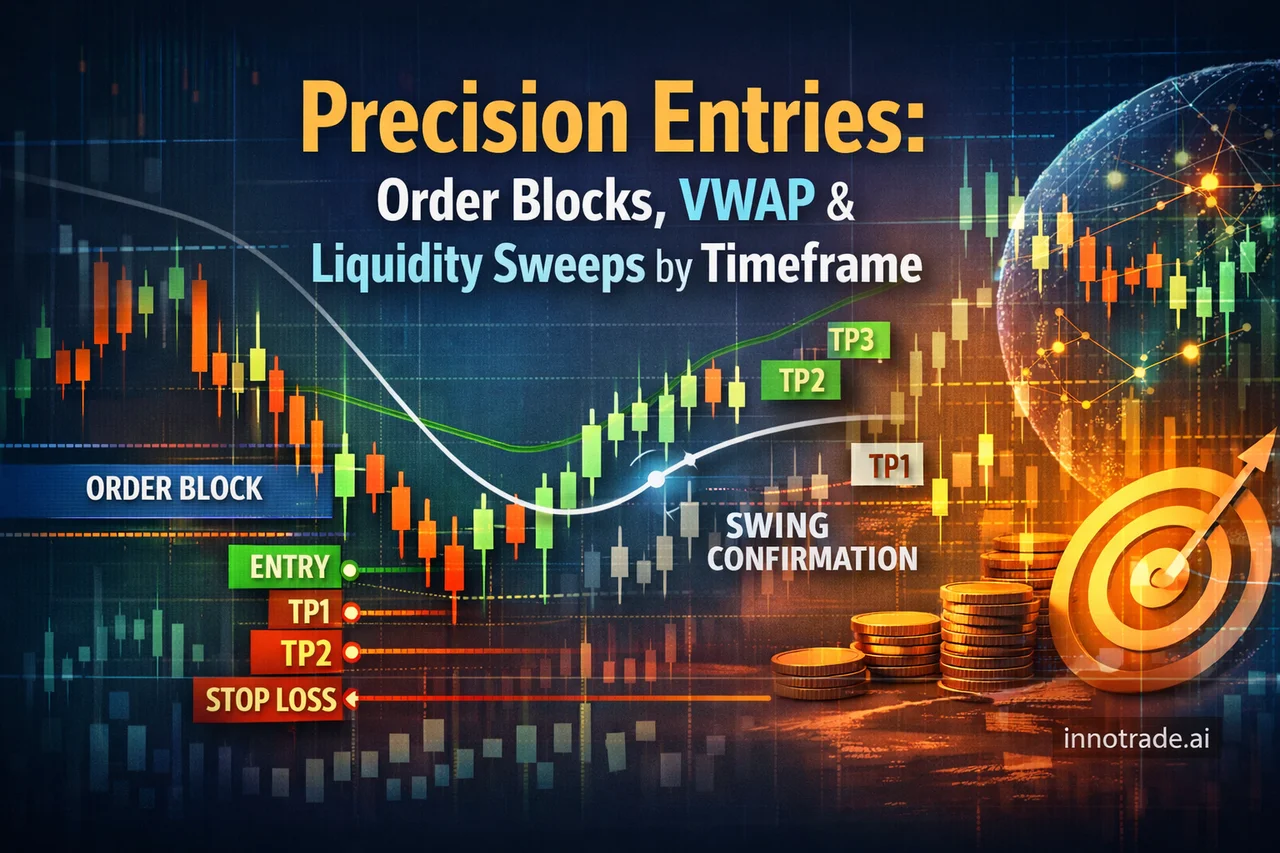
Most traders spend their energy perfecting stop-loss size and take-profit ratios, but the entry trigger itself is where the edge is usually won or lost. A textbook risk-reward setup means little if the entry is placed at the wrong point in the move. This guide breaks down three timeframe-specific entry techniques — order block scalping, VWAP day-trade bounces, and multi-timeframe swing confirmation — and shows how each maps onto the entry, TP1/TP2/TP3, and stop-loss structure used in every AI analysis on innotrade.ai.
Scalping: Order Block Entries With Tight Stop-Loss Discipline
Order blocks — the last opposing candle before a sharp impulsive move — mark where institutional-sized orders likely sat. For scalpers, the rule set is simple but unforgiving: enter on a retest of the block's edge, and place the stop-loss just beyond the block's far boundary rather than an arbitrary pip distance. This keeps risk tight enough to justify scalp-sized position sizes while still giving the trade room to breathe through normal noise.
Order block entries pair well with a moving average crossover as a timing filter — waiting for a fast EMA to cross above a slower one in the direction of the block before triggering avoids catching a fakeout. Similarly, a Keltner Channel breakout beyond the block's edge, rather than a simple touch, filters out low-conviction retests. During the Asian session range, where volatility compresses, scalpers using this combination often take TP1 exits quickly rather than holding for TP2 or TP3 — the range-bound nature of that session rewards fast partial profit-taking over patience. ScalpHunter's confidence scoring (1/5 to 5/5) is designed for exactly this kind of fast decision-making — see ScalpHunter for how real-time confidence levels are generated.
Day Trading: VWAP Bounces and Pivot Point Confluence
For intraday traders, the volume-weighted average price (VWAP) acts as a magnet and a fair-value reference. The classic VWAP bounce entry/exit setup involves waiting for price to tag VWAP after an initial directional move, confirming rejection with a candle close back in the trend's direction, and exiting the first portion of the position near the prior session high or low. Layering in pivot point levels — particularly the daily pivot and R1/S1 — gives a second confirmation layer: a VWAP bounce that also respects a pivot level carries more weight than one that doesn't.
Day traders should also watch the economic calendar closely. High-importance releases like Core PCE Price Index or Prelim GDP data can distort VWAP behavior for the first 15–30 minutes after release, pushing price through the average without a genuine bounce. Waiting for the initial spike to settle before trusting a VWAP-based entry avoids getting caught in news-driven noise. An engulfing candle reversal at VWAP, confirmed on a lower timeframe, is one of the cleaner day-trade triggers — scaling out at TP1 to lock in gains and letting a smaller portion of the position run toward TP2 keeps risk managed without fully missing extended moves. When the broader daily trend is intact, a trend continuation pullback to VWAP after a pause — rather than a reversal signal — is usually the higher-probability read, with the stop-loss placed beyond the most recent swing point rather than a fixed distance.
Swing Trading: Multi-Timeframe Confirmation and Staggered Targets
Swing setups demand patience and confluence across timeframes. A practical multi-timeframe swing trade confirmation checklist looks like this: confirm directional bias on the daily chart, identify a key structure level (support/resistance or a fibonacci retracement zone) on the 4-hour chart, and time the actual entry on the 1-hour chart using a trigger candle. A liquidity sweep reversal — where price briefly pierces a prior high or low to trigger stops before reversing — is one of the most reliable swing triggers, and the stop-loss belongs just beyond the sweep's extreme, not at the original structure level, since that's exactly where late entries get stopped out prematurely.
Fibonacci retracement entries work best when paired with staggered TP levels rather than a single exit: taking partial profit at the 1:1 extension, more at the 1.618 extension, and letting a small runner target the full measured move mirrors exactly how TP1, TP2, and TP3 are structured in each AI analysis — each level represents a progressively lower-probability, higher-reward milestone, which is why win rates naturally decay as you move from TP1 through TP3. An inside bar breakout on the 4-hour or daily chart, confirmed by the higher-timeframe trend, gives swing traders a clean, low-noise entry that fits naturally into this staggered exit approach.
What the Data Shows: Technique Choice Matters More Than Win Rate Alone
Over the most recent seven-day window tracked on the platform, the average win rate across daily analyses sat near 52.4%, with an average risk-reward ratio close to 2.08 — a healthy combination that reflects disciplined entry timing rather than simply chasing high win rates. The strongest session by expected value was Friday, August 21, where a 57.1% win rate combined with an average RR near 2.49 produced the week's best EV score, suggesting that a smaller number of well-timed swing and day setups outperformed a higher volume of marginal ones. By contrast, Saturday, August 22 was the weakest session of the period, with a 28.6% win rate and a lower average RR — a reminder that even a sound entry framework underperforms when liquidity thins and false breakouts multiply.
Looking at recent instrument activity, XAUUSD has carried the highest volume of tracked setups over the past two weeks, with consistent TP1 follow-through and solid continuation into TP2 and TP3 — though it has also produced its share of stopped-out trades, underscoring why precise stop-loss placement at structural levels (order blocks, sweep extremes, swing points) matters more than fixed pip distances. AUDJPY and XRPUSD showed similar patterns on a smaller scale, with fewer setups but comparable TP-level follow-through. Across all tracked trades on the platform, the all-time win rate has held near 53.9% with an average RR of 2.02 — a useful long-run baseline against which any single week's performance should be measured, rather than a promise of what any individual trade will do.
Building Your Own Precision Entry Checklist
The common thread across all three timeframes is that the entry trigger and the stop-loss placement are inseparable decisions — where you get in determines where your stop realistically belongs. Before applying any of these techniques live, it's worth reviewing the underlying concepts in the Trading Academy, then testing entries against the AI-generated analysis structure available through Analysis, which lays out entry, TP1/TP2/TP3, and stop-loss for each tracked instrument. Logging your own results in Trade Tracking over a few weeks will tell you far more about which technique suits your temperament than any single winning trade. For proof of how disciplined setups have performed historically, the Live Trades Scoreboard offers a transparent, read-only record of the platform's best-performing analyses over the past two weeks.
None of these techniques guarantee a winning trade — markets don't work that way. What they do is remove guesswork from two of the highest-leverage decisions in any trade: where to get in, and where to admit you were wrong. Combine that discipline with realistic position sizing and you have the foundation of a repeatable process, regardless of which timeframe you trade.
Analytical software only. We do not handle funds, make investments, or provide financial advice. Trading involves substantial risk and past performance does not guarantee future results. Always conduct your own research and consider your risk tolerance before making trading decisions.