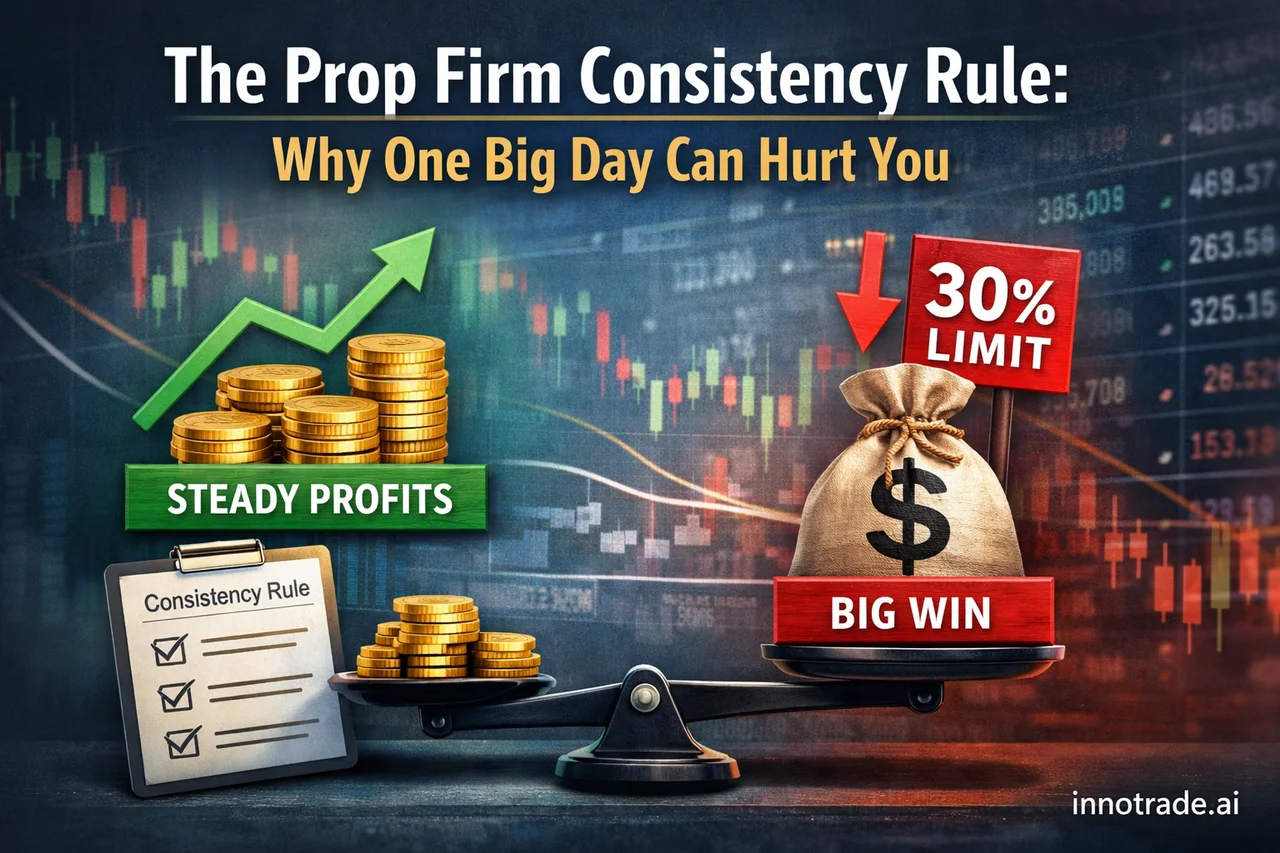
Most traders preparing for a prop firm challenge fixate on the obvious rules: maximum daily loss, overall drawdown, minimum trading days. Far fewer pay attention to a quieter requirement that trips up otherwise successful traders at payout time — the consistency rule, also called the profit consistency requirement.
In simple terms, many funded trading programs stipulate that no single trading day can account for more than a set percentage (commonly 20-30%) of your total profit during the evaluation or payout period. The logic is sound: firms want proof you can generate returns methodically, not that you got lucky once and coasted on that single result. But this rule catches traders off guard precisely because it rewards behavior most retail traders aren't used to thinking about — spreading performance evenly across sessions rather than chasing one outsized win.
Why a Single Big Day Can Actually Hurt Your Application
Imagine a trader has a phenomenal Tuesday, doubling their weekly profit target in a single session on a strong trending move. It feels like a win. But if that one day now represents, say, 45% of the account's total profit for the evaluation period, many prop firms will flag the account for review or delay the payout until the trader demonstrates further consistent sessions. The very day that felt like validation becomes a compliance problem.
This is where understanding your own performance distribution matters. A trader who tracks daily win rate, average risk-reward, and expected value (EV) session by session can spot when they're drifting toward an uneven profit curve — and adjust position sizing or trade frequency accordingly before a firm's compliance team does it for them.
What a Real Week of Data Looks Like
To illustrate what "consistency" actually looks like in practice, it helps to look at real, dated performance rather than an abstract average. Over the past seven tracked days on innotrade.ai, daily win rates ranged from 40.0% up to 83.3%, with average risk-reward ratios swinging between 1.65 and 3.11 depending on the day's market conditions. Ranked by EV score — the metric that blends win rate and RR into a single measure of trade quality — Monday, August 31 was the strongest session of the period, with an EV score of 1.21 on an 83.3% win rate and a 1.65 average RR. The weakest session, by contrast, was Wednesday, August 26, where EV dipped to 0.43 alongside a 40.0% win rate and a 2.57 average RR.
Notice something important here: the strongest day by EV wasn't the day with the highest RR — Sunday, August 30 actually posted a higher average RR of 3.11. This is exactly the kind of nuance that a consistency-focused trader needs to internalize. Chasing the single highest-RR day is not the same as building a steady, compliant equity curve. EV score matters more than any one metric in isolation, because it reflects the balance between how often you win and how much you win when you do.
The Takeaway for Prop Firm Traders
Averaged across the full week, win rates and RR figures settle into a much steadier picture than any single day suggests — which is the entire point of consistency requirements. Firms aren't asking you to eliminate variance entirely (that's unrealistic in any market), they're asking you to avoid relying on outlier sessions. A trader who understands their own weekly distribution, rather than fixating on their best-ever day, is in a far stronger position to pass evaluation and clear payout review.
How AI-Assisted Analysis Supports Steadier Results
This is precisely where structured, data-driven analysis earns its keep. Rather than manually journaling every session and hoping to spot patterns, traders working within a prop firm framework can use AI-generated trade analysis to maintain a repeatable process — the same entry logic, the same three-tier take-profit structure (TP1, TP2, TP3), and the same stop-loss discipline applied session after session. Scaling out at TP1 first, then TP2, then TP3 naturally smooths the profit curve over time, because it reduces the odds of any single trade or single day dominating your results — precisely the outcome a consistency rule is designed to encourage. Each level captures partial profit progressively, rather than betting the full position on a single outsized move.
The value isn't in guaranteeing a particular outcome — no analysis tool can do that, and any platform claiming otherwise should be treated with skepticism. The value is in repeatability. Across all tracked trades on innotrade.ai, the platform has maintained an all-time win rate of 53.8% with an average RR of 2.02 — figures that reflect a large, aggregated sample rather than any single lucky stretch. That kind of broad-based consistency is a far more useful benchmark for prop firm traders than any individual day's numbers, good or bad.
Practical Steps to Stay Consistency-Rule Compliant
- Track your daily profit distribution, not just your total. Use a personal trade tracking dashboard to see exactly what percentage of your total profit came from each session, not just your overall win rate.
- Avoid oversized position increases after a win streak. If Tuesday went unusually well, resist the urge to double size on Wednesday to "lock in" the week — that's exactly the behavior that skews your profit distribution and risks non-compliance.
- Respect your stop-loss and TP structure every session. Consistent adherence to a predefined risk-reward framework, rather than improvising on strong days, is what produces a steady curve over weeks and months.
- Review verified statistics, not gut feeling. Public, third-party-verifiable results — such as those synced with Myfxbook — give traders an honest reference point for what "normal" variance looks like across a real sample, rather than anchoring on their own best day.
For traders newer to these concepts, the Trading Academy covers risk management fundamentals in more depth, and the FAQ addresses common questions about how analysis and tracking tools fit into a broader trading plan. Those evaluating whether a data-driven approach suits their prop firm goals can review the full feature set or start with a trial via the pricing page.
Final Thought
Passing a prop firm evaluation — and clearing payout review afterward — isn't about having your best day ever. It's about proving you can produce steady, repeatable results across many sessions, including the mediocre ones. The trader who understands this, and structures their process around consistency rather than home runs, is the one who actually gets paid.
Analytical software only. We do not handle funds, make investments, or provide financial advice. Trading involves substantial risk and past performance does not guarantee future results. Always conduct your own research and consider your risk tolerance before making trading decisions.