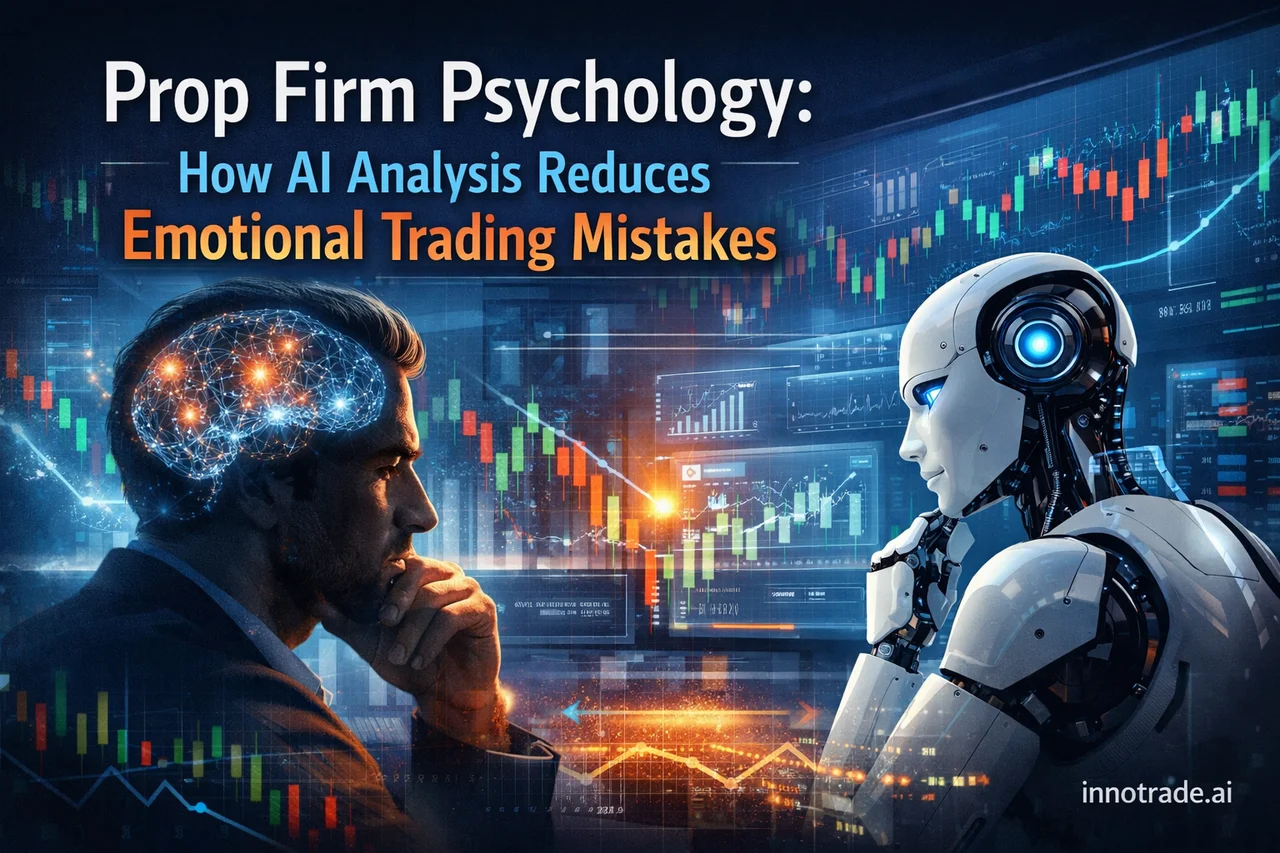
The psychology of prop firm challenges extends far beyond technical analysis and risk management rules. While most traders focus on hitting profit targets and avoiding drawdown limits, the real battle often occurs in the mind. Emotional decision-making has derailed more prop firm attempts than poor strategy or market volatility combined.
This is where AI-assisted analysis creates an unexpected psychological advantage. By removing the emotional burden of decision-making from individual trade setups, traders can focus on execution rather than second-guessing every market movement.
The Emotional Trap of Prop Firm Pressure
Prop firm challenges create a unique psychological environment. Unlike live trading with personal funds, every decision carries the weight of potential qualification. This pressure manifests in several destructive ways:
- Revenge trading after early losses to "make up" for missed targets
- Analysis paralysis when approaching profit goals, leading to missed opportunities
- Overconfidence during winning streaks, resulting in position size violations
- Fear-based exits that cut profitable trades short before reaching targets
Traditional discretionary trading amplifies these psychological pitfalls because every decision originates from the trader's emotional state. A frustrated trader makes different choices than a confident one, even when viewing identical market conditions.
How AI Analysis Provides Psychological Stability
AI-generated trading analysis functions as an emotional circuit breaker. When signals are produced through data-driven algorithms rather than human intuition, the psychological component shifts dramatically. Instead of wrestling with "should I enter this trade?" the question becomes "should I follow this AI-generated signal?"
This subtle distinction removes layers of emotional decision-making that typically sabotage prop firm attempts. Recent platform performance data demonstrates this psychological advantage in action. Over the past week, AI analysis maintained remarkably consistent performance across varying market conditions, with win rates ranging from solid recovery sessions to exceptionally strong periods where setups aligned particularly well.
The consistency emerges because AI doesn't experience frustration, fear, or overconfidence. Wednesday's moderate session with a win rate of 57.1% and average RR of 1.15 was followed by Thursday's stronger performance at 71.4% and 1.69 RR. A human trader might have carried Wednesday's disappointment into Thursday's session, potentially missing the improved opportunities. AI analysis simply processed Thursday's market data independently.
Breaking the Perfectionism Cycle
Many prop firm candidates fall into perfectionism traps, believing every trade must hit maximum targets to succeed. This mindset creates enormous pressure and leads to poor decision-making when positions move against them initially.
AI analysis naturally incorporates multiple take-profit levels (TP1, TP2, TP3) that psychologically normalize partial profits. Rather than viewing anything less than maximum profit as failure, traders learn to appreciate graduated success. This mental framework reduces the all-or-nothing thinking that destroys prop firm accounts.
Maintaining Emotional Distance During Drawdowns
Drawdown periods test every prop firm candidate's psychological resilience. When facing consecutive losses, emotional traders typically respond with one of two destructive patterns: aggressive revenge trading or complete paralysis.
AI-assisted analysis provides crucial emotional distance during these challenging periods. The platform's recent data shows how systematic analysis continues generating signals even during weaker market conditions. Saturday's session, while showing a negative EV score, still produced actionable setups based on technical criteria rather than emotional reactions to previous losses.
This systematic approach helps traders understand that drawdowns are statistical inevitabilities, not personal failures. When losses result from following predetermined AI signals rather than emotional decisions, the psychological recovery becomes much faster.
Consistency Over Home Runs
Prop firm psychology often drives traders toward "home run" mentality – seeking massive wins that will quickly achieve profit targets. This mindset typically leads to oversized positions and rule violations.
The platform's all-time performance metrics of 54.2% win rate with 2.04 average RR demonstrate how consistent, methodical analysis outperforms emotional swings for home runs. These figures represent thousands of systematic decisions rather than occasional lucky strikes, providing the steady progress prop firms actually reward.
Managing Success Without Overconfidence
Ironically, success can be as psychologically dangerous as failure in prop firm challenges. Winning streaks often breed overconfidence, leading traders to increase position sizes or ignore risk management rules just before qualification.
AI analysis provides a psychological anchor during strong performance periods. Friday's exceptional session with an 80.0% win rate and EV score of 1.18 represents exactly the kind of day that might trigger overconfidence in discretionary traders. However, when success comes from following systematic signals rather than "brilliant" personal insights, the psychological inflation remains contained.
The trader can appreciate the strong results without assuming they've suddenly become a market wizard. Monday's follow-up performance of 77.8% win rate with 1.20 RR shows how systematic analysis maintains steady performance without the emotional volatility that typically follows exceptional days.
Building Sustainable Trading Habits
Perhaps most importantly, AI-assisted analysis helps develop the psychological habits that serve funded traders long after passing initial challenges. The mental discipline required to consistently follow systematic signals directly translates to the emotional control needed for long-term prop firm success.
This psychological training becomes particularly valuable during live trading phases, where the pressure shifts from "passing the challenge" to "maintaining consistent profits." Traders who have developed comfort with systematic decision-making find this transition much easier than those accustomed to emotional, discretionary approaches.
The Trade Tracking dashboard reinforces these psychological benefits by providing objective performance feedback. Rather than relying on emotional impressions of "how trading is going," traders can review concrete statistics that support rational decision-making.
Practical Implementation for Prop Firm Success
To leverage AI analysis for psychological advantage in prop firm challenges:
- Pre-define your signal criteria before market open to avoid emotional adjustments
- Focus on execution quality rather than individual trade outcomes
- Review performance data weekly to maintain objective perspective on progress
- Use partial profit-taking to normalize "good enough" results over perfect outcomes
- Document emotional states alongside trading decisions to identify psychological patterns
The AI Analysis tool provides the systematic foundation, but the psychological benefits only emerge through consistent application. Traders must commit to following signals even when emotional instincts suggest different actions.
Consider starting with the 7-day free trial to experience how systematic analysis feels different from emotional decision-making. Many traders report immediate psychological relief when shifting from "What should I do?" to "What does the analysis suggest?"
This psychological shift represents the hidden edge in prop firm trading – not just better signals, but better emotional control that sustains performance across the full challenge timeline and beyond into funded trading success.
Analytical software only. We do not handle funds, make investments, or provide financial advice. Trading involves substantial risk and past performance does not guarantee future results. Always conduct your own research and consider your risk tolerance before making trading decisions.