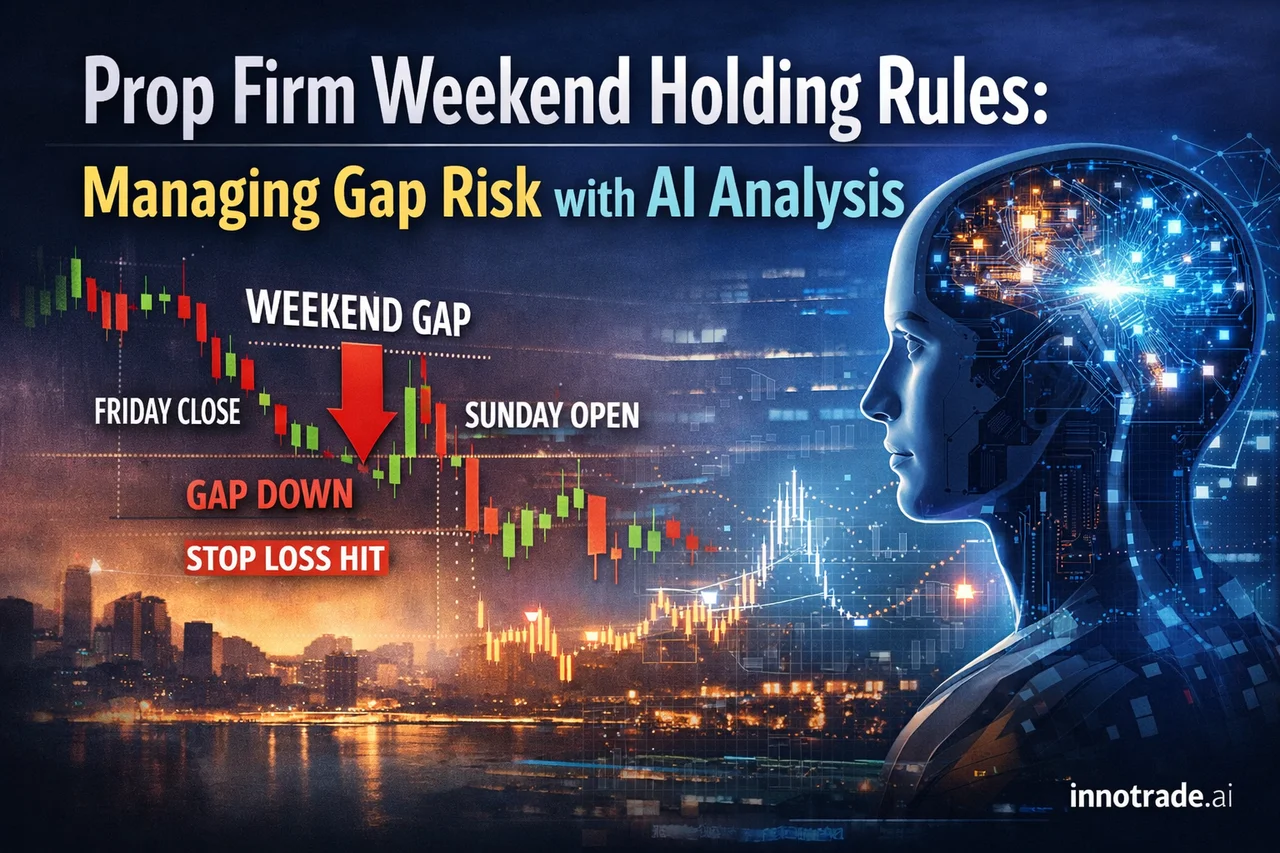
Ask any funded trader what killed their first challenge attempt, and a surprising number will point to something that happened while the markets were closed. A position held into Friday's close looked fine on the chart. By Sunday evening, the same trade opened dozens of pips away from where it settled — enough to blow through a stop-loss buffer or wipe out a week of careful gains in a single gap. Weekend holding risk is one of the least discussed but most consequential variables in prop firm trading, and it deserves a closer look.
Why Weekend Holding Rules Exist
Many prop firm programs build specific provisions around holding positions over the weekend — whether that's an outright restriction, a requirement to reduce position size before the close, or simply a warning that any resulting drawdown from a weekend gap counts fully against the account's loss limits. The logic is straightforward: liquidity thins out before the close on Friday, and when markets reopen Sunday evening, price can jump straight past levels that would normally offer support, resistance, or a controlled exit. For a trader mid-challenge, that unpredictability turns a manageable trade into an account-ending event.
This matters more for some instruments than others. Gold, major indices, and certain crypto-correlated forex pairs are particularly prone to weekend gaps around geopolitical headlines or unexpected pre-market data revisions. Traders working toward a funded account need a repeatable way to decide, trade by trade, whether a position deserves to be carried into the weekend or closed out regardless of how promising the setup looks on Friday afternoon.
Where Gap Risk Shows Up in Recent Data
Looking at the platform's tracked performance over the past week offers a useful illustration of how conditions shift heading into the weekend close. Across the seven most recent tracked sessions, the average win rate landed around 55.8% with an average risk-reward ratio near 2.31 — a healthy baseline for a mixed week of scalp, day, and swing setups.
The standout session of the week, ranked by EV score, posted a reading of 2.41 — a day where the AI's calls lined up unusually well across multiple instruments. On the other end, the weakest session by EV score came in at -0.70, with a win rate of 14.3% and an average RR of 1.13, a reminder that even a data-driven process has stretches where market conditions simply work against the setups. Friday, August 7 — the session immediately preceding the weekend close — logged a win rate of 62.5% with an average RR of 2.70 and an EV score of 1.31, while the following Saturday session, on much lighter volume, settled near a 50% win rate with a more modest 1.35 average RR.
That Friday-to-Saturday transition is exactly the window where weekend holding decisions get made. A trader relying purely on gut feel about "how the week is going" doesn't have visibility into EV score, RR consistency, or how a specific setup's TP and SL levels are structured relative to known event risk. Structured AI analysis makes that visibility explicit — every trade idea comes with a defined entry, three take-profit levels, and a stop-loss, giving the trader a clear reference point for whether a position is still inside its intended risk parameters as the weekend approaches.
Deciding What to Hold and What to Close
Not every open position needs to be closed before a weekend. The more useful question is whether the trade's stop-loss placement already accounts for realistic gap distance, and whether the setup's timeframe justifies carrying that risk. A few practical checkpoints:
- Check the instrument's historical gap behavior. Gold and index CFDs gap more frequently and more sharply than most major forex pairs — treat them with extra caution into a weekend close.
- Compare stop distance to typical gap size. If your stop sits closer than the instrument's average weekend gap, the position is effectively unprotected during non-trading hours.
- Weigh upcoming scheduled data. Reports like Retail Sales, Core Retail Sales, or Prelim UoM Consumer Sentiment — all recently on the calendar — can move markets sharply at the Sunday reopen if released or revised over the weekend window. Trades held through these releases carry a different risk profile than a Tuesday afternoon scalp.
- Respect your prop firm's specific language. Some evaluation rules count weekend gap losses against daily loss limits even though no trading technically occurred that day — know exactly how your firm defines a "trading day" before assuming you're covered.
None of this requires guessing. A trade generated with defined TP1/TP2/TP3 levels and a clear stop already tells you how much room the setup has before it invalidates — which makes the hold-or-close decision a mechanical one rather than an emotional one.
Consistency Matters More Than Any Single Trade
Across all tracked trades, the platform has maintained an all-time win rate of 53.8% with an average RR of 2.02 — figures that reflect a large and varied sample rather than any single week's conditions. That baseline is useful context, but the week-to-week view is what actually matters for a trader managing a live challenge, because prop firm evaluations are won or lost on the consistency of the curve, not on any one exceptional day. The Live Trades Scoreboard exists purely as a transparency layer for this reason — it shows verified past results across users so traders can see, in plain terms, that strong performance is tracked and published rather than claimed after the fact.
For your own account, the more actionable resource is your personal trade tracking dashboard, where you can review your own win rate, RR consistency, and strategy breakdown over time — including how your trades performed specifically around weekend closes. That kind of self-review is what separates traders who pass a challenge once from those who can repeat it.
Building a Weekend Risk Protocol
If you're actively working through a prop firm evaluation, write down a simple rule before Friday's session starts: which instruments you'll close outright, which you'll reduce, and which you'll allow to run with an existing stop already accounting for gap risk. Pair that rule with structured analysis rather than adjusting it emotionally as the week's P&L swings. New traders building this discipline from scratch can find grounded, no-hype guidance in the Trading Academy, and anyone still comparing tools can review the full breakdown of capabilities on the features page or check common platform questions in the FAQ.
Weekend gap risk isn't dramatic — it's quiet, and that's exactly why it catches so many challenge attempts off guard. Treat it as a defined variable with a defined rule, not an afterthought, and it stops being a threat to your evaluation.
Analytical software only. We do not handle funds, make investments, or provide financial advice. Trading involves substantial risk and past performance does not guarantee future results. Always conduct your own research and consider your risk tolerance before making trading decisions.