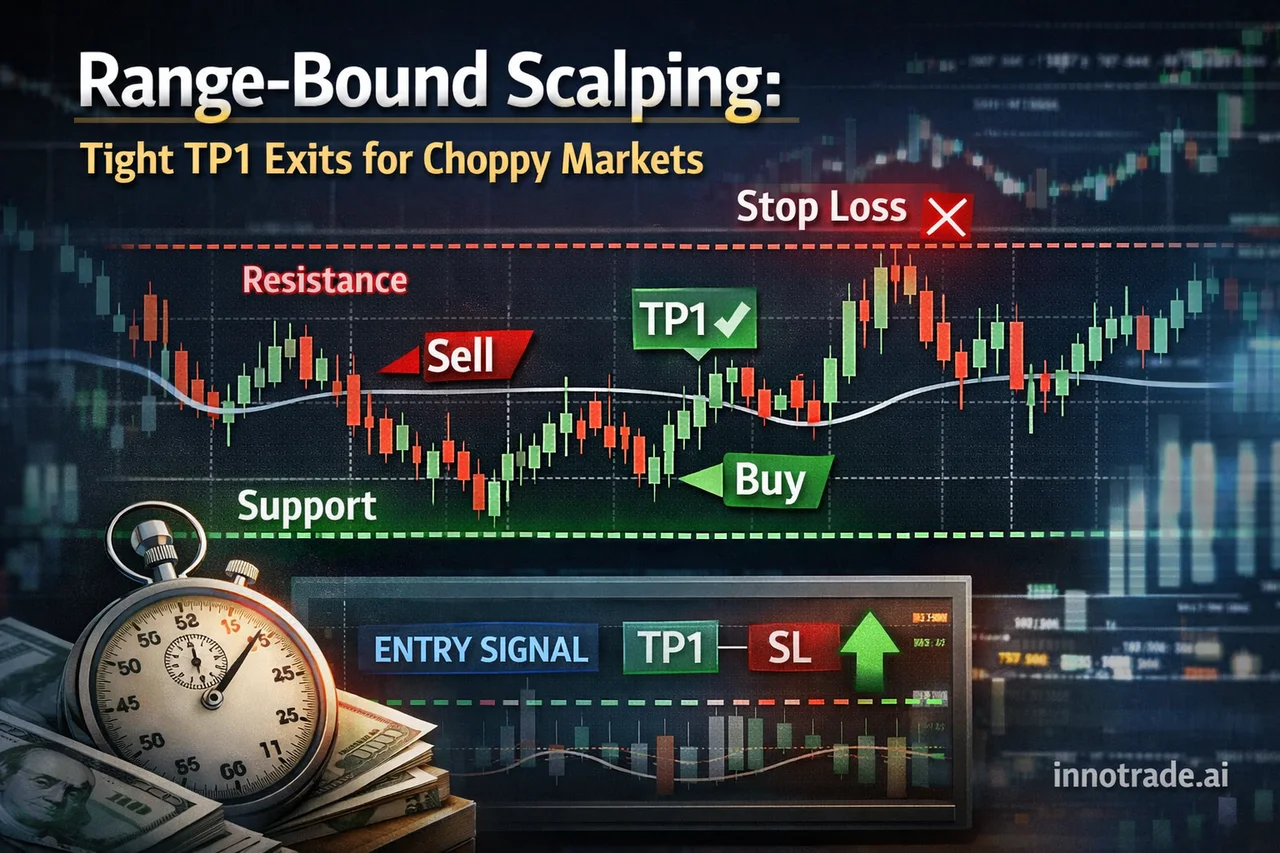
Not every session trends. In fact, most retail traders lose the majority of their equity not during strong directional moves but during the long, grinding hours when price oscillates inside a defined range. Range-bound scalping is a discipline of its own — it rewards patience, tight exits, and a healthy respect for spread cost. This guide breaks down how to build a range-bound scalping strategy around AI-generated entries, tight TP1 exits, and a stop-loss structure that keeps you out of trouble when the chop eventually breaks.
Why Range Conditions Demand a Different Playbook
Trend strategies rely on momentum carrying price toward TP2 and TP3. Range conditions do the opposite — price tends to stall, reverse, and retest the same boundaries repeatedly. A scalper who tries to hold for TP3 in a range often watches a winning trade round-trip back to breakeven or stop-loss. The fix isn't a different indicator; it's a different exit philosophy. In range conditions, TP1 becomes the primary profit target rather than a partial exit, because the statistical edge lies in capturing the small, repeatable move between range boundaries rather than chasing an extended breakout that may never arrive.
This is where AI analysis earns its keep. Each generated setup on innotrade.ai includes a defined entry, three take-profit levels, and a stop-loss — but the way you use that structure should adapt to market context. In a clean range, treat TP1 as your realistic destination and consider tightening your exit expectations rather than holding through TP2 and TP3.
Filtering Out the Chop: Building an Entry Filter
The single biggest mistake in range scalping is entering on every signal regardless of context. A choppy range filter should ask three questions before any entry is taken:
- Has price respected the same boundary at least twice? A range only qualifies as tradeable once support and resistance have been tested and held.
- Is the stop-loss distance proportionate to the range width? If the AI-generated stop-loss sits close to the middle of the range rather than just beyond a boundary, the risk-reward math for a scalp rarely justifies the trade.
- Are there low-importance news events on the calendar? Range scalping performs best in quiet news windows. Low-impact releases such as Crude Oil Inventories data or the UK's HPI yearly figures rarely trigger the volatility spikes that break a range apart mid-trade, making them safer windows for tight scalps than high-importance prints like a CPI release.
Pairing this filter with the AI's structured entry and stop-loss levels gives you a mechanical way to separate genuine range setups from noise — instead of guessing where the boundaries are, you're confirming that the signal's own risk parameters match a range-appropriate profile.
Low-Volatility Pairs and the Spread Problem
Scalping only works if the spread doesn't eat your edge. Tight-range scalping is best suited to instruments with naturally low volatility and tight spreads — pairs like EURGBP or USDCAD tend to hold cleaner, more predictable ranges during quieter sessions compared to higher-volatility instruments like BTCUSD or gold. Over the past two weeks, USDCAD has shown consistent TP1 follow-through across tracked setups, illustrating exactly the kind of steady, range-friendly behavior that suits a tight-exit scalping approach. Compare that to a symbol like XAUUSD, which sees far higher trade volume and volatility — great for swing or breakout strategies, but often too erratic for a pure range scalp.
Applying the Data: What Recent Weekly Performance Tells Us
Across the last seven tracked days on the platform, the average win rate sat around 63.5% with an average risk-reward ratio near 2.38 — a healthy baseline for evaluating whether a scalping filter is adding value or just adding noise. Not every day looked the same. Thursday, July 16 stood out as the strongest session of the period by EV score, with a win rate of 84.6% and an average RR of 2.09, suggesting conditions where setups aligned unusually well. By contrast, Tuesday, July 21 was the weakest session by EV score, with a win rate of 44.4% and an average RR of 2.58 — a reminder that even a favorable RR profile can't fully offset a rougher win-rate day.
The lesson for range scalpers: don't judge your filter on a single session. Look at the weekly trend, note where EV dipped, and ask whether that dip coincided with a breakout day rather than a genuine range day. A range-scalping strategy is not designed to perform on trending days — the filter should keep you flat when conditions clearly favor a breakout strategy instead.
Stop-Loss and Position Sizing for Tight Ranges
Because range scalps target a smaller distance to TP1, the stop-loss must be placed with equal precision — typically just beyond the range boundary rather than at a wide, arbitrary distance. This naturally produces a smaller stop distance, which means position size can often be adjusted upward while keeping the same dollar risk, but only if the range is genuinely holding. Traders who want to track how their sizing decisions interact with actual outcomes over time should use Trade Tracking to review win rates and RR by strategy type — separating range scalps from swing or breakout trades makes it far easier to see which context is producing your real edge.
A Simple Range-Scalping Checklist
- Confirm the range with at least two respected touches of support and resistance
- Check that the AI-generated stop-loss sits just beyond the boundary, not in the middle of the range
- Treat TP1 as the primary target; only hold toward TP2/TP3 if the range shows signs of breaking
- Avoid entries around high-importance news events; favor quiet calendar windows
- Prefer lower-volatility pairs with tighter spreads for pure scalping setups
For traders who want a faster-paced complement to structured range scalping, ScalpHunter surfaces real-time opportunities with confidence ratings, which can help confirm whether current conditions still favor a tight-range approach. And if you're new to structuring exits and stop-loss placement in general, the Trading Academy covers the fundamentals before you apply them to live setups.
The Takeaway
Range-bound scalping isn't about predicting the next big move — it's about harvesting small, repeatable edges while conditions remain contained, and stepping aside the moment they don't. Use the AI's entry and stop-loss structure as your filter, treat TP1 as your realistic destination in a range, and let the weekly data — not a single lucky day — guide your confidence in the approach. Platform performance, including verified historical results, is also visible on the Live Trades Scoreboard as a transparent record of past outcomes across all users, though it should be read purely as a proof-of-performance page rather than a source of trade signals. Explore the full Features overview or start a free trial to see how structured entries and disciplined exits can fit into your own range-trading routine.
Analytical software only. We do not handle funds, make investments, or provide financial advice. Trading involves substantial risk and past performance does not guarantee future results. Always conduct your own research and consider your risk tolerance before making trading decisions.