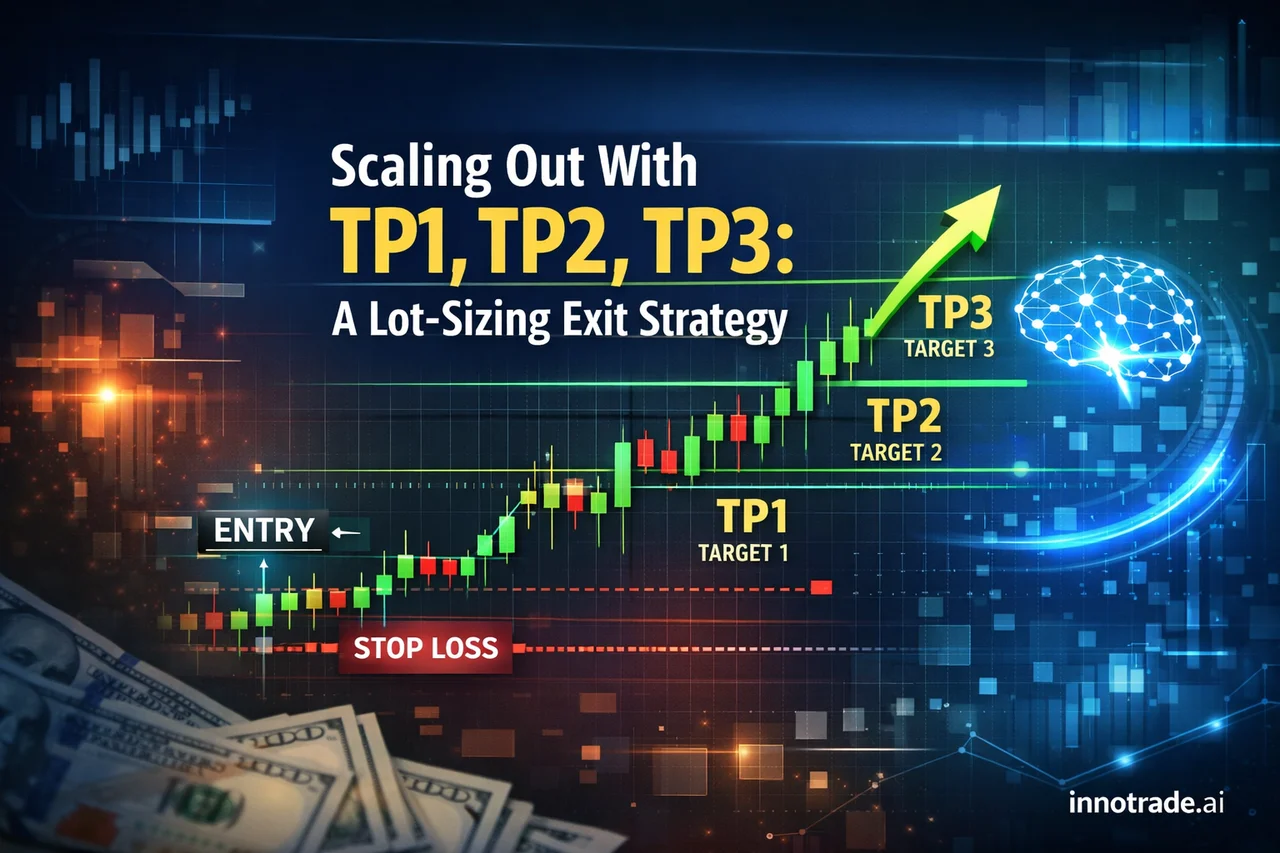
Most traders treat a take-profit level as a single decision: the trade is either open or closed. But the traders who consistently extract more value from the same setup are the ones who treat TP1, TP2, and TP3 as three separate exit decisions, each with its own lot allocation, its own stop-loss logic, and its own role depending on whether you're scalping, day trading, or holding a swing position. This guide breaks down exactly how to do that — and how to align it with the structure of an AI-generated analysis.
Why Every AI Analysis Is Built Around Three Exits, Not One
Every analysis on innotrade.ai is structured the same way: a defined entry, a stop-loss, and three take-profit levels — TP1, TP2, TP3 — each representing a progressively larger risk-reward multiple. This isn't arbitrary. It reflects a simple market truth: price rarely moves in a straight line to its final target. Some momentum fades after the first leg, more continues to the second, and only the strongest moves reach the third. Because each level is measured independently, it's completely normal — and expected — for TP1 to be reached far more often than TP3. That decay isn't a flaw in the signal; it's the reason scaling out exists as a strategy in the first place.
Matching Lot Size to TP Spacing
The core idea behind scaling out is simple: don't put all your risk on a single outcome. A common allocation splits a position into thirds — for example, closing 40-50% of the position at TP1, another 30% at TP2, and letting the final 20-30% run toward TP3 with a trailing stop. The exact split should reflect how far apart the levels are. If TP1 sits close to entry and TP2/TP3 are spaced much wider, it often makes sense to take a slightly larger chunk off at TP1 to lock in reward quickly, since price has more room to reverse before reaching the deeper targets. Conversely, if all three levels are tightly clustered, a more even three-way split can make sense since the reward-to-distance ratio between levels is more consistent.
Scalping: TP1 Is the Job, Not the Bonus
On 1-minute and 5-minute charts, especially in fast instruments like XAUUSD during London or New York session opens, TP1 should generally be treated as the primary objective rather than a partial exit. Volatile gold sessions can reverse a 15-pip move in seconds, so a scalping approach typically closes the majority of the position at TP1 and only lets a small remainder run toward TP2 with a stop moved to breakeven. This is also where tools like ScalpHunter, with its 1-5 confidence scoring, can help filter which setups are worth holding past that first target at all — a 5/5 confidence scalp behaves very differently from a 2/5 one, even if the entry structure looks identical on the chart.
Day Trading: Anchor the Stop to Structure, Not Just the Signal
Day trading benefits from a slightly wider lens. Rather than accepting an AI-generated stop-loss at face value, many traders use it as a starting point and then confirm it against the nearest swing low (for longs) or swing high (for shorts) on the execution timeframe. If the suggested stop sits comfortably beyond that structural level, it's validated. If it sits inside it, tightening or widening the stop to respect that structure — while adjusting position size to keep dollar risk constant — is a smart manual check that combines AI-generated entries with human validation. Once TP1 is hit intraday, moving the stop to entry (or slightly beyond it) on the remaining size is standard practice; it converts a winning trade into a risk-free runner for TP2.
Swing Trading: Partial Closes and Trailing Stops Do the Heavy Lifting
For swing positions held over multiple days, TP2 and TP3 carry more weight. A common approach: close a third at TP1, another third at TP2, and trail the stop behind a recent higher-low (or lower-high) structure for the final third heading toward TP3. For crypto swing entries specifically — BTCUSD and SOLUSD being the most volatile of the tracked instruments — stops generally need more room than forex counterparts to avoid being clipped by ordinary volatility, which means position size should be reduced accordingly to keep the risk-reward math intact. The moment TP2 is reached, trailing the stop rather than leaving it static is one of the simplest ways to protect gains without capping the upside if the move extends toward TP3.
What the Data Actually Shows
Looking at the past week of tracked analyses, the platform's daily win rate averaged roughly 53.0% with an average risk-reward ratio near 2.20 — a healthy spread that supports scaling-out logic, since even a sub-60% hit rate on TP1 can be strongly profitable when TP2 and TP3 add meaningful reward on the trades that follow through. The strongest session of the week, Monday, August 17, posted a 60.0% win rate with a 2.63 average RR and the highest EV score of the period — a day where trend continuation setups across multiple pairs lined up cleanly. The weakest, Saturday, August 22, saw win rate drop to 28.6% with a lower average RR, a reminder that even a data-driven process has quieter stretches where fewer setups reach their full targets.
Over the past two weeks, USDCAD showed strong follow-through across all three take-profit levels relative to its stop-outs, making it a reasonable candidate for a fuller three-way scale-out approach. XAUUSD remained the most heavily analysed instrument in that window, with solid TP1 conversion but a natural drop-off by TP3 — consistent with a market that rewards taking profit early during volatile sessions rather than holding for the full distance every time. AUDJPY, by contrast, saw a higher proportion of setups stopped out before TP1, reinforcing why manual confirmation of stop-loss placement against recent structure matters even when a signal looks clean on paper.
Bringing It Together
Scaling out isn't about predicting which target will hit — it's about building a position structure that performs reasonably well across a range of outcomes. Take partial profit early to reduce risk, let structure and confidence guide how much you leave on for TP2 and TP3, and adjust your stop as each level is cleared. You can track how your own scaled exits perform over time using Trade Tracking, and for readers newer to risk-reward mechanics, the Trading Academy covers the fundamentals in more depth. For proof that this kind of structured, multi-target approach can produce standout results, the Live Trades Scoreboard displays the platform's best-performing analyses from the past two weeks — purely as a transparency record of past outcomes, not a tool to plan future trades around.
Analytical software only. We do not handle funds, make investments, or provide financial advice. Trading involves substantial risk and past performance does not guarantee future results. Always conduct your own research and consider your risk tolerance before making trading decisions.