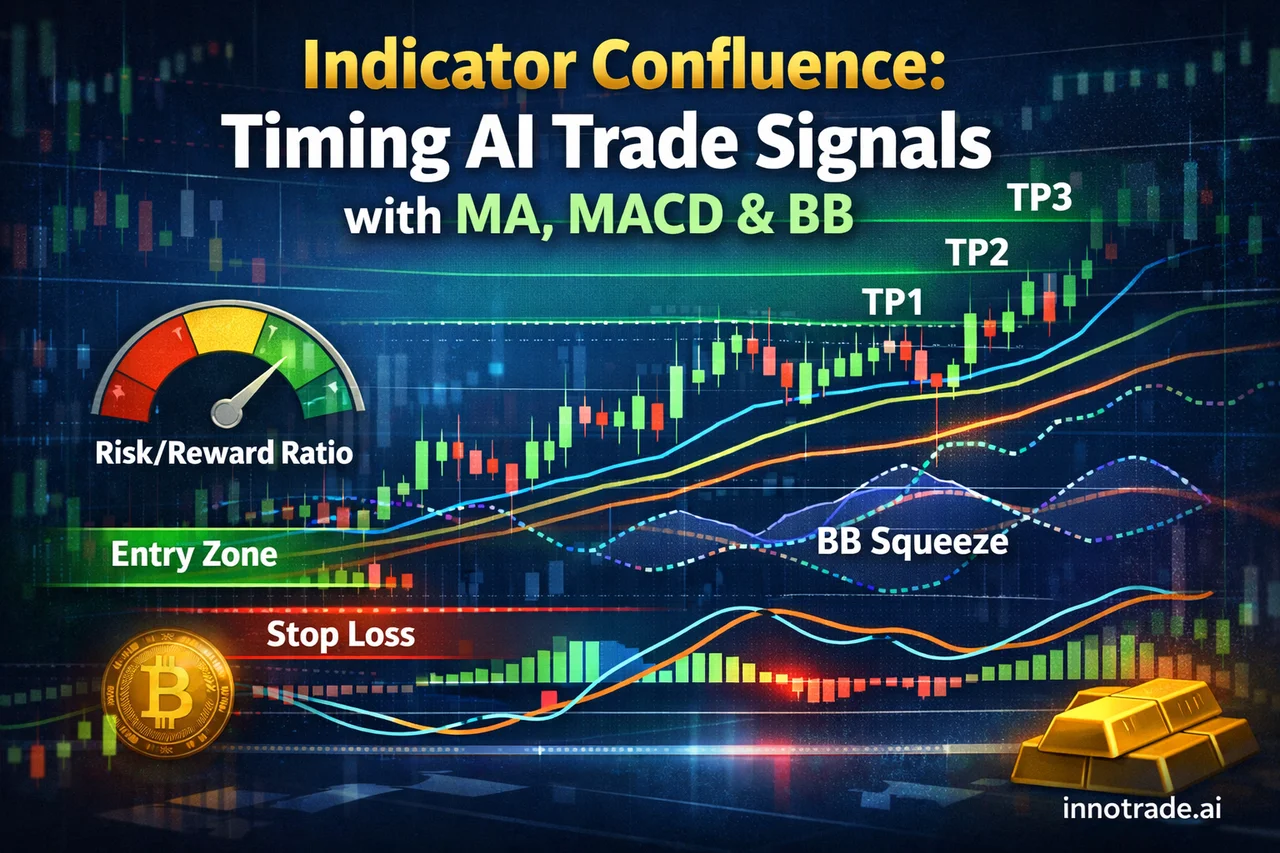
An AI-generated trade idea gives you a clean structure: an entry zone, three take-profit levels, a stop-loss, and a calculated risk-reward ratio. But the traders who consistently extract the most value from that structure rarely use it in isolation. They layer classic technical confirmation — moving averages, MACD crossovers, Bollinger Band squeezes — on top of the signal to time their entries more precisely and to understand why a level was chosen, not just where.
This guide walks through a practical confluence framework you can apply whether you're scalping BTCUSD on a 15-minute chart, day trading pullbacks on AUDJPY, or holding a multi-day swing position on XAUUSD.
Understanding the TP1–TP3 Structure Before You Add Indicators
Every AI analysis on the platform is built around a staged exit model. TP1 represents the nearest realistic target — the level most trades reach if the setup works at all. TP2 sits further out and requires the move to develop real follow-through. TP3 is the extended target that only a smaller subset of winning trades ultimately reach, since it demands sustained momentum in your favor. This is why win rates naturally decay as you move from TP1 to TP3 — it's not a flaw in the model, it's simply a function of distance and market behavior.
Where indicators earn their keep is in helping you decide how much conviction to place behind reaching for TP2 or TP3 versus banking gains earlier. A MACD crossover that confirms momentum in the direction of the trade, for example, gives you a data-backed reason to trail your stop toward TP2 rather than closing everything at TP1.
Scalping: 15-Minute BTCUSD Setups and Bollinger Squeeze Timing
Crypto scalpers using a 5–15 minute BTCUSD chart benefit enormously from Bollinger Band squeeze recognition. When bands compress tightly, volatility is coiling — and an AI entry signal that lines up with the squeeze breaking in the signal's direction is a stronger timing cue than the signal alone. Wait for the candle that closes outside the bands in the direction of the AI's suggested entry before committing, rather than entering the instant the analysis appears.
Stop-loss discipline matters even more at this timeframe. BTCUSD has recently been among the most heavily analyzed instruments on the platform, and its stop-loss hit rate reflects how quickly momentum can reverse on lower timeframes. Keep stops tight and sized to the actual volatility of the squeeze breakout, not to a fixed pip or dollar amount.
For choppy, range-bound forex sessions — think low-volume Asian hours on pairs like NZDUSD or EURGBP — a 20-period moving average acts as a simple filter. If price is oscillating around a flat moving average with no clear slope, treat AI signals in that window as range plays: target TP1 only and reduce size, since trending follow-through to TP2 and TP3 is statistically less likely in a directionless market.
Day Trading Pullbacks: MACD Confirmation on AUDJPY
Day traders working pullback entries get real value from pairing an AI signal with a MACD crossover on the same timeframe. AUDJPY has shown some of the more consistent TP-level follow-through among tracked instruments over the past two weeks, with trades progressing through TP1 and into TP2 and TP3 at a healthier rate than several other pairs. When the AI flags a pullback entry and the MACD histogram flips in the same direction shortly after, that alignment is a reasonable signal to hold toward the AI's stated TP2 zone rather than exiting purely on price action alone.
The reverse is equally instructive: if price pulls back to the AI's entry zone but MACD momentum is still fading, that's a cue to treat the setup more conservatively — smaller size, tighter management, quicker profit-taking at TP1.
Swing Trading XAUUSD: Holding Periods and 1-Hour Structure
Gold swing trades built around AI analysis typically need more patience than intraday setups — holding periods of one to several days are common when the target is TP2 or TP3. Pairing the AI's entry with 1-hour swing structure (higher highs/higher lows or the reverse) helps confirm that the broader trend actually supports the extended target, rather than just the immediate entry trigger.
It's worth noting that XAUUSD has recently seen a lower TP progression rate compared to instruments like AUDJPY — a reminder that gold's sensitivity to macro catalysts (rate decisions, dollar strength) can disrupt swing structure mid-trade. This is exactly the kind of environment where widening your stop-loss slightly beyond the immediate structure, in line with the AI's calculated distance, matters more than chasing a tighter risk figure.
The same stop-loss logic extends to major indices like NDX and SPX on swing timeframes — wider average true ranges mean stop distances need to breathe more than they would on a scalp, even when the entry logic is identical.
Managing News Spikes: EURUSD Around High-Impact Events
Recent high-importance releases — including the Federal Funds Rate decision, FOMC Statement, and FOMC Press Conference — are exactly the kind of catalysts that can blow through a stop-loss placed for normal volatility. Around confirmed high-impact USD events, consider either standing aside on EURUSD scalps entirely or widening stop placement beyond the AI's baseline distance to account for spike risk, then reducing position size to keep dollar risk constant.
What the Recent Data Shows
Looking at the platform's last seven tracked days, the average win rate across all sessions sat at roughly 52.4%, with an average risk-reward ratio near 2.10 — figures that reflect the value of disciplined, staged exits rather than all-or-nothing target chasing. The strongest session of the period, Thursday, September 10, combined a healthy win rate with strong risk-reward, producing the highest EV score of the week. The weakest, Saturday, September 12, saw both win rate and RR compress, a reminder that even a sound confluence approach will have off days — position sizing and stop discipline are what protect you through them. Across the platform's entire tracked history, the all-time win rate has held near 53.7% with an average RR around 2.03, reinforcing that consistency, not perfection, is the realistic goal.
Putting It Together
No indicator turns an AI signal into a guaranteed outcome. What confluence does is give you a second, independent reason to trust — or fade — a given entry, and a framework for deciding how far to reach across the TP1–TP3 structure. Start small: pick one indicator per strategy style (Bollinger squeeze for scalps, MACD for pullbacks, higher-timeframe structure for swings), track results using Trade Tracking, and adjust from there. If you're still building your foundation, the Trading Academy covers the basics of each indicator in more depth, and ScalpHunter can help scalpers spot real-time opportunities that fit this same confluence logic.
Analytical software only. We do not handle funds, make investments, or provide financial advice. Trading involves substantial risk and past performance does not guarantee future results. Always conduct your own research and consider your risk tolerance before making trading decisions.