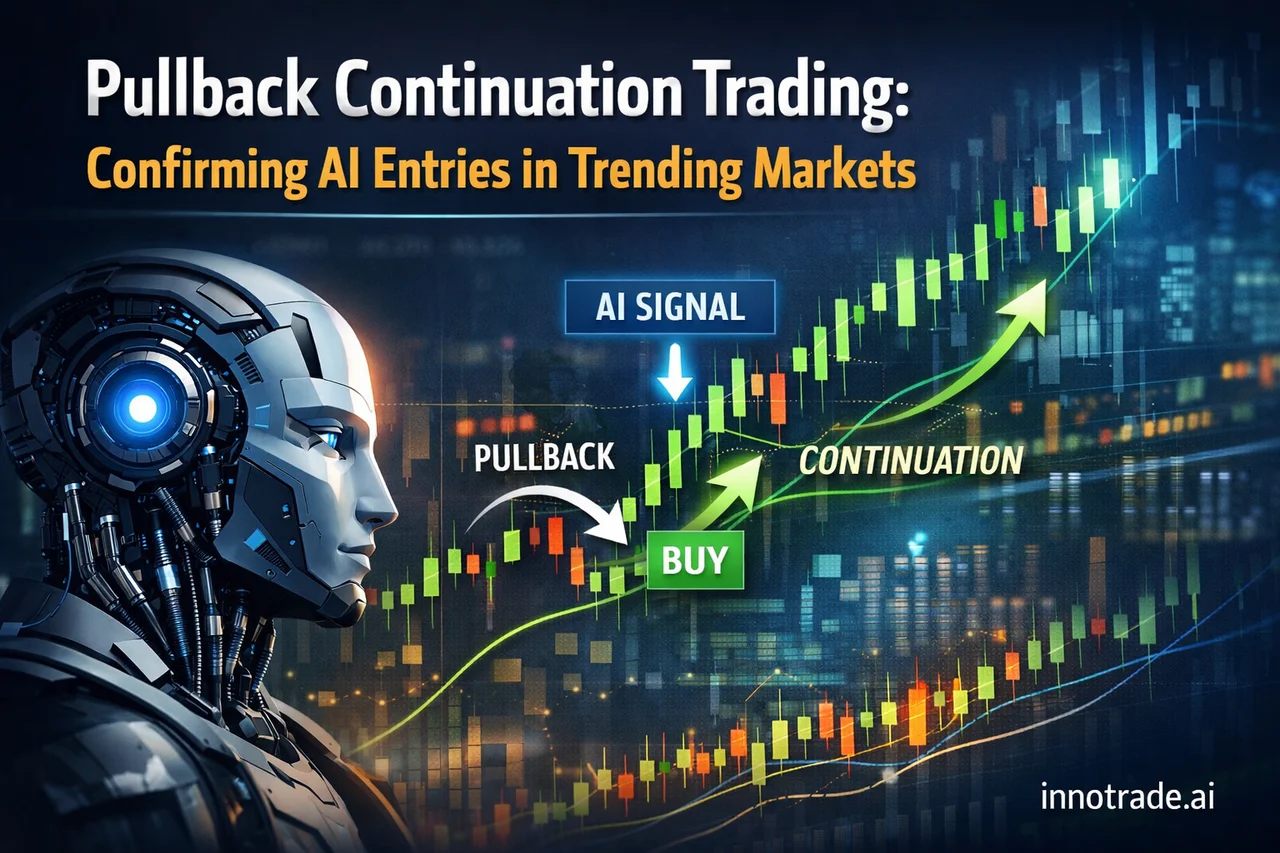
One of the most reliable ways to filter out low-quality signals in any market is to wait for a pullback before committing to a trade in the direction of the prevailing trend. When you layer this classic price-action concept on top of an AI-generated trade signal, you get two independent confirmations pointing the same direction — the algorithm's structural read and the market's own retracement behavior. This guide breaks down exactly how to apply pullback continuation logic to AI analysis across scalping, day trading, and swing timeframes.
Why Pullback Continuation Pairs Well With AI Signals
A pullback continuation trade is simple in concept: price establishes a trend, retraces against it briefly, then resumes in the original direction. The retracement gives you a better entry price and a tighter, more logical stop-loss placement than chasing the initial breakout. When an AI-generated entry, TP1/TP2/TP3 structure, and stop-loss level line up with a pullback that's still respecting the broader trend, you're effectively stacking two independent signals — trend-following momentum and algorithmic pattern recognition — rather than relying on either one alone.
This matters because raw win rate alone never tells the full story. A setup with a lower win rate but a favorable risk-reward ratio can still be profitable over time, while a high win rate with poor RR can quietly bleed an account. Over the past week, platform data across tracked trades averaged roughly a 53.4% win rate with an average risk-reward ratio near 2.17 — a combination that only works because losing trades are kept smaller than winners. Pullback entries help enforce that discipline by naturally producing tighter stops.
Scalping: Five-Minute Pullbacks With AI Confirmation
On the five-minute chart, pullback continuation trades move fast, so timing matters more than anywhere else. The typical sequence looks like this: price makes an impulsive move, an AI signal is generated in the direction of that move, and rather than entering immediately, you wait for a shallow retracement toward a recent swing low or high before triggering the position. The AI's suggested entry zone often overlaps with this retracement area, which is your confirmation to act.
Stop-loss placement should sit just behind the micro-structure of the pullback — below the most recent higher low in an uptrend, or above the most recent lower high in a downtrend — rather than at an arbitrary pip distance. This keeps risk tight, which is especially important for scalping, where TP1 is often reached within minutes. Traders running this style frequently pair it with ScalpHunter confidence ratings to avoid acting on marginal setups when the confirmation candle is weak.
Day Trading: Gold Pullbacks and ATR-Based Stops
Gold has been a genuinely difficult instrument recently. Over the past two weeks, XAUUSD setups on the platform showed a noticeably lower follow-through rate to TP2 and TP3 compared to other tracked pairs, with the majority of positions ultimately stopping out. That doesn't mean gold should be avoided — it means the stop-loss methodology needs to adapt to its volatility.
For an intraday gold pullback continuation trade, anchor the stop-loss to the Average True Range (ATR) rather than a fixed dollar amount. If ATR on the one-hour chart is elevated, widen the stop proportionally and reduce position size to keep dollar risk constant. Combine this with an AI entry that aligns with a pullback toward a session VWAP or recent order block — placing the stop just behind that structural level rather than inside the noise of the current candle. This is one of the clearest examples of why raw win rate and risk management have to be evaluated together, a concept covered in more depth in the Trading Academy.
Swing Trading: One-Hour Structure and Scaling Position Size
Swing traders benefit most from pullback continuation logic because the added confirmation reduces the chance of catching a trend right before it exhausts. On the one-hour timeframe, wait for the AI signal to align with a retracement into a prior support or resistance flip zone, and place the stop-loss below the broader swing structure — not just the immediate candle — since swing trades need room to breathe over multiple sessions.
Position sizing across TP1, TP2, and TP3 is where many swing traders leave value on the table. A common approach is to close a portion of the position at TP1 to lock in progress, hold a reduced size through TP2, and let a smaller remainder run toward TP3 only if price action continues to respect the trend structure. Recent data illustrates why this matters: AUDJPY setups over the past two weeks showed consistent follow-through from TP1 through to TP3, rewarding traders who held a portion of their position rather than closing everything at the first target. Compare that to a symbol like XAUUSD in the same window, where TP1 follow-through dropped off sharply — a case where trimming size earlier would have preserved more capital.
What the Data Says About Timing Your Entries
Looking at the past week of tracked performance, the strongest session by expected value came on a day where nearly every tracked position resolved favorably — an exceptionally strong stretch with an EV score around 1.53. By contrast, the weakest day of the week posted a win rate of just 16.7% against an average RR of 2.07, producing a negative EV score near -0.49. The gap between these two days underscores a core truth: no strategy, AI-assisted or otherwise, wins every session. What separates a sustainable approach from a reckless one is keeping losing days contained through disciplined stop placement, which is exactly what pullback-based entries and structure-anchored stops are designed to do.
For traders who want to verify this kind of variance for themselves rather than take it on faith, the Live Trades Scoreboard displays the best-performing tracked analyses from across all users over the past two weeks as a public record of past results — useful for understanding what strong outcomes have looked like historically, though it's a transparency page rather than a planning tool.
Putting It Together: A Practical Checklist
- Confirm the broader trend direction before looking for a pullback entry.
- Wait for the AI-generated entry zone to overlap with the retracement, not the initial breakout.
- Place the stop-loss behind actual structure — a swing point, order block, or ATR-adjusted buffer — not an arbitrary distance.
- Scale position size down progressively from TP1 through TP3 rather than treating all three targets as equal exits.
- Review your own trade history regularly using Trade Tracking to see which of your setups actually respected this structure and which didn't.
Pullback continuation trading isn't a shortcut — it's a filter. It won't turn a weak signal into a strong one, but it will help you avoid entering strong signals at the worst possible moment. Combined with disciplined stop placement and thoughtful position sizing across TP1, TP2, and TP3, it's one of the more repeatable ways to translate AI-generated analysis into consistently managed risk. Traders exploring this approach for the first time can review the full breakdown of signal structure on the Features page or start with a trial through Pricing.
Analytical software only. We do not handle funds, make investments, or provide financial advice. Trading involves substantial risk and past performance does not guarantee future results. Always conduct your own research and consider your risk tolerance before making trading decisions.