Why Trade Management Matters More Than Entry Accuracy
Most traders obsess over finding the perfect entry. In reality, two traders can take the identical entry at the exact same price and end up with completely different outcomes — one profitable, one not — based purely on how they manage the trade afterwards.
AI-generated analysis from innotrade.ai provides specific entry points, three take-profit levels (TP1, TP2, TP3), and a defined stop-loss for every setup. But having those levels handed to you is only half the equation. Knowing how to act on them — when to close partially, when to move your stop, and how your timeframe changes everything — is what separates consistent traders from those who give profits back.
This guide breaks down a complete multi-target trade management framework for scalpers, day traders, and swing traders, with direct reference to how the platform's analysis structure supports each approach.
The Foundation: Understanding the Three-Level Exit Architecture
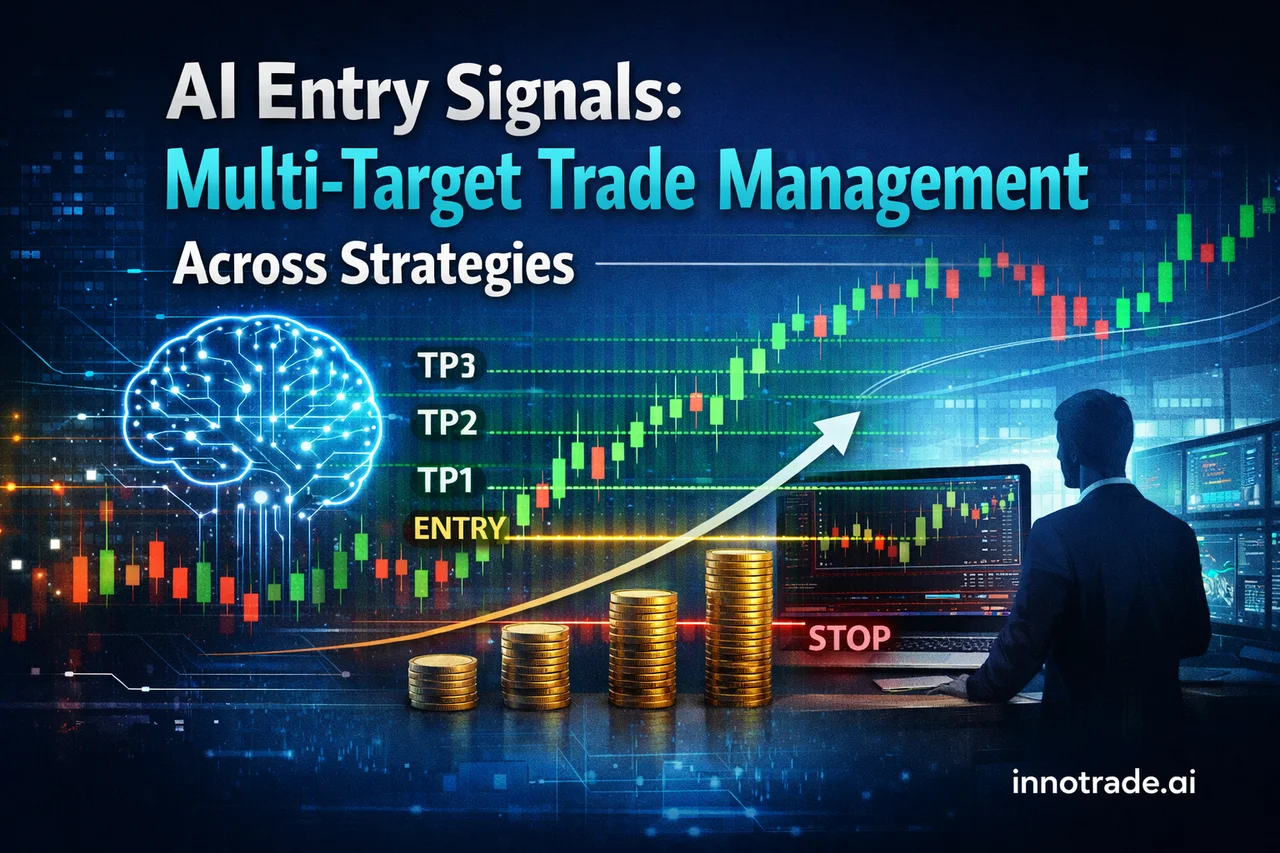
Every AI-generated analysis on the platform identifies an entry zone, a stop-loss, and three graduated take-profit levels. Conceptually, they work like this:
- TP1 — the nearest, highest-probability target. It represents a conservative exit at the first area of likely resistance or support. Win rates at this level are naturally higher because price doesn't have to travel far.
- TP2 — a mid-range target requiring more momentum and follow-through. Win rates are lower than TP1 because more things can go wrong across a wider price range.
- TP3 — the full extension target, often placed at a structural level or prior swing point. The lowest win rate of the three, but also the highest reward relative to risk.
This decay in probability from TP1 to TP3 is not a flaw — it's the honest math of markets. Any strategy worth using accounts for it rather than ignoring it. The platform's recent weekly data illustrates this dynamic well: across the seven days ending June 23, win rates varied meaningfully day to day, but the overall EV remained positive throughout most of the period — confirmation that a structured multi-target approach generates edge even in mixed conditions.
Scalping: First-Candle Close Confirmation and Tight TP1 Focus
For scalpers, the AI entry signal is most useful as a directional trigger — it tells you the bias, the zone, and the structure-based stop. Your job is to time the actual execution within that context.
The First-Candle Close Rule
When a scalping setup appears — particularly during high-liquidity windows like the London open or the New York session overlap — wait for the first full candle to close beyond the entry zone before executing. This single filter removes a significant portion of false breakouts where price wicks into a zone but immediately reverses.
Practically: if the AI signal identifies a long entry zone at 1.2450 on GBP/USD, and price sweeps into that area but the 1-minute candle closes back below 1.2450, that's a wick, not a commitment. Wait for a candle to close within or above the entry zone before entering.
Scalping TP Management
For scalpers, TP1 is usually the primary exit target — close 75–100% of the position there. The reason is simple: scalping thrives on high-frequency, high-win-rate outcomes, and TP1 aligns with that objective. TP2 and TP3 targets require sustained follow-through that often outlasts a scalp's optimal holding window.
The ScalpHunter feature on the platform is specifically designed for this use case — it surfaces real-time scalping signals with confidence levels from 1 to 5, helping scalpers filter for only the highest-conviction setups before committing capital.
Stop placement for scalps should sit just beyond the nearest structural level — below the last swing low for longs, above the last swing high for shorts. If the AI-identified stop is wider than you'd like for your position size, reduce your lot size — never tighten the stop arbitrarily, as this turns a structurally valid trade into one that will stop out on normal noise.
Day Trading: Session Bias Before Signal Entry
Day traders have a wider operational window than scalpers, but still need to close positions within the session. This creates a specific challenge: even if an AI signal is valid, entering at the wrong point in the session dramatically reduces the probability of reaching TP2 or TP3 before liquidity dries up.
Establishing Session Bias First
Before acting on any intraday AI signal, answer three questions:
- What is the prevailing market structure on the higher timeframe (1H or 4H)? Is price trending, ranging, or in a key reversal zone?
- What session are we entering? London open setups behave differently from late New York setups.
- Is there a high-impact economic event within the next two hours that could invalidate the signal's structure?
When session bias and the AI signal align, the trade has two independent reasons to work. When they conflict — for example, a buy signal during a clearly bearish intraday structure — treat the signal as lower-conviction and either reduce size or wait for a secondary confirmation.
The London Open AI Signal Checklist
The London open (08:00–09:00 GMT) is consistently one of the highest-probability windows for intraday setups. A practical checklist before taking an AI signal at this window:
- ✓ Price is at or near the identified AI entry zone, not already extended by 30+ pips
- ✓ The higher timeframe (1H) structure supports the signal direction
- ✓ No high-impact news is due within the next 60 minutes (check the platform's economic event data)
- ✓ Stop-loss is placed below a clear order block or structural level, not at a round number
- ✓ TP1 gives a risk-reward of at least 1:1 — if not, the entry has slipped and the setup is no longer valid
Day Trading Stop Adjustment After TP1
The single most effective trade management rule for day traders is the breakeven stop adjustment after TP1. Once price hits TP1 and you close your partial position (typically 40–50%), move your stop to your entry price. This creates a risk-free remainder of the trade with TP2 and TP3 still in play.
Why not trail aggressively? Because intraday price action is noisy. A tight trailing stop after TP1 will frequently get hit on a pullback that ultimately continues in your direction — locking in a breakeven result when TP2 was reachable. Give the trade room by anchoring to the entry rather than chasing price.
The platform's Trade Tracking dashboard lets you monitor exactly how your TP-level hit rates stack up over time — a genuinely useful feedback loop for refining how aggressively you trail and how much you close at each level.
Swing Trading: Retracement Entry and Structure-Based Stop Placement
Swing traders have the most flexibility in how they use AI-generated analysis, but they also face the most complex management decisions because positions can remain open for days.
The Retracement Entry Technique
Rather than entering at the initial AI signal trigger, swing traders can wait for price to retrace into the entry zone after an initial move. This approach has two advantages: a better average entry price and a natural validation that the level is being respected.
If an AI signal identifies a bullish setup with an entry at 1.0850 on EUR/USD, and price initially moves up to 1.0880 before pulling back, a swing trader can look to enter on the retest of 1.0850 — the original entry — rather than chasing the initial move. The AI-identified stop-loss remains valid (typically below the structural support that generated the signal), and the improved entry tightens the effective risk.
Structure-Based Stop Placement
AI-generated stops on the platform are calculated with reference to structural levels — order blocks, swing lows/highs, and key support/resistance zones. This is important context for swing traders, because the stop is not arbitrary. It represents the price level at which the original analysis is invalidated.
Avoid the common mistake of moving stops closer to reduce dollar risk on a large position. If the structure says the stop belongs at 1.0820, placing it at 1.0835 because you want a smaller loss is not risk management — it's wishful thinking that ignores market structure. Reduce position size instead.
Partial Close at TP1, Trail to TP2 and TP3
The most robust swing trading exit strategy using the platform's three-level structure:
- At TP1: Close 33% of the position. Move stop to breakeven. The trade is now free of original risk.
- At TP2: Close another 33%. Trail the remaining stop to just below the most recent swing low (for longs), keeping it at a structural rather than arbitrary level.
- Toward TP3: Let the final third run. If price stalls before TP3 and starts forming reversal signals, close manually rather than waiting for a stop hit.
This approach captures guaranteed profit at TP1, a meaningful second exit at TP2, and leaves a free position running toward the full structural target. It also means you'll have some participation in every trade that reaches TP1, regardless of whether the full move materialises.
What the Recent Data Tells Us About Multi-Target Edge
Looking at the platform's performance across the week ending June 23, 2026, the EV score remained positive on five of the seven trading days — with Tuesday June 23 standing out as the strongest session of the period, combining a win rate of 66.7% with an average RR of 1.94 for an EV score of 0.96. Saturday June 20 was the weakest, where a relatively low RR of 1.07 compressed the EV to just 0.04 despite a 50.0% win rate — a clear illustration that win rate alone doesn't define edge. You need the RR to carry its weight too.
Across the full seven days, the platform averaged a win rate in the mid-to-high 50s percentage range with an average RR consistently above 1.7 — metrics that reflect exactly the kind of multi-target discipline described in this guide. Broader context: across all tracked trades in the system, the all-time win rate sits at 53.7% with an average RR of 2.00, confirming that the edge is structural, not a lucky short-term streak.
For further context on verified historical performance, results are published transparently and synced with Myfxbook for third-party confirmation.
Key Takeaways: Actionable Rules for Each Strategy Type
- Scalpers: Use first-candle close confirmation. Target TP1 as the primary exit. Size down rather than tightening stops. Use ScalpHunter to filter for confidence level 4–5 setups.
- Day traders: Establish session bias before entering. Use the London open checklist. Move stop to breakeven after TP1 partial close. Monitor cumulative TP performance via Trade Tracking.
- Swing traders: Wait for retracement entries when possible. Respect structure-based stops — resize if needed. Scale out at TP1, TP2, and trail the remainder to TP3 with a structural trailing stop.
Every strategy type benefits from having a defined plan before the trade is open. If you haven't decided what you'll do at TP1 before price gets there, you'll make an emotional decision in real time — and that rarely ends well. New to building a structured approach? The Trading Academy covers risk management fundamentals that underpin everything described here.
Analytical software only. We do not handle funds, make investments, or provide financial advice. Trading involves substantial risk and past performance does not guarantee future results. Always conduct your own research and consider your risk tolerance before making trading decisions.