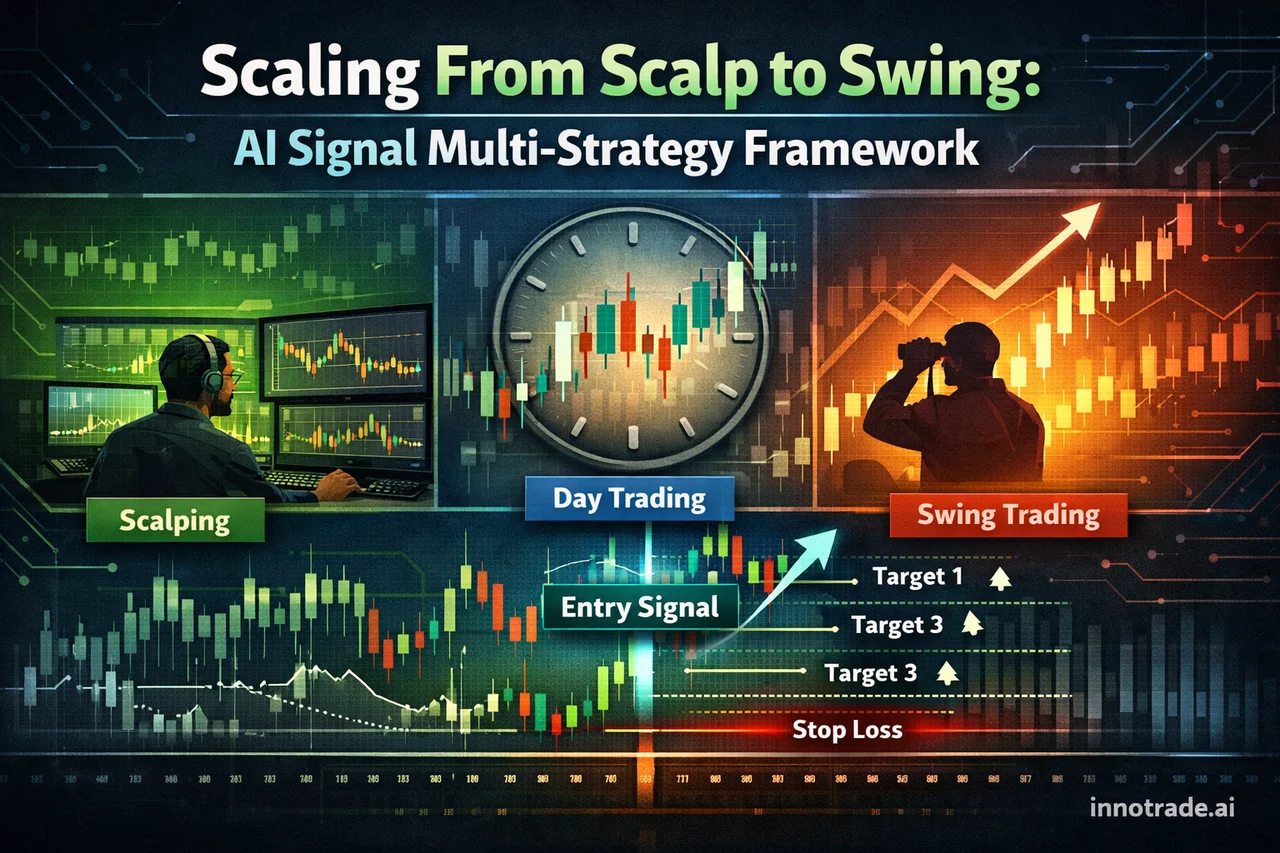
One Signal, Three Strategies: How to Extract Maximum Value From Each AI Entry
Most traders treat AI-generated signals as a binary proposition: either you take the trade or you don't. But the structure embedded in a well-constructed analysis — a defined entry, three tiered take-profit levels, and a calculated stop-loss — is actually a complete multi-strategy framework waiting to be used intelligently. Whether you're a scalper chasing the New York open, a day trader filtering for session bias, or a swing trader building a position across days, the same entry signal can serve all three approaches simultaneously.
This guide breaks down how to extract that layered value, using the entry mechanics from innotrade.ai's AI analysis as the structural backbone. The goal isn't to use every target on every trade — it's to understand which part of the signal belongs to which strategy, and execute with precision accordingly.
The Foundation: What the TP1/TP2/TP3 Framework Actually Represents
Before building a strategy around the signal, you need to understand what each level is communicating. TP1 is not a conservative target — it's the first inflection point where price has a statistically meaningful probability of reacting. TP2 sits at a structural zone where institutional participation becomes necessary to push further. TP3 is the full extension, typically reached only when the macro bias, momentum, and session dynamics all align.
This creates a natural hierarchy that mirrors the three strategy types:
- Scalpers operate primarily in the TP1 zone — fast in, fast out, using the AI-defined stop-loss for tight risk control and accepting partial fills near entry
- Day traders use TP1 confirmation as a session bias signal and target TP2 within the same trading day, often managing the stop dynamically after TP1 hits
- Swing traders size into the full TP1-to-TP3 sequence, positioning for multi-day moves with a wider initial stop and a trailing mechanism activated at TP2
Across all tracked trades over the past week — spanning seven days from July 1 through July 7 — the platform delivered an average win rate of approximately 57.5% with an average risk-reward ratio near 2.10, reflecting a broadly positive expected value environment. That backdrop matters for strategy selection: a high-EV week favors holding toward TP2 and TP3 rather than cutting at TP1.
Scalping Pullback Entries: Using AI Stop-Loss Levels as Your Anchor
The most common scalping mistake is placing a stop-loss based on a fixed pip count or a percentage rule, rather than a structural level. AI-generated stop-loss placement, by contrast, is anchored to market structure — typically below an order block, a recent swing low, or a liquidity zone that, if breached, invalidates the trade thesis entirely.
For a scalping pullback entry, the workflow looks like this:
- Wait for price to retrace toward the AI entry zone after an initial momentum impulse — particularly useful during the New York open when liquidity grabs are common before the real directional move begins
- Use the AI stop-loss as a hard floor, not a guideline — if price is trading below the stop level, the setup is already compromised
- Target TP1 only, with a position size calibrated to make that partial move worthwhile on its own. For scalpers, TP1 should represent at minimum a 1:1 risk-reward, ideally better
- Exit fully at TP1 if momentum stalls — do not hold for TP2 on a scalp timeframe unless there's a strong continuation candle and a clear session tailwind
The New York open is particularly powerful for this approach. The session opens with the highest institutional liquidity of the global trading day, and AI signals generated during the London-to-New York crossover often see their TP1 targets hit within the first 60–90 minutes of the New York session. The scalp setup requires discipline: enter on the pullback, not the spike. The liquidity grab before entry is often what creates the clean risk-to-reward entry the AI signal was built around.
For real-time scalping signals with confidence levels rated 1/5 to 5/5, ScalpHunter provides live alerts calibrated specifically to this kind of momentum-based short-duration setup.
Day Trading: Session Bias Confirmation Before the Entry
Day traders working with AI signals have an additional filtering layer available that pure scalpers often skip: session bias confirmation. Before entering any AI-generated signal within a day trading context, ask three structural questions:
- Is the current session (London, New York, or overlap) directionally aligned with the signal direction?
- Has the session already shown a range expansion impulse, or is price still coiling in a pre-session range?
- Does the broader market structure on the 4-hour or daily timeframe support the direction the AI signal is proposing?
When the answer to all three is yes, the AI entry becomes a high-conviction day trade setup, and TP2 becomes a realistic within-session target. This is the breakout-retest day trading setup at its most systematic: the AI identifies the structural level, the session provides the momentum, and the retest (if it occurs) provides the clean entry point with a pre-defined stop.
For stop-loss management after TP1 hits intraday, the protocol is simple but often neglected: once TP1 is confirmed, move your stop to breakeven on the remaining position. This converts the remaining day trade into a risk-free runner toward TP2. If TP2 is reached within the session, that represents the full day trade objective. Any residual position beyond TP2 transitions into swing trade territory — and should be sized accordingly (more on that below).
The strongest single session in last week's data was Monday, July 6, which posted the highest EV score of the seven-day period with a win rate of 83.3% and an average RR of 2.20 across tracked analyses. That kind of day — high win rate combined with a strong average RR — is precisely the environment where a day trader should be holding through TP1 toward TP2 rather than cutting early.
Swing Trading: Position Sizing Across the TP1/TP2/TP3 Sequence
Swing traders using AI signals need to approach position sizing differently from scalpers or day traders. The full TP3 target may be days or even weeks away — which means the initial stop-loss placement requires a wider buffer, and the position size must be smaller to compensate while keeping total risk constant.
A practical swing trading framework using the AI multi-target structure works as follows:
- Enter with a full position at the AI-defined entry point, sized so that a stop-loss hit represents no more than 1–2% of account equity
- Scale out one-third at TP1 — this banks a partial profit and confirms the trade is moving directionally as expected
- Move the stop-loss to breakeven after TP1 is hit — the trade is now psychologically and financially protected
- Scale out another third at TP2, and at this point activate a trailing stop on the final third — placed below the most recent significant swing low (or above a swing high for short trades)
- Let the final position run to TP3 or until the trailing stop is triggered by a structural shift, whichever comes first
This structure respects the natural decay in probability as targets extend further. As the Trading Academy covers in foundational risk management, the key insight is that TP3 completions are meaningful not because they're common, but because when they do occur, the risk-reward they deliver justifies their relative rarity. The platform's all-time average RR of 1.99 across all tracked trades reflects a system built for exactly this kind of asymmetric payoff — and that number understates the contribution of full TP3 completions to long-run expectancy.
Combining Scalping and Swing Targets in the Same Signal
One of the more advanced applications of the AI multi-target framework is running both a scalp and a swing position off the same signal entry — a technique that requires clear position separation from the start.
Here's how it works in practice:
- Split your intended position into two parts at the point of entry: a scalp allocation (targeting TP1, exiting fully) and a swing allocation (targeting TP2/TP3, managed as described above)
- Apply the same AI stop-loss to both — the structural stop is valid regardless of the holding period
- Treat them as independent trades mentally and logistically — the scalp closes at TP1 without exception; the swing follows its own trailing stop protocol
This approach is most effective on instruments that have demonstrated consistent TP-level follow-through. Over the past two weeks, gold (XAUUSD) generated the highest volume of tracked setups among all instruments and delivered strong TP1 hit rates — making it well-suited to this split-allocation approach. XRP (XRPUSD) also showed notable TP progression with multiple setups advancing from TP1 through to TP3, suggesting genuine multi-day momentum rather than isolated intraday spikes.
Your Trade Tracking dashboard is indispensable for managing this kind of multi-allocation strategy — tracking both positions separately, monitoring their individual performance, and ensuring your portfolio-level risk stays within defined limits even when both legs are active simultaneously.
The Order Block Context Behind AI Stop-Loss Placement
One detail that distinguishes AI-generated stop-loss levels from arbitrary pip-based stops is that they're typically anchored to order block structure — areas where institutional orders were previously executed and where price is likely to react if revisited. A stop placed below a genuine order block means that if the stop is hit, the underlying reason for the trade (the institutional order flow) has been demonstrably invalidated.
For scalpers, this means the AI stop-loss is often tighter than expected — because the pullback entry is close to the structural anchor. For swing traders, the stop may be wider because the relevant order block sits further from current price on a higher timeframe. In both cases, the logic is identical: the stop is placed where the setup is proven wrong, not where a pre-set risk tolerance arbitrarily runs out.
Understanding this distinction changes how you think about stop-loss hits. A stop triggered on an AI signal isn't a failure of the platform — it's the market communicating that the structural premise was incorrect. That feedback is valuable, and tracking it systematically through your personal performance dashboard over time reveals which market conditions and instruments tend to produce false signals worth avoiding.
Putting It All Together: A Decision Framework by Strategy Type
Before entering any AI-generated signal, run through this quick decision framework based on your strategy for that session:
- Scalping: Is the entry a pullback or retest? Is the session active (New York open preferred)? Size for TP1 only. Use the full AI stop-loss. Exit at TP1 with no exceptions.
- Day trading: Does session bias confirm the direction? Has range expansion already begun, or is a breakout-retest setup forming? Target TP2. Move stop to breakeven at TP1. Manage intraday.
- Swing trading: Is the daily or 4H structure aligned? Is there a multi-day catalyst (economic event, trend continuation)? Size smaller, use the full stop. Scale out at TP1 and TP2. Trail on the final third to TP3.
- Combined approach: Split allocation deliberately. Run scalp and swing positions as independent entries with separate management rules from the first candle.
The platform's performance over the past week illustrates why this framework earns its keep in live conditions. Thursday, July 2 — the weakest day of the period by EV score — posted a win rate of 36.4% with an average RR of just 1.51. In that kind of environment, a scalper exiting at TP1 would have preserved capital, while a swing trader holding through would have faced pressure. By contrast, the surrounding days — Sunday through Tuesday — delivered consistently strong EV scores that rewarded the multi-target hold. The framework gives you the language to make that distinction in real time, not in hindsight.
For a detailed look at how the platform's signals have performed historically, including third-party verification, you can explore the public performance data — results are synced with Myfxbook for independent transparency. And if you're ready to apply this framework with live AI-generated signals, a 7-day free trial gives you full access to explore entries, TP levels, and stop-loss placements across every supported instrument.
Analytical software only. We do not handle funds, make investments, or provide financial advice. Trading involves substantial risk and past performance does not guarantee future results. Always conduct your own research and consider your risk tolerance before making trading decisions.