Why Session Timing Changes Everything for AI Signal Execution
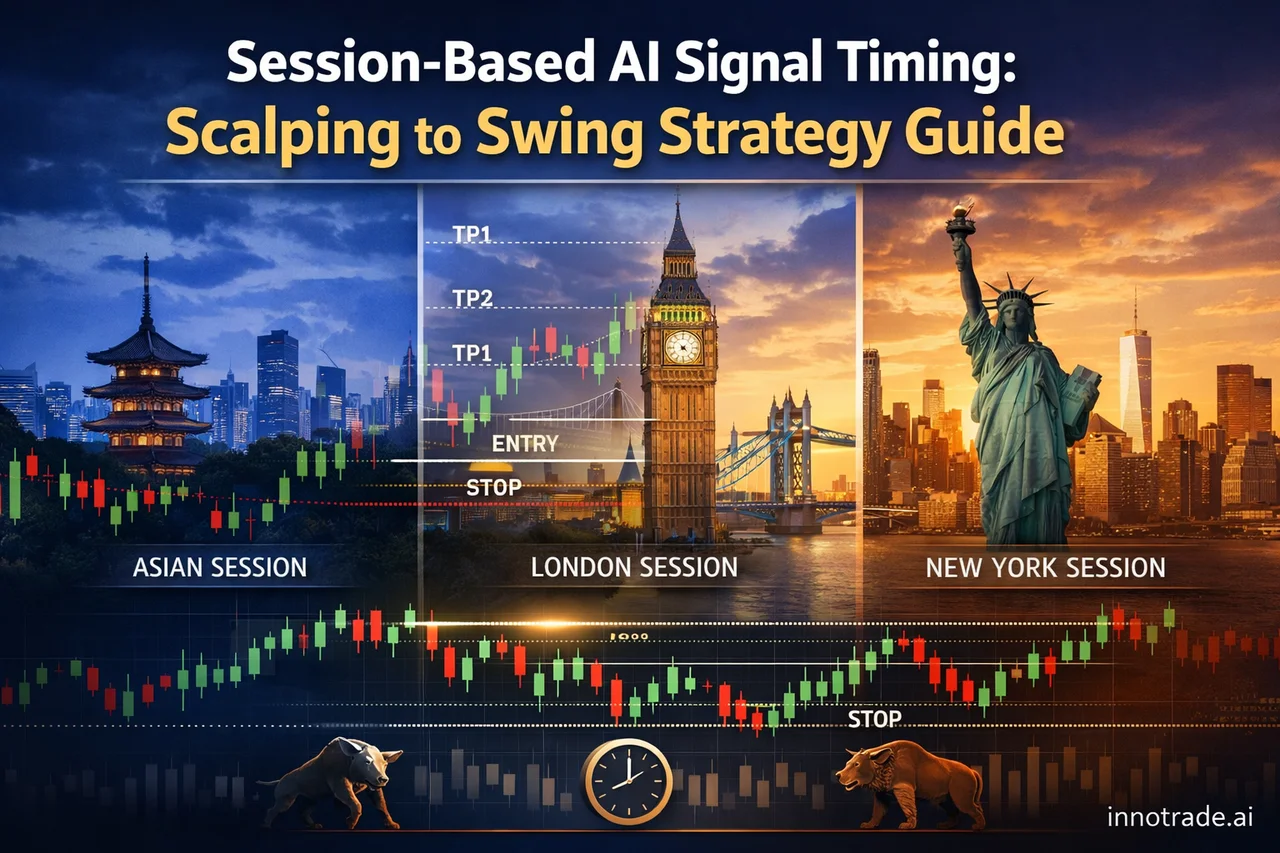
One of the most underappreciated edges a trader can develop is not which signals to act on — it's when. The same AI-generated setup with identical entry, stop-loss, and TP1/TP2/TP3 levels can produce dramatically different outcomes depending on which trading session it triggers in. Liquidity, volatility, and institutional participation vary enormously between the Asian consolidation window, the London open surge, and the New York session momentum phase.
This guide breaks down how to align your strategy — whether you're scalping, day trading, or holding swing trades — with session-specific dynamics, using the structure of AI-generated analysis to make the most of each window. The goal isn't just to take signals; it's to take the right signals at the right time, with the right exit framework already mapped out before you click buy or sell.
Understanding the AI Analysis Structure: Your Pre-Built Trade Plan
Before diving into session strategy, it's worth anchoring on what the AI analysis actually provides. Every generated signal includes a specific entry price or zone, a stop-loss level (typically placed below a structural reference like an order block, prior swing low, or liquidity cluster), and three tiered take-profit targets — TP1, TP2, and TP3. This three-target structure isn't arbitrary; it mirrors how professional traders naturally scale out of positions as momentum extends.
TP1 is the nearest, highest-probability target — a partial profit lock that immediately improves your trade's risk profile once hit. TP2 sits at the next structural level, where momentum trades typically stall if the move isn't exceptionally strong. TP3 represents the full thesis — the target that only gets reached when everything lines up: the right session, the right macro backdrop, and genuine follow-through. Understanding this natural decay from TP1 to TP3 is what allows traders to build session-specific exit plans rather than guessing on the fly.
The risk-reward ratio embedded in each analysis isn't static either. Across all tracked trades on the platform, the all-time average RR has held at 1.99 — meaning the system is consistently identifying setups where the potential reward is roughly double the risk taken. That structural edge compounds meaningfully when you layer smart session timing on top of it.
The Asian Session: Range Identification and Breakout Scalping
The Asian session — broadly 00:00 to 08:00 GMT — is characterised by relatively contained price action, particularly in USD pairs and metals. Institutional desks in London and New York are offline, and liquidity is thinner. For many traders, this is dead time. For session-aware scalpers, it's the setup phase.
How to Use the Asian Range as a Scalping Framework
The core Asian session scalping approach works as follows: identify the high and low of the Asian range before the London open. When an AI-generated signal triggers near one of these extremes — particularly if the entry point aligns with the range boundary — it's a high-quality setup. The stop-loss level provided in the analysis will often sit just beyond the range extreme, which is structurally logical: a break back inside the range invalidates the breakout thesis.
For scalping, the target is simple: TP1 only. You're not looking for a multi-hundred pip extension in the Asian session. You're extracting a quick, clean move as price either bounces from the range boundary or breaks out with the first London liquidity injection. The ScalpHunter tool is particularly useful here — real-time scalp signals with confidence levels let you filter for the highest-probability setups rather than acting on every boundary touch.
Key rule for Asian range scalps: If the AI-generated TP1 sits inside the established Asian range (i.e., mid-range), skip the trade. The most reliable Asian session scalps move toward or through the opposite boundary, not toward the middle where price has already been.
The London Open: First-Hour High-Probability Day Trades
The London open (08:00–09:00 GMT) is arguably the single highest-probability hour for day traders across forex and metals. European institutional flow arrives, the Asian range breaks in one direction or the other, and the first 60 minutes typically establish the directional bias for much of the day.
AI Signal Timing at the London Open
When an AI analysis triggers a long or short entry in the 07:45–08:30 GMT window, treat it with elevated confidence — particularly if the entry direction aligns with a break of the Asian session range. The stop-loss placement from the AI will typically anchor below the last significant structure: a prior order block, a consolidation base, or the Asian range itself. This is precise and meaningful, not arbitrary.
For London open day trades, the three-target structure becomes your scaling framework. A disciplined approach looks like this:
- At TP1: Close 40–50% of the position. Bank partial profit, move stop to breakeven on the remainder. Your worst case is now a scratch trade.
- At TP2: Close another 30–40%. You're now fully in profit regardless of what happens next. The remaining position is free-riding on momentum.
- TP3 or trail: Hold the final portion with a trailing stop or let the AI's TP3 act as your final target. If price stalls before TP3 and shows reversal signals, exit manually.
This scaling approach converts the AI's three-target structure into a genuine risk management framework — not just theoretical levels on a chart. Across recent tracked analyses, week-on-week performance data shows the platform maintaining consistent win rates in the mid-to-high 60% range on average, with individual sessions like Friday, June 26 posting a 68.8% win rate alongside a 1.67 average RR — the kind of output that emerges when session timing and signal quality align.
New York Open: XAUUSD and the Momentum Window
Gold (XAUUSD) is the platform's most actively analysed instrument by volume over recent weeks, and for good reason — it responds exceptionally well to New York session dynamics. The NY open (13:30–14:30 GMT) brings USD-driven volatility: economic data releases, Fed commentary, and fresh institutional positioning all compress into a tight window.
Day Trading XAUUSD with AI Entry and Session Confluence
The optimal XAUUSD day trade setup using AI signals involves two layers of confirmation. First, the AI generates an entry with a structurally placed stop below an order block or liquidity zone. Second, you check whether the entry direction aligns with the pre-NY session bias — is price trending in the direction of the trade during the London–NY overlap (12:00–14:00 GMT)? If yes, both layers confirm. If the AI signal is counter-trend to the overlap bias, treat it as a lower-confidence setup and consider reducing position size.
XAUUSD's TP-level characteristics over the recent two-week period have shown strong TP1 follow-through — the nearest target has been consistently hit at a high rate, while progression beyond TP2 toward TP3 is more selective. This pattern is actually ideal for NY open day trades: take the clean TP1 profit during the initial momentum burst, then manage the remainder with a tighter trailing stop as the NY session matures and volatility begins to mean-revert.
The Trade Tracking dashboard is invaluable here — over time, reviewing your own XAUUSD trade history will reveal whether your NY open setups consistently reach TP2 or stall at TP1. That personal data is more actionable than any generic benchmark.
Swing Trading: Holding Beyond TP2 and the Multi-Timeframe Entry
Swing trades occupy a different strategic space entirely. Rather than extracting quick session-based moves, swing entries aim to capture larger structural moves that play out over hours to days. The AI's three-target structure maps naturally onto swing management — but the psychology of holding beyond TP2 requires explicit rules, not just good intentions.
Multi-Timeframe Confirmation for Swing Entries
The strongest swing entries occur when the AI's signal direction aligns across timeframes. Before entering, check whether the 4H and daily charts are in agreement with the direction of the AI signal. A long entry on a 1H breakout that contradicts a clear 4H downtrend is a day trade at best — and a losing swing trade at worst. When the daily trend, the 4H structure, and the AI entry point all point in the same direction, you have genuine swing trade conditions.
The Partial Hold Technique: Swing Trading Beyond TP2
Most retail traders close their entire position at TP1 or TP2 and watch the price run another 300 pips without them. The partial hold technique solves this psychologically and mathematically:
- Entry: Take the AI's suggested entry. Set the stop-loss exactly where specified — typically below an order block or structural level.
- TP1 hit: Close 33% of the position. Move your stop to breakeven on the remainder.
- TP2 hit: Close another 33%. Your remaining position is now entirely risk-free and riding on genuine momentum.
- TP3 or beyond: Hold the final third with a trailing stop set just below the most recent swing low on the 4H chart. Let the trend do the work.
This technique transforms the AI's TP3 from a theoretical maximum into a realistic, protected target. You're not gambling on TP3 — you're letting a risk-free fragment of your original position run to its natural conclusion. The all-time average RR of 1.99 across all tracked platform analyses reflects trades where this kind of structured exit management is built into the system's framework from the start.
Building Your Intraday Trade Plan: Session Bias First, Signal Second
The most disciplined intraday traders don't open their platform and look for signals — they first establish a session bias, then look for signals that confirm it. Here's a practical pre-session checklist that works with the AI analysis structure:
- Macro context: Are there high-impact events today (ISM PMI, Fed speakers, major data releases)? If so, tighten position sizes and avoid holding through the release unless the stop-loss placement already accounts for the spike range.
- Session bias: What did the Asian session establish? Is there a clean range to break, or was price choppy and overlapping? Clean Asian ranges produce better London breakout setups.
- Signal direction filter: Before acting on any AI signal, confirm it aligns with the session bias. Counter-bias signals require extra confirmation; bias-aligned signals can be entered with standard sizing.
- Exit framework: Decide before entry whether this is a TP1-only scalp, a TP2 day trade, or a TP3 swing hold. Don't make this decision after the trade is live — that's where emotional management errors happen.
This framework is explored in more depth in the Trading Academy, which covers session dynamics, risk management principles, and the practical mechanics of trade execution for traders at all levels.
Weekly Performance Context: What the Data Tells Us About Strategy Timing
The past week of tracked platform analyses offers a useful lens on how session and market conditions affect outcomes. The week showed meaningful variation in daily quality — Saturday, June 28 delivered an exceptionally strong EV score of 1.30 alongside an 83.3% win rate, representing a standout session where setups aligned unusually well with market conditions. By contrast, Thursday, June 25 produced the weakest EV score of the period at 0.16, with a win rate of 43.8% — a reminder that even well-structured AI signals can face headwinds when broader market conditions aren't cooperative.
The weekly average across all seven days shows a win rate comfortably above 60%, which is meaningful context for strategy sizing decisions. Across all tracked trades in the system's history, the all-time win rate stands at 53.9% — so recent weekly performance has been running ahead of the long-term baseline, suggesting favourable conditions in the current market environment.
For traders trying to optimise their strategy timing, this data supports a straightforward principle: when recent EV scores are elevated, lean into your full TP3 swing framework. When daily EV is depressed (as on that Thursday session), reduce size and target TP1 only — extracting smaller, higher-probability profits rather than swinging for extended targets in hostile conditions.
Putting It Together: A Strategy Decision Matrix
Different market conditions and session windows call for different approaches to the same AI-generated signal. Here's how to match them:
- Asian session + range boundary signal: Scalp to TP1 only. Tight stop. High confidence filter (use ScalpHunter 4/5 or 5/5 setups only).
- London open + Asian range breakout direction: Day trade to TP2. Scale out 50% at TP1, trail remainder to TP2.
- NY open + XAUUSD momentum setup: Day trade to TP1–TP2 range. Reduce size if counter to overlap trend bias.
- Multi-timeframe aligned swing entry: Full TP3 framework. Partial closes at TP1 and TP2, trail final position.
- Low-EV market conditions (confirmed by recent daily data): Reduce all targets by one level — TP2 targets become TP1 targets, swing trades become day trades.
The platform's full feature set — including risk-reward calculations, session-aware analysis, and automated trade tracking — is designed to support exactly this kind of structured, conditional decision-making. If you're ready to test this framework with live analysis, the 7-day free trial gives you full access to every signal type across all supported instruments.
Final Takeaway
The most powerful upgrade most retail traders can make isn't finding better signals — it's building a consistent framework for how they act on the signals they already have. Session timing, partial exits at structured TP levels, and a pre-trade bias check cost nothing and require no additional tools. Combined with AI-generated entries and stop placements that are grounded in real structural analysis, they convert a passive signal service into an active, disciplined trading system. The data from recent weeks demonstrates this edge is real — now it's about executing it consistently.
Analytical software only. We do not handle funds, make investments, or provide financial advice. Trading involves substantial risk and past performance does not guarantee future results. Always conduct your own research and consider your risk tolerance before making trading decisions.