Why Most Retail Traders Exit Too Early — Or Too Late
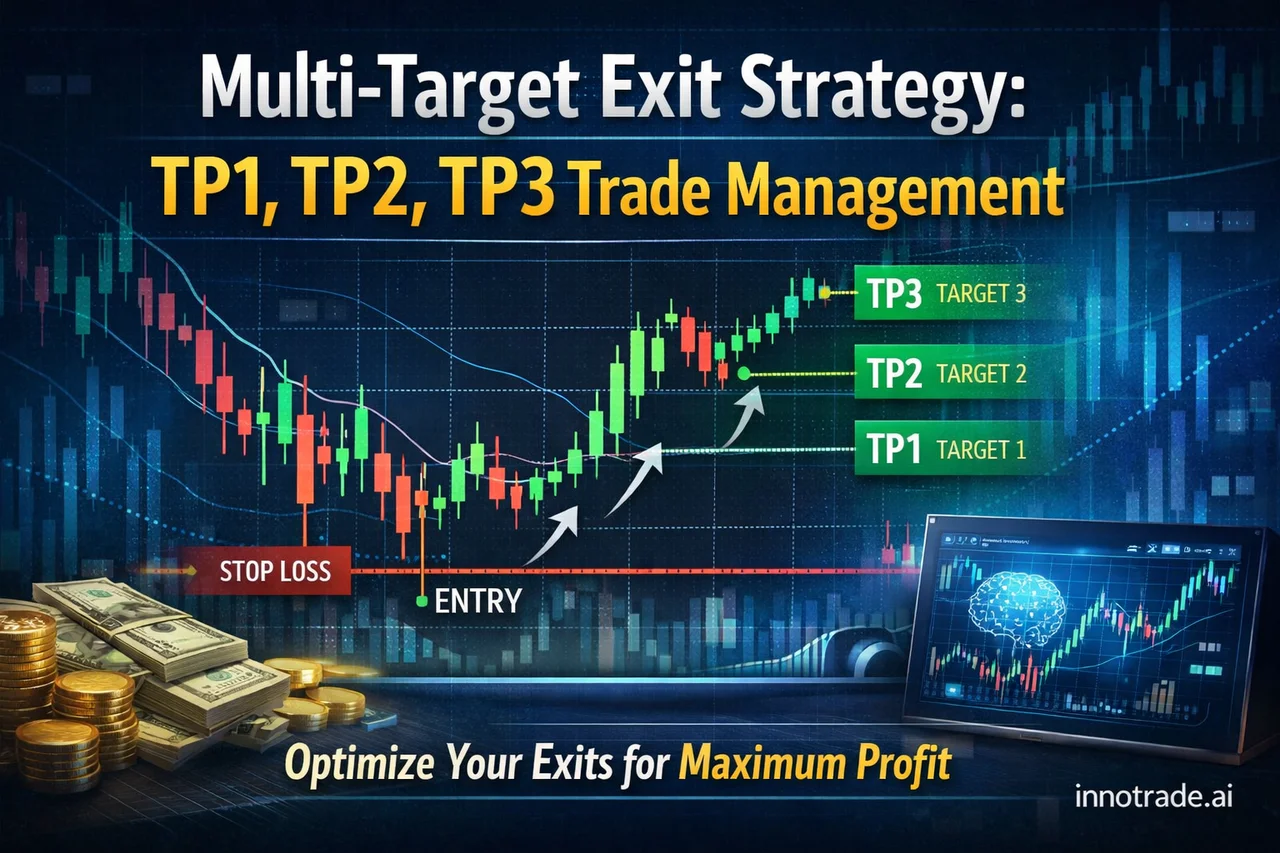
The single most common mistake among retail traders isn't a bad entry. It's a bad exit. Closing a position the moment it moves a few pips in your favour robs you of the trade's full potential. Holding indefinitely in the hope of a massive winner wipes out gains when the market reverses. What sits between those two extremes is a structured, tiered exit plan — and that's exactly what the TP1, TP2, and TP3 framework is designed to solve.
This guide breaks down how to build a multi-target exit strategy across scalping, day trading, and swing trading using AI-generated analysis that provides specific entry points, three take-profit levels, and a defined stop-loss for every setup. The goal isn't just to understand the mechanics — it's to implement them with consistency, adapt them to your preferred timeframe, and use real performance context to reinforce why the structure works.
Understanding the Three-Target Framework Before You Size Your Position
Every AI signal on innotrade.ai comes with a defined entry zone, a stop-loss anchored to market structure, and three sequenced take-profit levels. The math matters before anything else.
When planning a trade with three exits, you are not dividing your position into three equal parts by default. You are making a deliberate decision about where your risk-reward payoff sits at each stage. A practical starting allocation many day traders use is:
- TP1 — 50% of the position: The high-probability, near-term target. Closing half here locks in profit and psychologically frees you to hold the remainder without emotional pressure.
- TP2 — 30% of the position: The mid-range target, typically aligned with the next significant structure level or swing high/low. This is where the trade's edge proves itself beyond the initial reaction.
- TP3 — 20% of the position: The full-extension target. Lower hit frequency, but the risk-reward at this level often justifies the runner even if it closes at breakeven via a trailed stop.
This tiered allocation directly addresses the win-rate decay that naturally occurs as price reaches farther targets. TP1 will always carry the highest hit rate across any instrument or strategy type — that's a mathematical certainty of how markets move. TP2 hits less frequently. TP3 less still. Weighting your exits accordingly means your expectancy curve stays positive even when extended targets aren't reached.
Across all tracked trades on the platform, the all-time win rate sits at 54.1% with an average risk-reward ratio of 1.99 — a positive-expectancy baseline that the tiered exit model is specifically designed to support and extend.
Scalping: Retracement Entry and TP1 as the Primary Target
For scalpers, TP1 is not just the first exit — it is often the only intended exit. The scalping playbook centres on capturing a fast, defined move with minimal exposure time. But that doesn't mean TP2 and TP3 are irrelevant — they inform the trade's validity.
When a scalp setup fires, the first thing to assess is whether TP1 sits at a clean, unobstructed level — free of nearby resistance (in longs) or support (in shorts). If the AI signal places TP1 directly into a prior swing high or session open level, the probability of a clean hit drops and the setup loses quality regardless of the entry trigger.
Retracement entry timing is critical in scalping. A signal that has already moved sharply in the intended direction before you enter is a degraded signal — you are buying into momentum rather than positioning before it. The ideal scalp entry is on the first or second pullback after the AI confirmation fires, entering as price returns to the entry zone rather than chasing the move. Tools like ScalpHunter offer real-time confidence-rated signals (from 1/5 to 5/5) that help identify whether an active opportunity still has clean entry conditions rather than a depleted one.
On a strong scalping day, TP1 confirmation typically comes within minutes to a couple of hours. Monday, July 6 stood out as the strongest session of the recent tracking period based on expected value — the kind of environment where scalp setups resolved quickly and cleanly across multiple instruments.
Day Trading: Stop Hunt Awareness and the TP1-to-TP2 Trail
Day traders operate in a more complex environment than scalpers. They are exposed to session transitions, liquidity sweeps, and institutional stop hunts — all of which can shake a position out before it reaches its intended target.
One of the most actionable uses of AI entry signals in day trading is treating the defined stop-loss level not just as an exit, but as a structure reference. When price dips briefly below the entry zone before reversing — a classic stop-hunt pattern — the AI-generated entry level tells you exactly how far that manipulation can extend before the setup is genuinely invalidated. If the stop-loss is set structurally below a swing low, a wick that touches but doesn't close below it is still a valid setup. Panic-exiting on that wick is exactly what the stop hunt is designed to induce.
Once TP1 is hit on a day trade, the move to trail the stop-loss to breakeven is standard practice — but breakeven isn't always the smartest trail. A more refined approach is trailing the stop to just below the last significant structure point that formed after the entry, rather than mechanically to the entry price itself. This gives the TP2 runner room to breathe through minor consolidations without being stopped out by normal intraday noise.
For the TP1-to-TP2 leg specifically, the key question is whether price is making higher lows (in longs) or lower highs (in shorts) after TP1. Continuation structure justifies holding the TP2 portion. A failure to make a new high or low after TP1 is an early signal to tighten the trail rather than wait for a full reversal to erase gains.
Recent data reinforces the case for holding to TP2 in the right conditions. Over the past week, the platform recorded a weekly average win rate of approximately 68% across all tracked sessions, with individual session RR figures ranging from 1.76 to 2.33 — the higher end of that range occurring in sessions where setups had room to develop beyond initial targets.
Swing Trading: Stop-Loss Below Structure and the Case for TP3
Swing traders play an entirely different game. Where a scalper measures time in minutes and a day trader in hours, a swing trade might run for days. The parameters around stop-loss placement and target selection reflect that extended horizon.
For AI-generated swing signals, stop-loss placement is the most critical decision — and it must be structural, not arbitrary. A stop set at a round number or a fixed pip distance unrelated to the chart structure is essentially a random exit. The AI signal's stop-loss is anchored to a meaningful structural level: below a swing low for longs, above a swing high for shorts. This is the level at which the underlying thesis for the trade is genuinely wrong, not just temporarily under pressure.
The TP3 target in swing trades carries more significance than in shorter-term strategies. In scalping, TP3 is rarely the primary focus. In swing trading, it represents the full projected move — often a major structural level, previous high/low, or weekly pivot — and can generate risk-reward multiples that justify the overnight and multi-day exposure. The reduced position size allocated to the TP3 runner means a stop-out at breakeven on that portion costs nothing while keeping you in a trade that could deliver 3:1 or beyond.
Two of the top symbols by activity over the past two weeks illustrate this dynamic well. Gold (XAUUSD) generated the highest volume of tracked setups in that period, with consistent TP1 follow-through and meaningful TP2 progression — making it a natural candidate for swing traders looking to structure full three-target plans on a liquid, technically-driven instrument. XRP (XRPUSD) showed particularly strong TP3 progression relative to its total setups, suggesting that when its setups align, they tend to carry momentum well beyond the initial targets.
Scaling Between Strategies: Using Multi-Target Exits to Bridge Timeframes
One of the more advanced applications of the three-target framework is using it to transition between strategy types within a single trade. This is sometimes called a scalp-to-swing approach — and it's more systematic than it sounds.
The mechanic works as follows: enter with scalping intent, targeting TP1 as a full exit. If TP1 is hit cleanly and market structure confirms continuation (higher lows holding, volume supporting the move, session still in its active window), rather than closing entirely, you re-enter or retain a smaller portion of the original position and target TP2 with day-trade intent. If TP2 is also hit with continuation structure intact, the final runner becomes a swing position with a trailed stop and TP3 as the target.
This is not about changing your mind mid-trade — it's about having pre-planned rules for each stage that allow the market's own behaviour to determine whether you extend your time horizon. The AI signal's three-level structure makes this systematic: each target defines a natural decision point for reassessment, rather than forcing you to invent exit logic on the fly.
For traders who want to track exactly how their individual implementations of this approach perform over time, the Trade Tracking dashboard provides a personal analytics layer — including win rates by strategy type, performance graphs, and breakdown by target level — so you can objectively measure whether extending from TP1 to TP2 has added value for your specific approach.
Risk-Reward Calculation: Making the Math Work Across All Three Targets
The final piece of the framework is keeping your risk-reward calculation honest across the full position. A common error is calculating RR as if the entire position exits at TP3 — which overstates the trade's expected payoff given that TP3 is hit less frequently than TP1 or TP2.
A more accurate approach is to weight the RR by your intended exit allocation:
- Calculate the RR from entry to TP1, multiply by your TP1 allocation percentage
- Calculate the RR from entry to TP2, multiply by your TP2 allocation percentage
- Calculate the RR from entry to TP3, multiply by your TP3 allocation percentage
- Sum those three weighted figures to get your blended expected RR
This blended RR is the true measure of the trade's risk-adjusted potential. When you compare it against the all-time average RR of 1.99 across the platform's tracked analyses, you have a concrete benchmark — setups where your blended RR falls well below that average deserve scrutiny before entry, while setups that exceed it significantly carry stronger expected value.
For traders newer to building these calculations from scratch, the Trading Academy covers foundational risk management concepts that underpin the math behind multi-target exit planning.
The Practical Edge: Why Structure Always Beats Intuition
Markets are designed to make emotional exits feel rational. The stop hunt before a genuine breakout feels like confirmation of a reversal. The TP1 hit feels like the perfect moment to bank everything. The TP3 runner feels like greed when it starts pulling back from TP2.
The three-target exit framework doesn't eliminate those feelings — it replaces the decision-making moment with a pre-set rule. When Thursday, July 9 produced one of the week's strongest EV scores alongside an average RR above 2.0, it wasn't because traders in that session made exceptional real-time decisions. It's because the underlying setups had well-defined structure and traders who followed through on their target plans captured more of the available move than those who exited on impulse.
That's the operational advantage of AI-generated signals with three defined targets: every trade starts with a complete exit plan, not just an entry idea. The full platform feature set is built around this principle — analysis that tells you not just where to enter, but where the three logical exits sit and what the risk-adjusted expectancy looks like before you place a single order.
Analytical software only. We do not handle funds, make investments, or provide financial advice. Trading involves substantial risk and past performance does not guarantee future results. Always conduct your own research and consider your risk tolerance before making trading decisions.