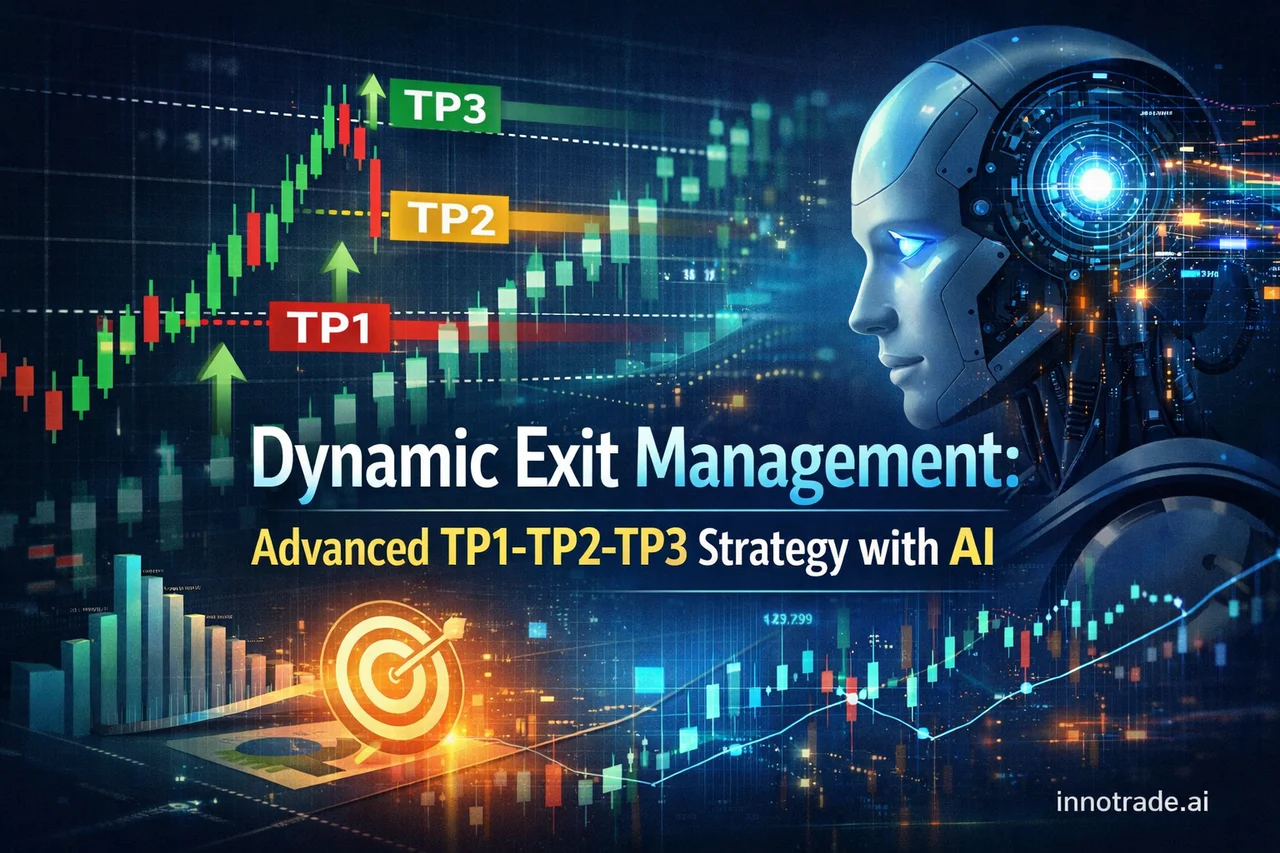
The difference between profitable and struggling traders often lies not in entry timing, but in exit management. While most traders focus exclusively on when to enter, the real edge comes from systematically extracting maximum value from winning positions through structured exit sequences. AI-powered analysis provides the perfect framework for this through its three-tier target system: TP1, TP2, and TP3 levels.
Understanding the Three-Target Psychology
The TP1-TP2-TP3 structure isn't arbitrary—it's designed around market psychology and probability decay. Each level serves a distinct purpose in the profit extraction process:
TP1 (First Target): Positioned at high-probability resistance or support zones, typically 1-2 risk units away. This level captures the initial momentum thrust and provides psychological comfort by banking early profits.
TP2 (Second Target): Located at intermediate technical levels, usually 2-3 risk units from entry. This target exploits continuation moves while accounting for potential pullbacks.
TP3 (Third Target): Set at major technical confluences, often 3-5 risk units away. This level captures extended trending moves but naturally has lower hit rates due to increased market uncertainty over larger price ranges.
Recent platform data illustrates this probability decay perfectly. Over the past week, the AI analysis system demonstrated how win rates naturally decrease across the target sequence, with TP1 levels showing the highest success rates, followed by TP2, then TP3. This reflects the mathematical reality of market movement—the further price must travel, the more opportunities exist for reversal.
Dynamic Position Scaling Strategies
The key to maximizing the three-target system lies in position scaling rather than all-or-nothing exits. Here's how different trading styles can optimize this approach:
Scalping Session Momentum Management
For scalping strategies (1-5 minute charts), the three-target system becomes a rapid-fire profit extraction tool. When the AI generates a scalping signal with high confidence, consider this scaling approach:
- 40% exit at TP1: Lock in quick profits during the initial momentum burst
- 35% exit at TP2: Capture the continuation move while maintaining significant exposure
- 25% exit at TP3: Let the final portion ride for maximum profit extraction
During high-volume sessions like London-New York overlap, this approach becomes particularly effective. The increased liquidity and volatility create cleaner price action that tends to follow through to multiple targets. When scalping during these periods, trailing your stop to breakeven after TP1 hit transforms the remaining position into a risk-free profit opportunity.
Day Trading Stop Loss Adjustment Protocol
Day trading setups (5-30 minute timeframes) benefit from a more conservative scaling approach with aggressive stop management. The strongest performance day this week demonstrated how proper exit sequencing can turn marginal setups into significant winners through systematic profit taking.
Implement this day trading protocol:
- 50% exit at TP1: Secure half the position immediately upon first target hit
- Move stop to breakeven: Eliminate downside risk on remaining position
- 30% exit at TP2: Take additional profits while maintaining trend exposure
- Trail stop on final 20%: Use a dynamic trailing stop (ATR-based or structural) to maximize final profits
This approach proved particularly effective during Wednesday's session, where strong follow-through to TP2 levels allowed traders to extract significant value while protecting against sudden reversals that can quickly erase day trading gains.
Swing Trading Confluence Setup Management
Swing trading positions (4-hour to daily charts) require the most patience but offer the highest profit potential through the complete TP1-TP2-TP3 sequence. The key lies in allowing enough time for the full price development while managing position size appropriately for longer holding periods.
Optimal swing trading scaling:
- 25% exit at TP1: Light profit-taking to reduce psychological pressure
- 25% exit at TP2: Maintain substantial exposure for trend continuation
- 50% hold for TP3: Maximum exposure to capture the full trending move
This patient approach aligns with the AI's ability to identify major technical confluences that often result in extended moves. Recent tracking shows that swing positions reaching TP3 levels delivered the strongest risk-reward ratios, justifying the patience required for full development.
Advanced Trailing Stop Techniques
Once TP1 hits, the entire risk profile changes. The position has proven its directional bias, and aggressive stop management becomes crucial for extracting maximum value from the remaining exposure.
Structure-Based Trailing
After TP1 execution, identify the most recent structural support (for longs) or resistance (for shorts) and trail your stop just beyond these levels. This approach respects price action while giving the trade room to breathe during normal pullbacks.
ATR Dynamic Trailing
For more volatile instruments, use a multiple of Average True Range (ATR) as your trailing distance. A common approach uses 1.5-2x ATR from the current price, adjusted as new highs (or lows) develop. This method adapts to changing market conditions automatically.
Time-Based Exit Considerations
Don't overlook time decay in your exit management. If a position reaches TP1 quickly but stalls before TP2, consider tightening stops or taking additional partial profits. Markets often lose momentum when targets take significantly longer than expected to develop.
AI Signal Validation and Momentum Detection
The AI analysis system excels at identifying momentum shifts that can dramatically impact exit timing. Pay special attention to these confirmation signals:
Volume Confirmation: When AI signals coincide with expanding volume, the probability of reaching multiple targets increases significantly. Scale out more conservatively to capture extended moves.
Multi-Timeframe Alignment: Signals showing confluence across multiple timeframes (5-minute setup aligning with 1-hour trend) typically produce stronger follow-through to TP2 and TP3 levels.
Session Timing: AI signals generated during high-impact news events or major session overlaps often show enhanced momentum that supports aggressive position holding through the complete target sequence.
Risk Management Within Target Sequences
While three-target systems maximize profit potential, they also require disciplined risk management. Never allow a winning position to turn into a loser due to poor exit execution.
The Breakeven Rule: Once TP1 hits, moving stops to breakeven is non-negotiable. This simple rule transforms partial profits into risk-free opportunity on the remaining position.
Correlation Considerations: When running multiple positions with three-target exits, monitor correlations carefully. Having five EUR/USD, GBP/USD, and EUR/GBP positions all approaching TP2 simultaneously represents concentrated risk that may require earlier exit management.
Account Size Scaling: Your position sizing should account for the fact that only a portion will reach final targets. Size positions based on the assumption that TP1 will hit (highest probability) rather than hoping for TP3 completion.
Technology Integration and Execution
Modern trading platforms make sophisticated exit management accessible through conditional orders and automated execution. Set up your platform to automatically execute the scaling sequence:
- Place all three target orders simultaneously upon entry
- Program automatic stop adjustment to breakeven after TP1 fills
- Use trailing stops with appropriate parameters for final position management
The AI analysis system provides specific price levels for all three targets, eliminating guesswork in target placement. This precision allows for confident automation of the exit sequence while maintaining the flexibility to adjust based on developing market conditions.
Measuring Exit Strategy Performance
Track your exit management effectiveness by monitoring these key metrics:
- Target Hit Rates: What percentage of your trades reach TP1, TP2, and TP3 respectively?
- Average Risk-Reward by Exit: Calculate separate RR ratios for each target level
- Profit Capture Efficiency: How much of potential profits are you actually banking through your scaling approach?
The platform's trade tracking system provides detailed analytics on these metrics, allowing continuous refinement of your exit management approach. Recent data shows that traders implementing systematic three-target exits significantly outperform those using simple binary exit strategies.
Professional traders understand that entries get you into trades, but exits determine your profitability. The AI-powered three-target system provides the framework for systematic profit extraction, but success depends on disciplined execution and continuous refinement based on performance data. Master these exit management principles, and watch your trading consistency improve dramatically across all timeframes and market conditions.
Analytical software only. We do not handle funds, make investments, or provide financial advice. Trading involves substantial risk and past performance does not guarantee future results. Always conduct your own research and consider your risk tolerance before making trading decisions.